Has the water in your shower or sink suddenly turned cold? Before deciding that the water heater must be replaced, determine exactly what is happening. A power interruption, recent heavy use, a problem limited to one faucet or a faulty component can produce similar symptoms.
Several useful checks can be completed without removing the water heater’s access panels, using a multimeter or touching any wiring.
The short answer:
- If every faucet produces only cold water, the electrical supply or water heater may be involved.
- If only one fixture is affected, its faucet, cartridge or mixing device may be the source.
- If the water starts hot but runs out quickly, recent demand, insufficient capacity or a component failure may be responsible.
- If the tank is leaking, the breaker trips again or you smell something burning, stop troubleshooting and request professional assistance.
1. Check Whether the Problem Affects One Fixture
Test the hot water at two or three fixtures, preferably in different rooms. Let each faucet run just long enough to clear the water that was already sitting inside the pipe.
Only one faucet or shower is affected
If a sink provides normal hot water but the shower does not, the water heater is probably still heating. A worn faucet cartridge, partially closed valve or anti-scald device may be restricting or mixing the hot water at that specific fixture.
A cold shower does not, by itself, prove that the hot water tank has failed.
Every fixture is affected
If the water remains cold throughout the property, the cause may involve the electrical supply, the water heater’s controls or one of its internal components. Continue with safe exterior observations before deciding which professional to call.
In a condominium, rental unit or multi-unit building, also determine whether the water heater serves only your unit or multiple occupants. A problem involving a shared system should be reported to the owner, property manager or condominium association.
2. Describe Exactly What the Water Is Doing
“No hot water” can describe several different situations. Distinguishing between them helps narrow the possibilities.
The water is completely cold
A power interruption, tripped breaker, activated safety control or failed internal component may be responsible. Heavy water use alone is less likely to explain water that remains completely cold for an extended period.
The water starts hot but becomes cold quickly
Several showers, a filled bathtub, laundry or other closely timed uses may have depleted the stored hot water. Demand that exceeds the tank’s capacity, very cold incoming water or a faulty component can also reduce the available supply.
In Laval, as elsewhere in Quebec, incoming water is naturally colder during winter. The water heater must use more energy to reach the same temperature, which can increase recovery time. This seasonal effect may expose an existing performance problem without necessarily indicating that the tank has failed.
The water remains lukewarm
Lukewarm water throughout the property may result from a temperature-control issue, mixing problem, heavy demand or water-heater fault. An unstable temperature limited to one shower is more likely to involve the shower valve or cartridge.
There is very little flow from the hot side
Low flow is not the same as a heating failure. If very little water comes out when the faucet is turned to hot, a valve, pipe, fitting or the faucet itself may be restricting the flow.
The water becomes unusually hot
Stop using the affected fixture to prevent scalding. Water that is significantly hotter than usual may indicate a temperature-control problem. Do not remove the water heater panels to adjust the thermostat yourself.
3. Perform Safe Exterior Checks
The following checks do not require dismantling the water heater.
Consider recent hot-water use
Determine whether several people showered, a bathtub was filled or hot-water appliances were recently used. Consult the manufacturer’s manual for the expected recovery time of your specific model.
There is no universal waiting period for every tank. Capacity, heating power, incoming water temperature and household demand all affect recovery time.
Check for a power outage
See whether other circuits or electrical appliances are affected. You can also consult Hydro-Québec’s ongoing power-outage map to determine whether an interruption has been reported in your area.
After power is restored, a storage water heater cannot immediately provide a full tank of hot water.
Observe the breaker
If the electrical panel is dry, accessible and shows no signs of overheating, locate the breaker labelled for the water heater. A breaker positioned between its normal settings may have tripped.
Follow only the instructions supplied with the panel or appliance when resetting it. If the breaker trips again, do not keep resetting it. Repeated tripping can indicate a fault that requires professional assessment.
Never touch a wet electrical panel or attempt to hold a breaker in position.
Inspect the area around the tank
Without removing any panels, look for:
- a puddle or dampness on the floor;
- drops around the upper connections;
- corrosion on the tank or pipes;
- water inside the drain pan;
- discharge from the relief valve;
- a smell of burning plastic or wiring;
- unusual buzzing near an electrical access panel.
A puddle does not automatically mean that the tank itself is perforated. Water can originate from a fitting, valve, relief valve or nearby pipe. The source must be confirmed.
Photograph the rating plate
Take a clear photograph showing the model, serial number, capacity and electrical specifications. Serial-number formats vary by manufacturer, so do not assume that the first digits always represent the month or year of manufacture.
4. Do Not Mistake an Observation for a Diagnosis
An electric water heater can stop providing hot water for several reasons. An English-language residential electric water-heater troubleshooting guide from Giant, a Quebec manufacturer, lists possibilities such as an interrupted power supply, tripped breaker, activated high-limit control, defective thermostat, failed heating element, high demand and mineral deposits.
This range of possible causes is why one symptom cannot reliably identify a specific defective part.
For example, a hot-water supply that runs out quickly does not automatically prove that the lower heating element has failed. Tank capacity, household habits, incoming water temperature, a hot-water leak or a mixing problem can produce a similar result.
A reliable diagnosis may require electrical measurements, plumbing checks and reference to the documentation for the specific model.
5. Know Where Your Checks Should Stop
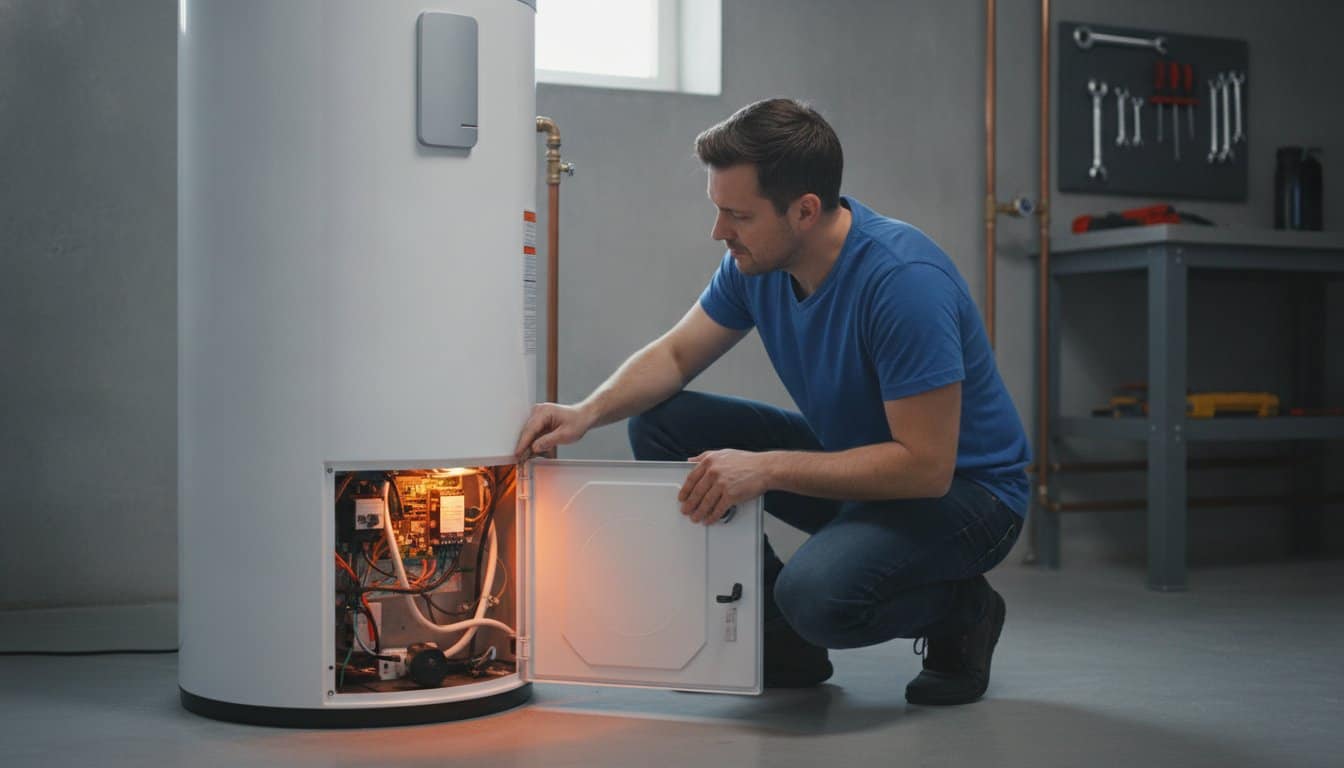
Do not remove an access panel to press a reset button, adjust a thermostat or test a heating element. Even after switching off a breaker, properly confirming the absence of voltage requires appropriate knowledge and testing equipment.
You should also avoid:
- repeatedly resetting a breaker that continues to trip;
- testing heating elements with a multimeter without the proper qualifications;
- touching wires, terminals or thermostats;
- increasing the temperature to compensate for poor performance;
- blocking or manipulating the temperature and pressure relief valve;
- draining the tank without following its manual;
- restoring power to a tank that may not be completely full.
Electrical work is regulated in Quebec. The Régie du bâtiment du Québec’s guidance on work homeowners may perform states that work involving an electrical installation must be performed by a contractor holding the appropriate licence.
6. Recognize an Urgent Situation
A cold shower is inconvenient, but it is not necessarily an emergency. The priority changes when there is a risk involving water, electricity or scalding.
Request prompt assistance if:
- a puddle around the tank is spreading;
- water is approaching an electrical panel, outlet or appliance;
- the tank or one of its connections is leaking continuously;
- the breaker trips again;
- you notice a burning smell, smoke or unusual heat;
- the water becomes dangerously hot;
- the tank appears distorted or swollen;
- steam or unusual discharge comes from the relief valve.
If you can do so without stepping into water or touching wet equipment, close the water heater’s supply valve. Turn off its electrical supply only when the electrical panel is accessible and completely dry.
If you see smoke or signs of a fire, leave the area and contact emergency services.
7. Call the Appropriate Professional
The nature of the symptom helps determine which trade may be required.
A plumber
A plumber is generally the appropriate professional when the problem involves:
- a leaking tank, valve or fitting;
- the relief valve or its discharge pipe;
- low hot-water flow;
- a plumbing or mixing problem;
- assessment or replacement of the tank;
- installation and plumbing connections for a new water heater.
A licensed electrical contractor
A properly qualified electrical contractor may be required when the problem involves:
- the breaker or electrical panel;
- the supply wiring;
- missing or abnormal voltage;
- electrical connections or components;
- circuit modifications for a different appliance.
When the cause is unclear, begin by describing the symptoms you observed. Restoring hot water may require coordination between the plumbing and electrical trades rather than automatically replacing the tank.
8. Decide Between Repair and Replacement Without an Arbitrary Rule
The age of the water heater is useful information, but it is not a diagnosis. A relatively recent unit may have a repairable problem, while an older tank may still be operating without leaking.
The decision should consider several factors:
- the confirmed source of the problem;
- the condition of the tank and its connections;
- visible corrosion;
- previous repairs;
- the availability of replacement parts;
- the relative cost of the work;
- the manufacturer’s recommendations;
- the conditions of the property’s insurance policy.
Infoinsurance’s English-language water-damage guidance notes that some insurers may require water-heater replacement after 10 to 15 years, but this requirement is not identical in every policy. Check your own insurance contract instead of applying a universal “10-year rule.”
If the tank itself is perforated, replacement is generally necessary. The RBQ publishes technical requirements for replacing a storage water heater in an existing building involving the safety valve and its discharge piping. This specific RBQ technical directive is available in French only.
To review the available options according to the condition of the unit, visit the page about electric water-heater installation, replacement and repair.
9. Protect the Water Temperature After Service Is Restored
Significantly lowering the water heater’s temperature is not a safe solution to a performance or scalding problem. The Government of Quebec’s English hot-water guidance identifies 60°C, or 140°F, as the normal temperature for a conventional water heater.
This temperature helps limit the growth of Legionella, but the water can cause burns. The Public Health Agency of Canada recommends storing water at 60°C while using automatic mixing or anti-scald valves to limit the temperature delivered at faucets, showers and bathtubs.
The storage temperature and the temperature delivered at fixtures therefore serve two different purposes.
Information to Prepare Before Calling
A few observations can make the diagnostic process more efficient:
- Does the problem affect every faucet?
- Is the water cold, lukewarm or simply running out sooner?
- When did the problem begin?
- Was there a recent power outage or unusually high demand?
- Did the breaker trip?
- Is there water on the floor or visible corrosion?
- Is the problem constant or intermittent?
- What are the tank’s model, serial number and capacity?
- Does the unit have its own water heater?
- Have you noticed an unusual smell, sound or temperature?
These details are more useful than attempting to determine which internal component has failed.
Frequently Asked Questions
How long should I wait to see whether the water is heating again?
The recovery time depends on the tank’s capacity, heating power, the amount of water used and the incoming water temperature. Consult the manufacturer’s stated recovery time. A slight temperature change after only a few minutes is not enough to assess an entire tank.
Can I press the red reset button myself?
The reset button is generally located behind an access panel near electrical components. Because reaching it requires removing a protective cover and confirming that the equipment is de-energized, it is not one of the safe exterior checks recommended here. A tripped thermal control should also be treated as a symptom requiring diagnosis, particularly if it happens repeatedly.
Why is the shower cold when the sink has hot water?
If other faucets provide normal hot water, the water heater is still producing heat. The shower cartridge, anti-scald device, a valve or a flow restriction may be responsible.
Can sediment cause a loss of hot water?
Mineral deposits can reduce heat-transfer efficiency and contribute to component wear. They are not the only possible cause. Maintenance methods and schedules should follow the manufacturer’s directions; attempting to drain an older tank without proper preparation can also create problems.
Must a water heater automatically be replaced after 10 years?
No. There is no single regulatory deadline that applies to every water heater and insurance policy. Check the actual age, tank condition, manufacturer’s recommendations and the conditions of your insurance contract. Some insurers may impose their own age limit.
Is having no hot water an emergency?
Not necessarily. A loss of hot water without leakage or electrical danger can often wait for a regular appointment. An active leak, water near electricity, a breaker that trips again, a burning smell or dangerously hot water requires a faster response.
The Next Step Depends on the Symptom
Having no hot water does not automatically mean that the tank must be replaced. Begin by determining whether the problem affects one fixture or the entire property. Inspect the exterior of the water heater and note what happened before the problem began.
Do not remove any panels or attempt to test electrical components. If the tank is leaking, the breaker trips again or the problem continues after the exterior checks, have the cause confirmed before authorizing a repair or replacement.