
Private sewer line · Plumbing emergencies 24/7
Sewer Line Excavation and Repair
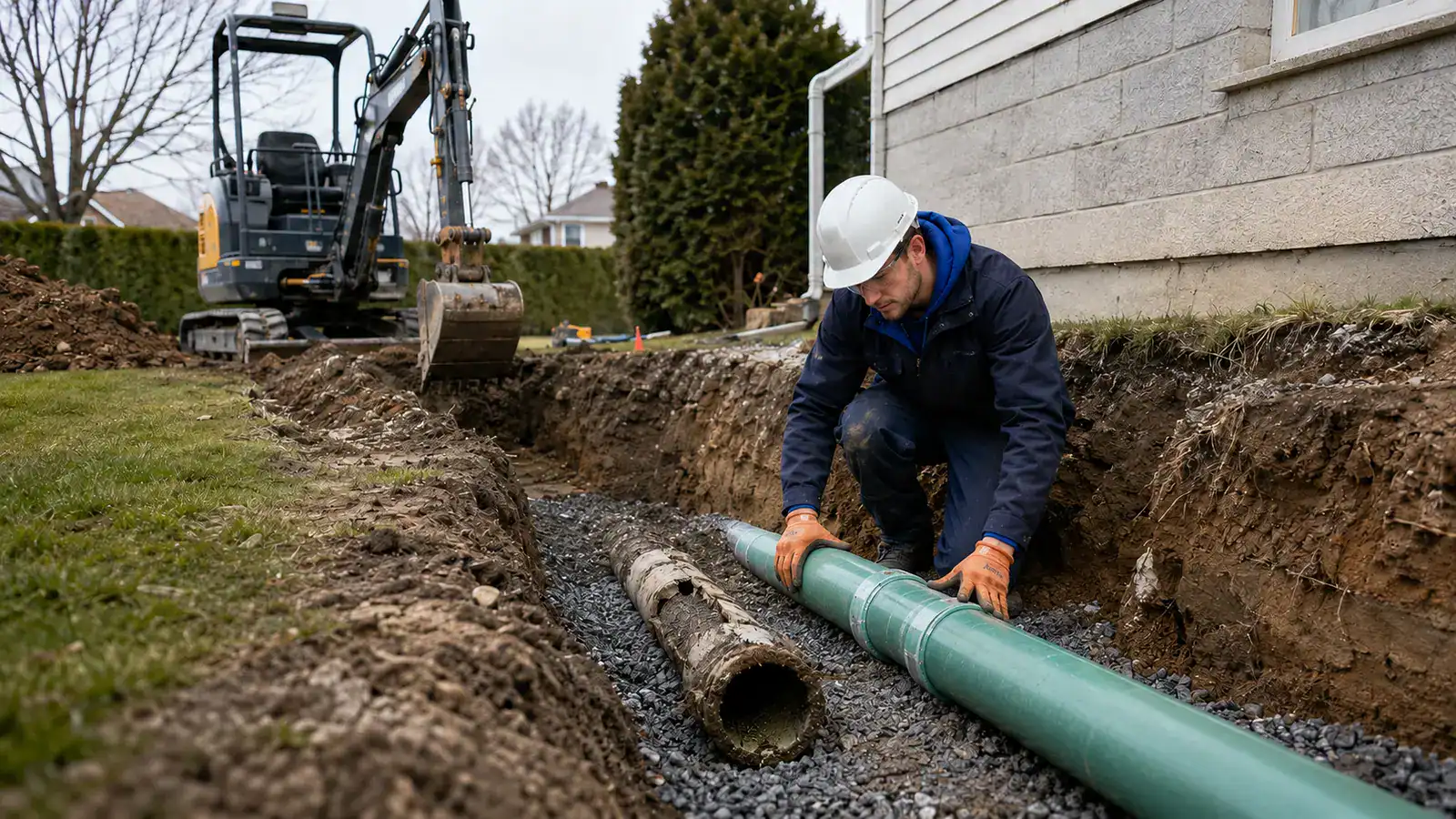
Sewer line repair becomes necessary when a camera inspection or site evidence confirms a crack, offset joint, sag, collapse or other structural defect. We first separate a removable blockage from damaged pipe, then define a targeted repair or sewer line replacement based on the route, depth, property access and municipal requirements.
- 24/7 plumbing emergencies
- RBQ 5688-9025-01
- CMMTQ verifiable member
The backup keeps returningThe problem comes back soon after cleaning or affects several fixtures.
A defect appears on cameraA crack, displaced joint, sag, roots, crushing or collapse is documented.
A sewer pipe may be brokenPersistent odour, saturated soil or settlement appears along the suspected route.
Excavate only when the diagnosis supports it
A clog, a localized defect or a sewer line that needs replacement?
Slow drains alone do not prove that sewer excavation is required. The number of fixtures affected, how quickly the problem returns, the obstruction’s location and the condition seen inside the pipe determine the appropriate level of work.
Drain cleaning may be enough
Grease, paper, buildup or a localized obstruction can block a pipe that remains structurally sound. Cleaning can restore flow without opening the yard.
Decision: clear the passage and confirm that normal flow remains stable.A camera documents the sewer line
A drain camera can identify the distance to an offset joint, crack, root intrusion or deformed section. This evidence helps prevent an excavation based only on assumptions.
Decision: connect the recorded defect to its physical location before choosing access.Repair or replace the failed section
A broken, collapsed, crushed or poorly aligned sewer pipe cannot be corrected by repeated cleaning. The affected section must be exposed and rebuilt to provide a reliable route.
Decision: compare a localized repair with the condition and remaining life of the full lateral.A scope built around the confirmed defect
Sewer line repair and replacement of failed sections.
The private sewer lateral carries wastewater from the building toward the municipal system. Repairing it involves more than digging a trench: the defect, slope, bedding, connections, inspections and site closure must be treated as one coordinated scope.
Locating the sewer defect
Symptoms, interior access, camera findings, the probable route and estimated depth are compared to narrow down the section that must be opened.
Localized sewer line repair
A limited section may be replaced when the damage is isolated and the adjoining pipe still has acceptable condition, alignment and support.
Sewer line replacement
A longer section may be justified when multiple defects, severe deformation, poor slope or deteriorated material makes a small patch unlikely to provide durable value.
Targeted residential excavation
Access is planned around foundations, steps, driveways, mature landscaping, buried utilities and the working space required for excavation equipment.
Bedding, slope and transitions
The new pipe section needs prepared support, a controlled route and compatible connections. These details help reduce movement, retained wastewater and leakage at joints.
Verification before backfilling
The pipe, connections, support and flow are checked before the trench is closed and before any applicable municipal inspection.
From diagnosis to backfill
Sewer excavation planned around the building, utilities and site.
A properly sequenced sewer line repair protects occupants, limits unnecessary openings and allows the new section to be inspected before it disappears below grade.
The defect must be located, the private and public portions distinguished, the required permissions checked and buried infrastructure identified before excavation begins.
- 01
Assess the urgency
We review active backups, affected fixtures, visible damage, odours, prior cleaning history and any available camera report.
- 02
Confirm the defect and its location
Accessible inspection points, camera evidence and route tracing help connect the defect inside the pipe to a position on the property.
- 03
Check permits, responsibility and locates
The municipality, property line, inspection steps and underground locate requirements are verified before an opening is scheduled.
- 04
Excavate and prepare the bedding
The failed section is exposed in a controlled manner. Unsuitable material is removed and the support for the new sewer pipe is prepared for site conditions.
- 05
Repair, connect and verify
The replacement section is installed with suitable transitions; support, alignment and flow are checked before staged backfilling.
Two scopes that address different risks
Localized sewer repair or a longer sewer line replacement?
The smaller option is valuable only when it leaves sufficiently sound pipe in place. A responsible recommendation weighs the present defect against the rest of the lateral, its material, slope, joints, history and accessibility.
Replace only the failed section
This approach may fit when camera evidence shows a single break, the neighbouring sections appear stable and a precise opening can be made without compromising slope.
- Excavation concentrated around a documented defect
- Compatible transitions to the retained sewer pipe
- Condition of the remaining lateral considered before approval
Rebuild the section when defects are widespread
A broader replacement can make more sense when several joints are displaced or the pipe has significant sagging, deformation, poor support or failures spread along its route.
- Route, depth and connection points defined in the estimate
- Prepared bedding across the specified replacement length
- Surface restoration clearly included or excluded
Residential and commercial service
Sewer line repair in Laval, the North Shore and Montréal.
Service is available across our listed areas in Laval, the main North Shore communities and selected Montréal boroughs. Before confirming the scope, we review the property address, building type, urgency, private lateral, site access and local procedure.
In Chomedey, Sainte-Rose, Vimont, Fabreville or Duvernay, a sewer route may cross a driveway, front steps or established landscaping. Across the North Shore—including Terrebonne, Repentigny, Mascouche, Blainville, Saint-Eustache, Boisbriand, Sainte-Thérèse and Mirabel—the applicable municipality must be checked. In Montréal, requirements also vary by borough and by any use of public property.
View all service areas →Start with the permit route that applies to the address and work.
Ville de Laval’s English permit finder helps property owners identify the municipal process for a project. Excavation near a private sewer lateral can involve permits, inspections or conditions tied to the exact location and the boundary with public infrastructure, so the applicable file should be confirmed before the work date is set.
Use Laval’s official permit finder ↗Review Québec plumbing information from the RBQ ↗
Permits and underground locates come before the ground is opened.
Ville de Montréal directs owners to the relevant borough procedure for work on water and sewer service connections, and temporary occupancy of public property may also be required for equipment or materials. Across Québec, Info-Excavation provides a free locate-request process for underground infrastructure owned by its participating members.
Check Montréal’s sewer-connection permit procedure ↗Request an underground infrastructure locate ↗
Compare estimates with equivalent scopes
What affects the cost of sewer line repair.
A meaningful price depends on the defect and the site—not a generic cost per foot. The estimate should identify the repair section, access, permissions, materials, backfill and which surfaces will or will not be restored.
Diagnosis and location
Usable camera footage, depth and defect tracing reduce uncertainty about where the excavation should begin.
Length and depth
A short repair near the foundation and replacement to the property line involve very different excavation scopes.
Access and obstacles
Driveways, concrete, pavers, steps, trees, fences and narrow access affect both method and equipment.
Soil and disposal
Rock, saturated soil, unstable fill and excavated material that must be hauled away can change the schedule.
Permits and inspections
Municipal requirements, public-side work and any street occupancy should be identified separately when applicable.
Site restoration
Backfill, compaction, asphalt, concrete, pavers, sod and landscaping should be explicitly included or excluded.
Verifiable trust
Underground work assigned to an identifiable business.
Read reviews published on Google. The rating and review count update automatically in the modules below.
Frequently asked questions
Make the right decision before sewer excavation.
These answers explain the major planning decisions. The final diagnosis depends on the accessible line, site conditions and rules that apply to the property.
PLUMBING EMERGENCY 24/7450-241-0488What signs can point to a broken sewer line?
Backups that return after cleaning, several affected fixtures, persistent sewer odours, unusually wet or sinking soil and a camera-confirmed defect are meaningful signs. No single symptom replaces locating and documenting the problem.
Should a camera inspection always happen before excavation?
When the line is accessible and the camera can travel through it, inspection is one of the best ways to confirm the type and distance of a defect. A completely collapsed pipe may stop the camera; other site evidence is then needed to target the opening.
When does a targeted sewer line repair make sense?
It may be appropriate when one break is clearly located and the remaining pipe has acceptable material, slope, joints and condition. The immediate saving should be weighed against the risk of reopening the site for another failing section.
When should a longer sewer line replacement be considered?
Multiple cracks, displaced joints, deformation, significant sags, deteriorated material or poor support can make a longer replacement more dependable than a series of small repairs.
Can a sewer line be repaired without excavation?
Specialized trenchless methods exist, but they do not fit every pipe, diameter, defect or property. This page describes open excavation; no trenchless method should be promised until the configuration and actual service availability have been verified.
What can damage a sewer lateral?
Soil movement, inadequate bedding, offset joints, corrosion in certain materials, roots, crushing, poor slope or the pipe reaching the end of its useful life can all contribute.
Who is responsible for the pipe between the building and the street?
Responsibility depends on the municipality and the exact location of the defect relative to the property line and public network. The private section, municipal section and procedure for the address should be confirmed before work begins.
Is a permit required for sewer line repair?
It may be required depending on the city, type of connection, excavation location and any work near public property. Laval, North Shore municipalities and Montréal boroughs can use different procedures, so the requirement must be checked before scheduling.
Why is an Info-Excavation locate request important?
A locate request identifies underground infrastructure owned by participating Info-Excavation members. The organization notes that not every network owner is a member, so any other necessary network information must also be obtained.
How much does sewer line repair cost?
Cost is driven by diagnosis, depth, replacement length, soil, obstacles, machinery access, permits, excavated-material disposal and restoration. A dependable estimate requires a defined scope rather than a generic per-foot number.
How long does the work take?
An accessible localized repair can take less time than a longer replacement beneath several surfaces. Permits, locates, inspections, soil, weather and depth can affect the timeline as much as the plumbing itself.
Can sewer excavation be completed in winter?
An emergency may require work despite the season. Frozen ground, snow, material handling and municipal conditions can change the method, access, restoration and schedule.
Will asphalt, pavers or sod be restored?
That depends on the contract. The estimate should identify the surfaces to be opened and specify the included backfill, compaction and finish. Plumbing, paving, interlocking stone and landscaping may be separate scopes.
Is a broken sewer pipe covered by insurance?
Coverage varies by policy, cause and resulting damage. Document the condition, keep inspection reports and contact the insurer promptly; only the insurance contract can confirm coverage.
When should I call for emergency service?
Call promptly if wastewater is backing up, several fixtures are affected, the basement is at risk or normal water use makes the situation worse. Stop using the affected fixtures until the problem is assessed.
Suspect a damaged sewer line?
Locate the defect before opening the entire property.
To prepare for sewer line repair, describe the symptoms, affected fixtures, previous work and any camera report you have. This helps establish urgency and the most useful next step.
Call now