
Main water service · 24/7 emergency response
Water service line replacement
Water service line replacement may be required after an underground leak, a building-wide pressure drop, the discovery of an aging pipe or a lead service line. We assess the private section, access conditions and local requirements before work begins.
- 24/7 for plumbing emergencies
- RBQ 5688-9025-01
- CMMTQ verifiable member
Leak or saturated groundWater appears near the foundation, indoor valve or suspected pipe route.
Unusually low pressureSeveral fixtures lose flow rather than one isolated faucet.
Aging service pipeThe line is lead, galvanized, corroded or identified in a municipal notice.
Identify the right system before digging
Water service, indoor plumbing or sewer?
Low pressure or water in a basement does not prove that the underground supply line must be replaced. The affected fixtures, water location, meter, shut-off valves and system behaviour help separate a service-line issue from indoor plumbing or drainage.
The water service line may be involved
Persistent running-water noise, moisture near the point of entry, saturated soil or reduced pressure throughout the building can indicate a leak on the private water service.
Priority: limit damage and determine who must shut off the supply.The restriction may be inside the building
A faucet, cartridge, aerator, local valve or indoor pipe can reduce flow at a single fixture. Excavating the yard would not correct that kind of localized problem.
Priority: compare hot and cold flow at several fixtures.The drainage system requires a different service
Water rising through a toilet, shower or floor drain concerns the sewer or drainage system. A drain camera is not used to inspect a pressurized drinking-water service line.
Priority: stop using fixtures that make the backup worse.From diagnosis to restored water service
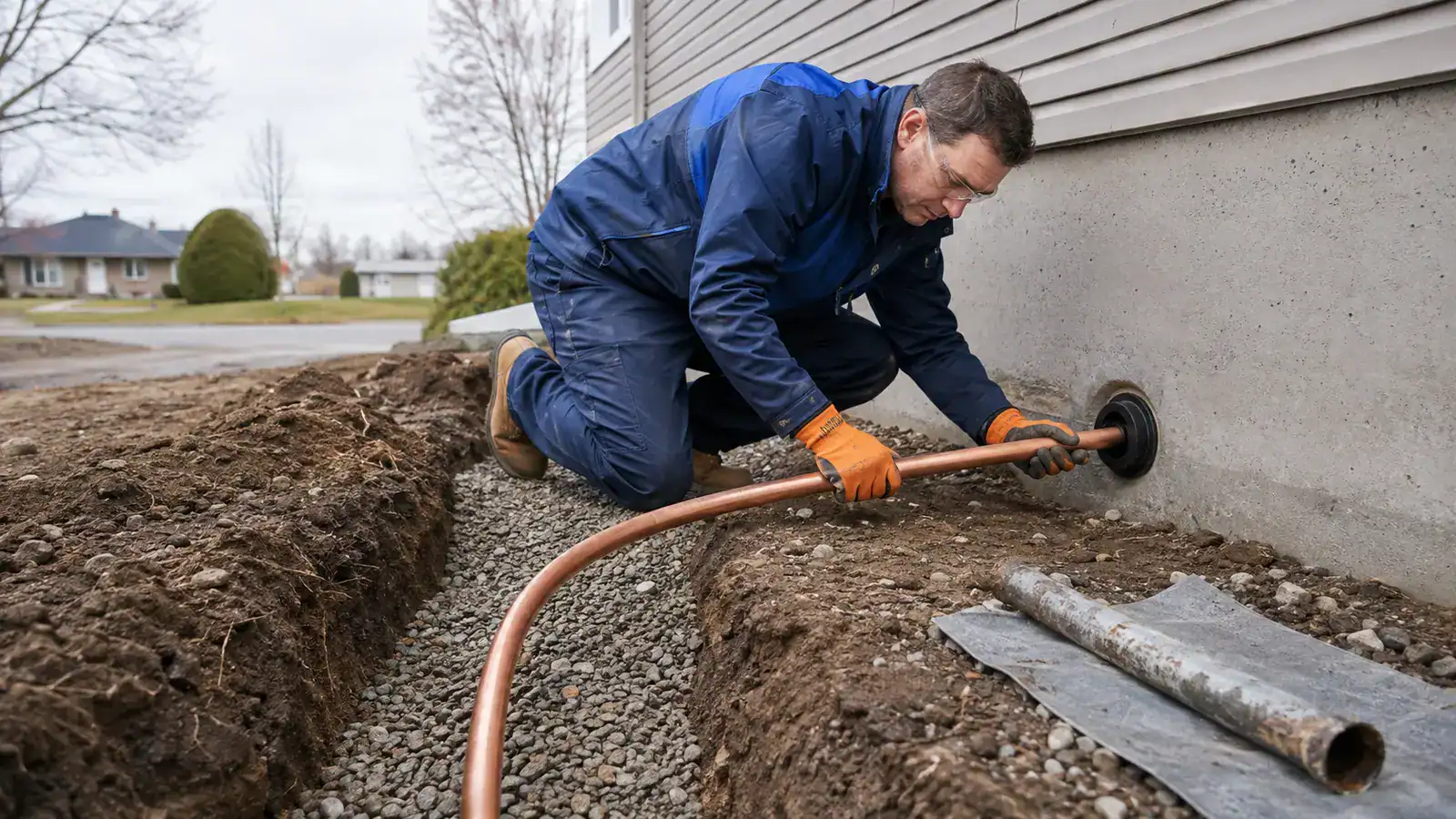
Water service line replacement planned around the property.
The main supply line connects the municipal water system to the building’s plumbing. A water service line replacement must account for the public-private boundary, existing material, route, foundation entry and surfaces that may be affected.
Underground water-line diagnosis
Review of the symptoms, entry point, accessible valves, pressure and suspected route so that excavation is not based on a single assumption.
Targeted water service repair
When the location, material and remaining condition allow it, an accessible section may be repaired. The risk of another failure elsewhere on the line is considered.
Private service-line replacement
Removal or appropriate abandonment of the old line and installation of a new supply pipe between the confirmed responsibility limit and the planned indoor connection.
Lead water service replacement
Planning for replacement of a private lead section or non-compliant material, with the applicable municipal process confirmed before excavation begins.
Open excavation or pipe pulling
An open trench provides direct access; a limited-access pull may sometimes reduce the disturbed surface. The method depends on the route, soil, obstructions, underground utilities, foundation and actual feasibility.
Connection, testing and return to service
The foundation penetration, indoor shut-off, fittings, watertightness and operation are checked before the water is restored and the agreed flushing is completed.
Plan before opening the ground
From the property line to the indoor shut-off valve.
A properly planned water service line replacement distinguishes municipal and private sections, confirms permits and locates underground infrastructure before access and materials are selected.
Depending on the municipality, service-box operation, inspection, permitting and coordination with the public water system follow a defined procedure. These items are confirmed before work starts.
- 01
Qualify the problem and building
Pressure symptoms, visible water, approximate construction period, known pipe material, municipal notices, route length and prior repairs are documented.
- 02
Confirm responsibilities and approvals
The property line, private portion, municipal work, permit and inspection requirements are verified for the specific address.
- 03
Locate utilities and select access
Gas, electricity, telecommunications and other infrastructure must be identified. Steps, pavers, trees, parking and finished spaces influence the route.
- 04
Install the new service pipe
Material, diameter, depth and fittings are chosen for the building, applicable requirements and expected water demand.
- 05
Connect, test and document
The foundation entry and indoor distribution are connected, then watertightness, pressure and return to service are checked before access points are closed.
Two methods, one site-based decision
Open trench or limited-access pipe pull?
For water service line replacement, pipe pulling is not automatically possible and a full-length trench is not always required. The right method provides a compliant, testable connection suited to the real route.
Direct access to the service-line route
A trench exposes the soil, old line, obstructions and new installation along the accessible route. It may be needed when the route must change or pulling is not feasible.
- Direct access to correct bedding and pipe passage
- Suitable for route changes and known obstacles
- Surface-restoration scope defined in the estimate
Reduce openings when site conditions allow it
A new line can sometimes be pulled along the old service route using access points at the connections. The technique depends on a workable path and adequate room at both ends.
- May reduce the amount of ground opened
- Feasibility checked before the method is promised
- Does not eliminate permits, locating or inspection
Residential and commercial service
Water service lines in Laval, the North Shore and Montréal.
Water service line replacement is available throughout the covered areas of Laval, the principal North Shore cities and several Montréal boroughs. The address, urgency, building, responsibility limit, excavation access and municipal process are confirmed before the scope is set.
In Chomedey, Sainte-Rose, Vimont or Fabreville, a line may pass under a driveway, pavers, front steps or mature landscaping. Montréal duplexes, triplexes and older buildings often require careful coordination between public and private portions. In Terrebonne, Repentigny, Mascouche, Blainville or Saint-Eustache, approvals are verified with the municipality responsible for the address.
View all service areas →Permit and water-service requirements are checked before excavation.
The City of Laval’s English permit finder and water management pages are the current municipal starting points for a service-connection project. The applicable by-law, supporting documents, inspections and approvals must still be confirmed for the exact address. Before digging, Info-Excavation provides free locating for its members’ underground networks and asks for three business days for planned work.
Open Laval’s permit finder ↗View Laval’s Water Management Service ↗
Prepare an underground locate request ↗
The public and private sections have different responsibilities.
Montréal distinguishes the public portion, from the water main to the property line, from the private portion ending at the indoor shut-off. The City also explains lead water service replacement, borough permits and how to declare the private-section material after work is completed.
Review water-service responsibilities in Montréal ↗View Montréal water and sewer guidance ↗
Understand the estimate
What affects water service line replacement cost?
A reliable price depends on the site, not only a number of metres. A useful estimate identifies the exact section, method, access, exclusions and restoration so that equivalent scopes can be compared.
Length and depth
Distance to the confirmed boundary, actual burial depth and access to the connection affect labour and materials.
Soil and obstacles
Rock, fill, roots, steps, parking, pavers and landscaping influence the method and working space.
Access method
Open trenching, localized openings and pipe pulling require different preparation and equipment.
Pipe and connections
Material, diameter, length, foundation entry, shut-off and indoor adaptation define the plumbing work.
Permits and restoration
Municipal coordination, inspections, soil disposal and surfaces to restore must be clearly included or excluded.
Emergency coordination
An active leak may require rapid stabilization followed by planned work with the municipality and utility owners.
Verifiable trust
Underground work handled by an identifiable company.
Read reviews published on Google. The rating and review count update automatically in the modules below.
Frequently asked questions
Make the decision with the right information.
If water is actively entering or pressure suddenly drops throughout the building, reduce use and close the indoor shut-off only when it is accessible and safe to operate.
24/7 PLUMBING EMERGENCY450-241-0488What is a water service line?
A water service line—sometimes called the main water supply line or building service pipe—carries drinking water from the municipal system to the indoor shut-off and building distribution. The municipality should confirm the precise responsibility boundary.
What are the signs of an underground water-line leak?
Low pressure at several fixtures, persistent water noise, unusually saturated ground, moisture near the entry point or unexplained consumption can justify an assessment. No single sign establishes the exact leak location.
Does low pressure mean the service line must be replaced?
Not necessarily. A partly closed valve, pressure regulator, filter, meter, deposits in indoor piping or a municipal issue can also reduce pressure. Flow should be compared at several fixtures before drawing a conclusion.
Can the line be repaired instead of fully replaced?
A targeted repair may be reasonable when the leak is located and the remaining pipe is in acceptable condition. An old, corroded, lead or repeatedly repaired line can make full water service line replacement the more coherent scope.
Is a full trench always required?
No. Limited-access pipe pulling may be possible, but it depends on the old route, pipe material, soil, bends, obstructions and buried utilities. The method cannot be guaranteed before the site is assessed.
Who is responsible for the public and private portions?
The answer depends on the municipality and exact location. Montréal describes the public portion from the water main to the property line and the private portion from the property line to the indoor shut-off. Other municipalities must be checked for the specific address.
What should I do if my service line is made of lead?
Contact the municipality to confirm the recorded material, responsibilities, public-work schedule, permits and available programs. In Montréal, replacement of the private lead section is regulated and owners are asked to declare the material after work with the required evidence.
What material is used for a new water service?
Material and diameter are selected for the building, demand, municipal connection, plumbing code and local requirements. Copper is common, but the final specification should not be copied from another property without reviewing this project.
Is a permit required for water service line replacement?
Permits, inspections or municipal notices may be required, especially for excavation, connection work or public-system coordination. Laval provides a municipal permit finder; in Montréal, the borough identifies the process and permits for the address.
How long does the work take?
Timing depends on utility locating, permits, municipal shut-off coordination, access, depth, length, obstacles, the installation method and restoration. An emergency can be stabilized before permanent replacement is fully coordinated.
How much does water service line replacement cost?
Cost varies with length, depth, soil, access method, material, diameter, fittings, foundation entry, permits, disposal and restoration. The estimate should state what is included so that competing prices represent comparable work.
Do you serve Laval, the North Shore and Montréal?
Yes, within the covered service area. The address, building type, symptoms, urgency, municipal responsibility, access and availability are confirmed before the visit or project is scheduled.