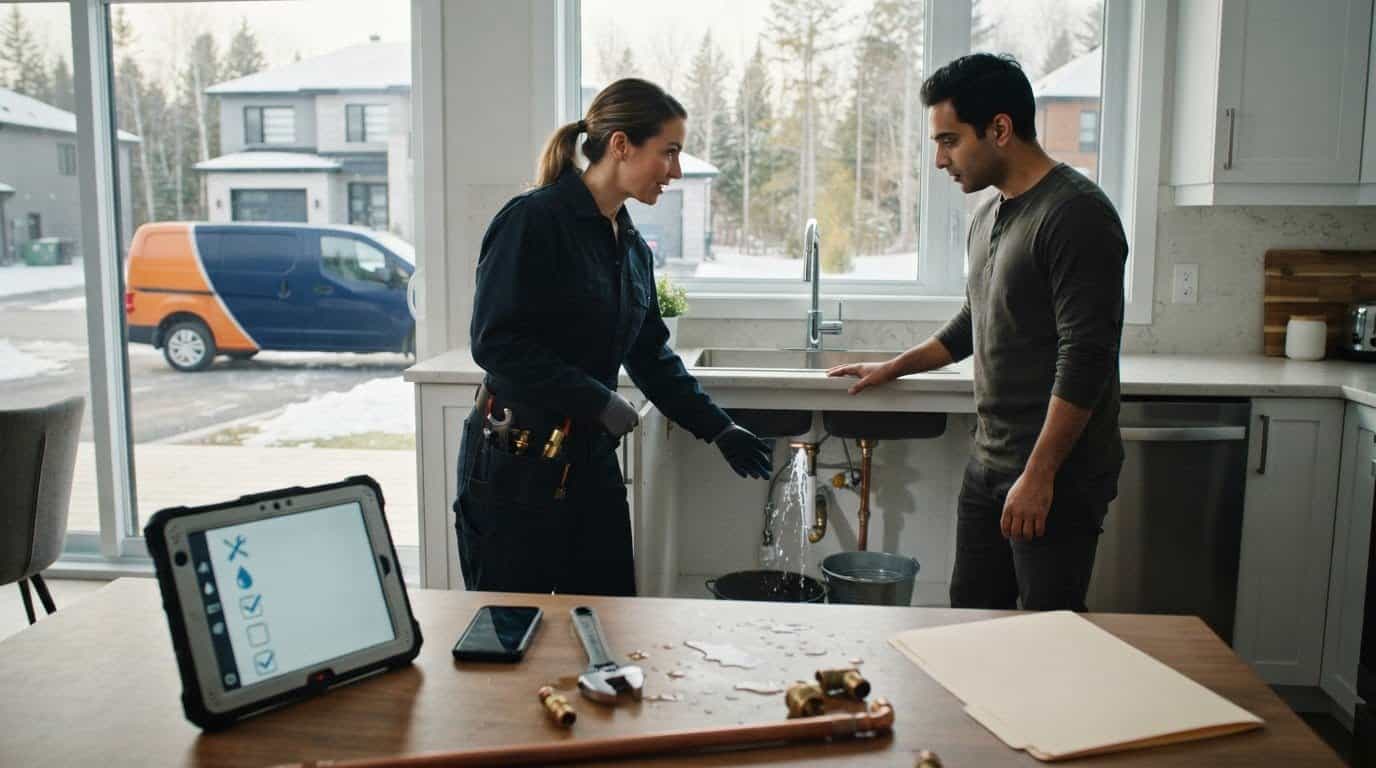
A name in search results, a neighbour’s recommendation or a collection of positive reviews can help you make a shortlist of plumbers. None of those clues is enough on its own to choose the right company. Before hiring someone for a repair or renovation, you should be able to identify the contractor, check that the business is authorized to carry out the proposed work, and understand what it plans to do, at what cost and on what schedule.
You do not need to become a plumbing expert to do this. A few specific details, checked against official registers and confirmed during the first conversation, can prevent many misunderstandings. The depth of your checks will depend on the circumstances: you have more time to plan a renovation than to stop an active leak. The essential questions still apply in both situations.
Key takeaways
- Ask for the company’s legal name and licence number, then compare them with the Régie du bâtiment du Québec (RBQ) register.
- Check that the licence is valid and its classes or subclasses cover the proposed work. For plumbing, also consult the Corporation des maîtres mécaniciens en tuyauterie du Québec (CMMTQ).
- Describe what you have observed and ask how travel, diagnosis, labour and parts will be charged.
- For planned work, compare written estimates for the same scope, not just their bottom-line prices.
- Establish which extra costs or changes require your approval and keep the documents you receive.
Table of contents
- Define the job before looking for a plumber
- Confirm the company’s identity
- Check the licence and qualifications for the work
- Read reviews and recommendations carefully
- Ask the right questions on the first call
- Compare estimates and document the work
- Adapt your checks to an emergency
- Frequently asked questions
Define the job before looking for a plumber
Start by describing what you can see without pretending to know the cause. Note which fixture or room is affected, when the problem started, how often it happens and what you have already done. “Water appears under the sink when the tap is running” is more helpful than a guess about exactly which pipe is defective. For a planned project, identify the fixtures to install or move, the type of building and your preferred timeline instead.
This description helps you find a company that handles the kind of work you need. A small accessible repair, a leak investigation, a fixture replacement and a renovation involving relocated pipes require different preparation. When the scope is still unknown, ask how the contractor will establish a diagnosis first. The company can explain what can be assessed by phone and what requires a visit. An estimate given remotely may be preliminary rather than a final price.
Gather the practical details too: the precise address, access to the fixture and water shut-off, whether the unit is occupied, any possible shared piping, and scheduling restrictions. In a condo or rental property, the person ordering the work may need to arrange access with a property manager, condo board or landlord. Sorting that out early prevents a visit from being booked before an essential access arrangement is confirmed.
Make a short list using personal recommendations, a professional directory and search results. Then look up each business under its legal name. A trade name, phone number and review profile can change or be displayed in different ways; none replaces an identity you can independently check. You do not need to compare ten companies. Two or three credible options are often enough for planned work, provided that you give each one a comparable description.
Confirm the company’s identity
Before weighing any promises, ask who will enter into the contract with you and issue the invoice. The name in an advertisement may be a trade name, while the licence and contract belong to a corporation or sole proprietor under a different legal name. Request both names if they differ, along with the RBQ licence number and the company’s contact details. Check that the information is consistent across the website, estimate, contract and invoice.
The RBQ’s guide to checking a contractor’s licence directs you to its licence-holder register, where you can examine the business name, contact information and licence classes, among other details. The record may also show the Quebec Enterprise Number (NEQ). A difference in names does not automatically mean something is wrong, but it calls for a clear explanation before you sign. If the company uses another business name, ask which entity holds the licence and which will be responsible under the contract. Régie du bâtiment du Québec
Be cautious with directories that display numbers, reviews or logos without making their relationship to the company clear. To verify a licence, open the regulator’s own register and run the search yourself. A screenshot supplied by a candidate can be a starting point, but confirm the licence’s status at the time you are considering the contractor. Keep a note of the name and number you checked, especially if several companies have similar names.
The Quebec consumer protection office’s Get Information About a Merchant tool can add context about a business. Its explanatory page is in English, but search results are available only in French. The tool does not replace the RBQ register or an evaluation of the offer: a business that does not appear in it is not thereby cleared or condemned. Search using the precise name and, where available, the NEQ to reduce confusion. opc.gouv.qc.ca
Finally, check how you can reach the company after the technician leaves. A working phone number, professional address and contact information on the paperwork make it easier to follow up about an invoice, a part or the completed work. A polished web presence may be reassuring; being able to identify the party responsible for the work is more useful.
Check the licence and qualifications for the work
In Quebec, a central check is whether the contractor holds a licence appropriate to the work you are assigning. The RBQ explains how to check its validity and the authorized classes or subclasses. For plumbing, it specifically identifies subclass 15.5. Do not stop at seeing a licence number: open the record and compare its scope with your project. A contractor may be licensed for some work without being authorized to do every other kind of work. Régie du bâtiment du Québec
The CMMTQ has a particular role in qualifying plumbing and heating contractors. Its public member directory (in French) lets you search for a company and its specialties. The CMMTQ also recommends checking that the contractor is in good standing and has the licence subclasses required for the job; its guidance before assigning work (in French) explains the checks. If a search is inconclusive, ask the company for its precise details or contact the organization instead of drawing a conclusion from a difference in names. www.cmmtq.org
A licence answers a question about authorization to perform work. It does not, by itself, tell you whether the company is a good fit for your situation, will arrive on time or will produce an accurate estimate. Ask about experience with the specific job you have described. For a planned alteration, you might ask how the contractor will assess access, identify what should stay in place and coordinate with other trades. For a repair, ask how it will distinguish the symptom from its cause before proposing a substantial replacement.
Liability insurance is another topic to raise directly. Ask whether the company has coverage relevant to the proposed work, and have pertinent details recorded in the contract when the project warrants it. The Office de la protection du consommateur’s guidance on hiring a plumber advises checking for liability insurance. The appropriate coverage for a particular job may depend on the work, the building and any requirements set by a landlord or condo board. Home Renovations
In a condo building, also check the rules for access, advance notice and proof of insurance. For planned work, ask who will handle any municipal permit or authorization that may be needed, then confirm the applicable requirements with the municipality where the property is located. Do not assume that a provincial licence automatically settles every requirement associated with the building and address.
Read reviews and recommendations carefully
Online reviews can point to patterns in communication, punctuality or follow-up. Read several recent comments with concrete details and see how the company responds when a customer reports a problem. A very high average rating does not tell you whether the contractor has handled a situation like yours. Conversely, one negative review does not necessarily establish a recurring practice.
A personal recommendation becomes more useful when you ask specific questions: what work was done, did the estimate change, were the steps explained, and was the problem resolved after the visit? A positive experience with a simple replacement does not show that the same company is the best choice for a complex renovation. Treat the recommendation as a lead, then perform your own identity and licence checks.
Be equally wary of a large number of vague reviews and a single unsupported claim of expertise. Project photos may show a method or type of installation, but they do not establish who performed the work or under what conditions. If the job is significant and you have time, request relevant references or examples of comparable projects while respecting former customers’ privacy. The CMMTQ also recommends asking former clients about a contractor and comparing the services and timelines of more than one business. www.cmmtq.org
Record your observations without turning the search into an endless investigation. Once the basic qualifications are confirmed, pay attention to the conversation itself: understandable answers, candid discussion of limits and a willingness to document the job. A candidate who explains what is known, what must be seen on site and what could change the cost gives you a sounder basis for deciding than someone who makes an absolute promise after hearing two sentences by phone.
Ask the right questions on the first call
Give the facts in a simple order: address and building type, affected fixture or area, signs you have noticed, when they began and whether the situation is urgent. Mention any recent or repeated repairs. For a project, say whether you want a like-for-like replacement or plan to move a fixture, and whether other work is scheduled. The first conversation should establish whether the company serves your address and takes on this kind of assignment.
Next, ask who will attend, the expected arrival window and what the first visit will cover. Is the appointment solely for a diagnosis, for an estimate, or for an attempted repair if conditions allow? Will the options be explained before an expensive part is ordered? If access is uncertain, ask what might extend the visit. These questions help distinguish an assessment appointment from a promise to complete every part of the job that day.
Discuss fees before booking. Is there a service-call or travel charge? What labour rate applies, and when does the clock start? Are parts, special equipment and taxes included in the amount mentioned? Do different terms apply outside regular hours? The answer may depend on an on-site assessment, but the method of charging should be explainable. Note what the company confirms and request it in writing when the amount or scope warrants it.
One useful way to ask is: “This is what I’m observing. What can you confirm now, what will need to be checked on site, and how will you let me know if the work changes?” This invites the plumber to separate an initial theory from a diagnosis. Avoid insisting on a particular repair before an inspection; the assumption may conceal a different problem or lead to an incomplete estimate.
Also ask how replaced parts and completed work will be described on the invoice, and what terms apply to any warranty on parts and labour. A warranty mentioned verbally should be clarified in writing: its duration, coverage, exclusions and process for requesting follow-up. The manufacturer of an appliance and the contractor may provide different protections. Establish which applies to each item rather than treating the two as interchangeable.
Compare estimates and document the work
For planned work, give candidates the same description and ask for a detailed written estimate. Compare the scope first: proposed assessment, affected pipes or fixtures, materials and models, access, dismantling, restoration, debris removal and post-work checks. Two prices are comparable only when the underlying work is comparable. A lower offer may leave out a step; a higher one may include something you do not need. Ask for clarification before making a choice.
The CMMTQ recommends that a written estimate describe the work and expected duration, materials, price and taxes, any hourly rate, warranties, validity period and payment terms. It says any transport or equipment charges that will be billed should be disclosed as well. If the full scope cannot be known until a wall is opened or a pipe inspected, ask which parts of the estimate are firm, which are provisional and what will depend on the findings. This CMMTQ estimate guidance is available in French. www.cmmtq.org
A fixed price and an hourly arrangement call for different questions. With a fixed price, check the exclusions and assumptions behind it. With an hourly rate, ask how time, travel and materials will be counted and when you will be consulted if the work goes beyond the initial scope. Do not automatically choose the lowest total. Clear inclusions, relevant qualifications and the ability to follow through are also part of the decision.
Once you choose a contractor, have the agreed terms recorded in a contract or work order suited to the job. Identify the parties, location, work, price or pricing method, schedule, materials, payment terms and any promised warranties. The OPC guidance in English recommends a detailed written agreement and your authorization before work outside the contract is done. For a small repair, a legible work order and itemized invoice may serve a practical purpose; a renovation calls for a more detailed agreement. The rules that apply can also vary with how the contract is made. Home Renovations
An unexpected finding during the work may require a decision. Ask what was discovered, what reasonable options exist, how much each would cost and how the schedule would change before authorizing a new scope. Keep the discussion and the updated agreement with the other project records. At completion, ask what was done, what was tested, whether any limits remain and what instructions matter for the equipment. The invoice should make the charges understandable and allow you to identify the business if a question arises later.
Adapt your checks to an emergency
A spreading leak or active sewer backup leaves little time to collect several full estimates. If you can do so safely, first limit the damage: stop using the affected fixture, shut off the appropriate water supply if you know how, and alert those responsible for the building if other units may be affected. If water threatens electrical equipment, stay clear of the area and contact the appropriate emergency service. Then tell the plumber what you can observe and what steps have already been taken.
Even in an emergency, confirm the business name, RBQ licence number, ability to serve your address and method of charging before dispatch, as far as the situation allows. Ask for a realistic arrival window rather than relying solely on a “24/7” claim. Have the company distinguish the visit charge, any after-hours rate and the cost of work that cannot be determined until the problem is examined. An honest account of the unknowns is more useful than a guaranteed final price before the cause is visible.
Authorize what is needed first to make the situation safe and understand the problem. A permanent repair may need a part, access or decision that cannot be arranged immediately. Ask what will be completed during this visit, what remains to be scheduled and how you will receive an account of the charges. If several unplanned components are proposed for replacement, ask for the explanation and your options before agreeing. Time pressure should not eliminate a record of what was done.
After the immediate situation is stable, complete the checks that urgency forced you to shorten: review the invoice, request photos or a written finding if useful, clarify warranty terms and get an estimate for further work. You can then compare other options for the next stage. Choosing someone to attend an emergency and choosing a contractor for an entire renovation are separate decisions; the first responder does not automatically need to handle the whole project.
To see the types of work Plomberie Laval offers, consult its English plumbing services page. It helps identify the relevant service; the checks above still apply before an agreement is made.
Frequently asked questions
Does an RBQ licence prove that a plumber is reliable?
No. A valid licence with the appropriate subclass is an essential check on authorization to perform the work, but it cannot predict communication, timing or the accuracy of an estimate. Combine that check with business identification, relevant experience, a written description of the job and understandable billing terms.
How do I check a plumber who advertises under a different name?
Ask for the legal name, trade name, licence number and, if available, the NEQ. Search the RBQ register yourself, then check which name appears on the estimate, contract and invoice. If the connection between the names remains unclear, request an explanation in writing before hiring the company.
Do I need several estimates for a small repair?
Not necessarily. It may be more useful to ask how the visit will be charged and what requires your approval on site. For a planned project or significant replacement, several written estimates are more helpful, provided that each company receives the same description and you compare what is included as well as the price.
What if the price changes after a wall is opened or the problem is diagnosed?
Ask what was found and why the initial approach is no longer enough. Have the revised scope, cost, materials and effect on timing explained, then confirm your approval before additional work begins. Keep that explanation and the change to your agreement with the other project documents.
Can online reviews replace checks with the RBQ and CMMTQ?
No. Reviews report customer experiences; official registers help you check the stated business identity, licence and qualifications. Use each type of information for its own purpose without making a final judgment from one comment or an overall rating.
What should I ask if I need a visit in the evening or on a weekend?
Confirm availability for your address, the estimated arrival time, travel charges, the applicable after-hours rate and what will be decided after diagnosis. Ask whether the visit is intended to stabilize the situation temporarily or whether a complete repair may be possible with the available parts. Make sure the work and charges are recorded on a document you can keep.
Choosing a reliable plumber comes down to a sequence of manageable checks: identify the company, confirm the appropriate licence, describe the need, compare a clear scope of work and document the decisions. In an emergency, complete those checks in the order that safety and time allow. For a planned project, take the time to compare offers before signing.