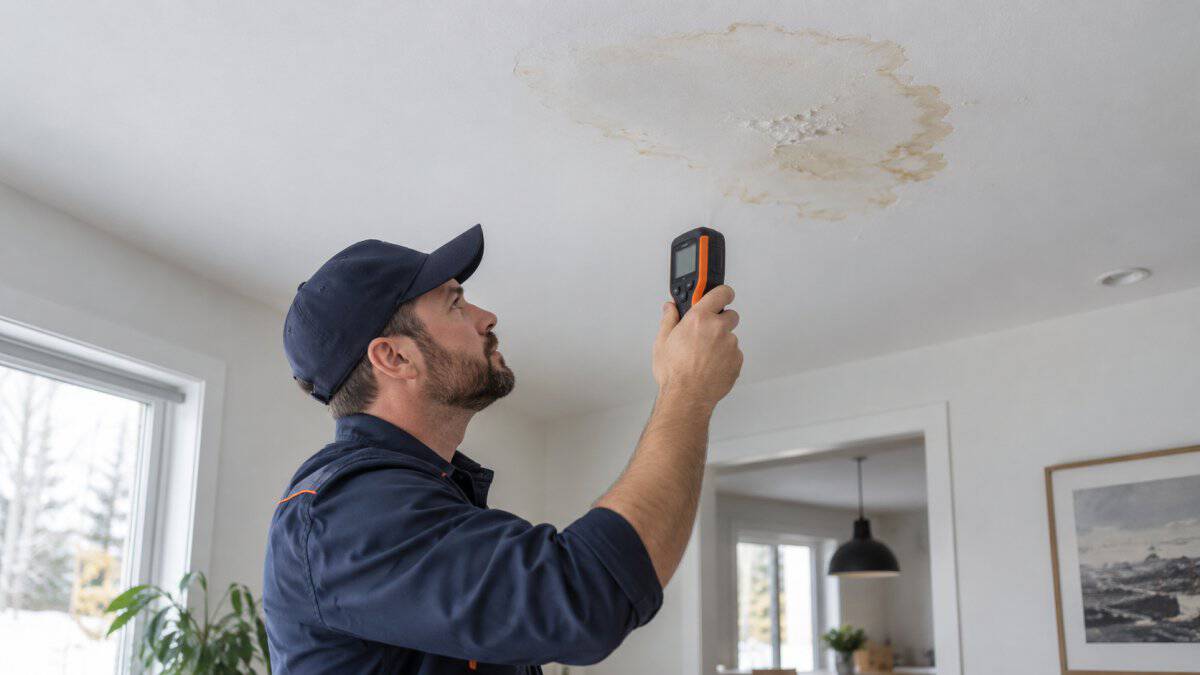
A water stain on the ceiling confirms that moisture has reached the material, but it does not automatically reveal where the water originated. The source may be a pressurized supply pipe, a drain that leaks only when a fixture is used, a shower seal, condensation or part of the building envelope.
The visible mark is often where the water exits, not where it entered. Water can travel along a joist, pipe or the back of the drywall before appearing several centimetres away from the actual source.
The most useful first clue is usually when the stain changes. A mark that grows continuously does not point to the same problem as one that appears only after a shower or during heavy rain.
The Short Answer: Observe When the Stain Changes
Before trying to identify a specific cause, note how the stain behaves.
- It grows even when nobody is using water: A pressurized supply pipe, fitting or continuously supplied appliance may be responsible.
- It appears during or after a shower: The cause may be the drain, overflow, seal, shower door or water escaping from the tub or shower area.
- It appears when a toilet is used: The toilet connection, drain line or seal at the base should be checked.
- It returns during rain or snowmelt: The roof, flashing, window, exterior wall or another part of the building envelope may be involved.
- It changes with humidity or temperature: Condensation on a cold surface, water pipe or mechanical duct becomes more likely.
- It appears while an appliance is operating: Check the dishwasher, washing machine, refrigerator and their plumbing connections.
These observations can help identify the appropriate trade and reduce unnecessary openings. They do not replace an on-site assessment.
Immediate Safety Steps
A small, dry ring can usually be documented and monitored briefly. A surface that is dripping, sagging or becoming soft requires a faster response.
Keep Away From a Bulging Ceiling
A ceiling that forms a bubble, begins to sag or drops debris may be holding a substantial amount of water. Do not stand directly beneath it or try to puncture it. Wet drywall, insulation and accumulated water can fall suddenly.
Keep children and pets away. Move furniture and valuables if this can be done safely. Place a container beneath dripping water only if the ceiling remains stable and there is no electrical risk.
Do Not Touch Wet Electrical Equipment
If water is approaching a light fixture, outlet, appliance, electrical wire or panel, do not touch the water or the equipment.
Turn off the power only from a dry and safe location. Hydro-Québec’s water-damage and electrical-safety guidance warns against entering an area where water may be in contact with an electrical installation.
Stop Using Fixtures Located Above the Stain
If a bathroom, kitchen or laundry room is located on the floor above, temporarily stop using the fixtures and appliances in that area. This may slow a drain leak or prevent another overflow.
Shut Off the Water Only if It Is Safe
A local shutoff valve may isolate a toilet, sink or appliance. If the flow continues and the source appears to be a supply pipe, closing the main water shutoff may be necessary.
Do not force a seized or heavily corroded valve. It may break and make the situation worse.
Take Photographs Before Moving or Cleaning Anything
Photograph the stain, the entire room and any fixtures located above it. Record when the problem was discovered and what was happening immediately beforehand.
This information can help with both the diagnosis and a possible insurance claim.
Timing Often Provides the Best Clue
A ceiling stain should be examined as an event over time. Its behaviour is often more revealing than its colour or shape.
The Stain Grows Without Any Water Being Used
A potable-water line normally remains pressurized even when every faucet is closed. A pinhole, failed fitting or leaking valve can therefore release water continuously.
Compatible warning signs include:
- A stain that expands overnight
- The sound of running water while every fixture is off
- Reduced pressure at several faucets
- An area that remains constantly damp
- A leak that slows after the main water supply is shut off
Closing the main water supply may limit further damage, but it does not locate the failed component. Water already trapped inside the ceiling can continue dripping for some time.
The Stain Appears Only When a Fixture Is Used
When a stain develops only while a shower, toilet, sink or appliance is being used, a drain line, seal or fixture connection becomes more likely.
The delay also matters. A stain that appears immediately may come from a nearby connection. A delayed reaction may mean that the water is travelling farther before reaching the ceiling.
Do not repeatedly operate the fixture to reproduce the leak if water is already flowing. Every test can add more water to the concealed space.
The Stain Returns After Rain or Thawing
A stain associated with precipitation may come from the roof, flashing, an exterior joint, a window, a balcony or another part of the building envelope.
In this situation, closing the home’s main water supply will not normally change the problem. Instead, record:
- The intensity and duration of the rain
- Wind direction
- The presence of snow or ice on the roof
- The delay between precipitation and the stain appearing
- Whether the mark is close to an exterior wall, chimney or roof penetration
A stain that follows the weather should not automatically be attributed to plumbing.
The Stain Changes With Temperature or Humidity
Condensation develops when humid air meets a sufficiently cold surface. A cold-water pipe, ventilation duct or poorly insulated surface can then collect droplets.
The Government of Quebec recommends identifying the source of a moisture problem before simply increasing ventilation or installing a dehumidifier. Its guidance on moisture problems in a home explains the role of cold surfaces, ventilation and exterior moisture sources.
Condensation can resemble a slow leak. The difference becomes clearer when you document the precise conditions under which the moisture returns.
Check What Is Located Above the Stain
The room directly above is a logical starting point, but the surrounding area must also be considered. Water often travels before it becomes visible.
A Bathroom
Several sources are possible in a bathroom:
- Sink, toilet or shower supply lines
- Bathtub or shower drain
- Bathtub overflow
- Seals around the faucet or shower valve
- A shower door or curtain allowing water to escape
- Toilet wax seal
- Concealed drain line
- Condensation near a ventilation duct
Observe whether the stain appears with cold water, hot water, the shower, a filling bathtub or a toilet flush. Do not disassemble the plumbing or continue testing if the ceiling is deteriorating.
A Kitchen or Laundry Room
A stain below a kitchen may be related to the sink, dishwasher, refrigerator or their supply lines. Below a laundry room, possible sources include washing-machine hoses, valves, the drain and the appliance pump.
An appliance leak may be intermittent because it occurs during only one stage of the operating cycle. Record when the appliance starts and when the water becomes visible.
A plumber can work on building valves, pipes, connections and drains. An internal appliance failure may require an appliance technician.
A Water Heater or Mechanical Room
Water may come from the tank, a fitting, valve, relief valve or nearby pipe. A puddle can then travel through an opening in the floor.
If the water heater is near the affected area, photograph its installation and rating plate. Our guide explains how to determine a water heater’s age from its rating plate without applying the wrong serial-number format.
An Attic or Roof
When no plumbing is located above the stain, the attic and building envelope become important possibilities. From a safe and accessible location, look for visible signs such as:
- Discoloured insulation
- Damp wood
- Marks near a roof penetration
- Condensation on cold surfaces
- Staining that follows a slope or framing member
Do not step on insulation or between framing members in an unfamiliar attic. A wet, snowy or icy roof should not be inspected by an unequipped occupant.
Another Unit in the Building
In a condominium, multiplex or rental building, the source may be in another unit or involve a common building component.
Notify the property owner, manager or syndicate of co-ownership promptly. Shutting off the water may affect several occupants and should be coordinated unless an immediate emergency requires action.
The Stain May Be Far From the Leak
Water looks for a path. Once inside a concealed space, it may follow:
- A pipe
- A joist
- A cable
- A screw
- A panel joint
- The slope of the ceiling
- The upper surface of the drywall
This explains why opening the exact centre of the stain does not always expose the source.
Targeted access may be necessary, but it should be guided by fixture use, the probable pipe route and measurements taken on site. Opening a large section at random creates more restoration work without guaranteeing that the leak will be found.
Colour and Shape Are Not Enough for a Diagnosis
The stain’s appearance can provide clues, but no colour identifies the affected system by itself.
Yellow or Brown Ring
This colour may come from dust, minerals, rust, wood or other materials through which the water has travelled. It does not prove that the pipe itself is rusted.
Blistering or Bubbling Paint
Moisture can separate paint from drywall. A surface that is swelling rapidly should be considered unstable.
Dry Centre With a Dark Outline
An older stain may dry in the centre while leaving a visible ring. This does not necessarily mean that the problem has been resolved. The source may be intermittent.
Black Spots or a Musty Odour
These signs may indicate persistent moisture. The Government of Quebec explains that mould can grow when water or excess humidity reaches materials such as cardboard-faced drywall.
The priority is to identify and correct the moisture source. Painting over the surface without addressing the cause does not solve the problem.
How to Monitor a Stain Without Causing More Damage
If the stain is dry, stable, away from electricity and the ceiling is not deformed, a short observation period may provide useful information.
- Take a photograph of the entire area.
- Take a close-up with an object that provides a sense of scale.
- Record the date and time.
- Note the weather and any recently used fixtures.
- Place a small piece of removable tape at the edge of the stain without damaging the surface.
- Check whether the boundary changes.
- Stop using suspected fixtures and appliances.
- Compare the results without deliberately recreating the leak.
This approach is not appropriate when water is actively flowing, the ceiling is sagging, electricity may be involved or occupants could be exposed to danger.
What Leak-Detection Tools Can Actually Reveal
Specialized tools can narrow the search area, but no device replaces an informed interpretation of the building and its plumbing system.
Moisture Meter
A moisture meter compares moisture levels at different points. It can help map the extent of a damp area, but a high reading does not automatically identify the source.
Thermal Camera
Thermal imaging displays temperature differences. A cooler area may be consistent with moisture, but it may also indicate missing insulation, airflow, a cold pipe or another thermal condition.
A thermal camera does not directly see water and cannot guarantee that a leak will be located without opening a surface.
Acoustic Detection
Acoustic equipment may help when water is escaping from a pressurized pipe. Its effectiveness depends on the pipe material, water pressure, background noise and accessibility.
It is not the primary method for a shower seal, a drain that leaks only during use or water entering through the roof.
Drain Inspection Camera
A camera inserted into an accessible drain can show the inside of a drainage pipe. It cannot inspect a pressurized potable-water line, a ceiling, a roof or the exterior of a pipe.
The probable cause should determine which tool is used. The tool should not determine the diagnosis before the symptoms have been considered.
Quebec Weather Can Complicate the Diagnosis
In buildings in Laval and elsewhere in Quebec, the same stain may behave differently depending on the season.
During winter, a pipe exposed to cold temperatures can freeze or split. Warm, humid indoor air reaching a cold attic surface can also produce condensation.
In spring, melting snow, ice and repeated freeze-thaw cycles can reveal a roof or building-envelope problem.
During summer, humid air can condense on a cold-water pipe or air-conditioning duct. A blocked condensate drain can also release water near a cooling system.
These local conditions are why the date, weather and outdoor temperature should be included in your notes.
Plumber, Roofer or Restoration Company: Who Should Respond?
The appropriate resource depends on the likely cause.
A Plumber
A plumber is appropriate when the water appears connected to:
- A supply line
- A valve or fitting
- A plumbing fixture
- A drain or waste line
- A water heater
- A washing-machine, dishwasher or refrigerator connection
A Roofer or Building-Envelope Specialist
This type of specialist becomes more relevant when the stain follows rain, wind, melting snow or a particular area of the roof or exterior wall.
A Ventilation or Air-Conditioning Specialist
This may be necessary when the water comes from a condensate drain, mechanical duct or ventilation problem.
A Restoration Company
After the source has been stopped, water extraction, structural drying, decontamination and reconstruction may form a separate scope from the plumbing repair.
An Electrician
Electrical equipment affected by water must be assessed by the appropriate trade. Do not re-energize a wet circuit or appliance without confirmation that it is safe.
Documenting Damage for an Insurance Claim
Coverage varies according to the cause of the loss and the terms of the policy. A broken supply pipe, exterior water intrusion and sewer backup may not be covered in the same way.
Infoinsurance recommends:
- Contacting the insurer promptly
- Taking photographs and videos
- Preventing additional damage when it is safe to do so
- Keeping invoices and receipts
- Preparing an inventory of damaged property
- Avoiding immediate disposal of damaged items unless they present a health risk
The complete process is explained on Infoinsurance’s page about home insurance claims involving water damage.
Do not delay an urgent safety measure simply to photograph every detail first. Once the situation is controlled, ask your insurer which evidence and documents are required for your specific claim.
Why Drying Should Not Be Delayed
Even after the leak has stopped, water can remain trapped in drywall, insulation, wood or flooring.
The Government of Quebec recommends completely cleaning and drying affected materials within 24 to 48 hours to reduce the risk of mould growth. Its resource on finding and eliminating mould in the home also explains that heavily water-damaged porous materials may need to be removed.
Repairing a pipe without checking for remaining moisture can leave a second problem concealed. Conversely, replacing the drywall before correcting the source exposes the new finish to the same damage.
Mistakes to Avoid
Repainting Immediately
A stain-blocking primer may hide the mark, but it does not confirm that the leak has stopped or that the material has dried.
Puncturing a Bulging Ceiling
This can suddenly release water and damaged materials or cause part of the ceiling to collapse. It may also expose concealed electrical equipment.
Operating Every Fixture to Find the Cause
Repeated tests can increase the damage. Limited and controlled observation should be considered only when the area is dry, stable and safe.
Assuming the Source Is Directly Above the Stain
Water may travel some distance. The plumbing layout, building structure and timing must be considered together.
Promising Detection Without Any Opening
Some tools can narrow the probable area, but no method guarantees a completely non-destructive diagnosis in every building.
Confusing Plumbing With Exterior Water Intrusion
A stain caused by rain will not be corrected by replacing an indoor pipe. Conversely, a pressurized water line can continue leaking during dry weather.
Information to Prepare Before Requesting an Assessment
A precise description helps direct the response toward the correct source.
Prepare the following:
- The room where the stain is visible
- What is located directly above it
- The date and time it was discovered
- Whether its size is changing
- Whether the ceiling is dripping or bulging
- Which fixtures or appliances were used beforehand
- Whether the problem may be related to rain or thawing
- Whether a light fixture or outlet is nearby
- Whether an accessible valve can be closed
- Photographs of the stain and the room above
- The type of building, such as a house, condominium or multiplex
If the situation appears related to plumbing, this information can help prepare an assessment for water leak repair without turning this guide into a duplicate service page.
Frequently Asked Questions
Does a Dry Stain Mean the Leak Has Stopped?
No. The source may be intermittent and return during the next shower, rainfall or appliance cycle. The surface may also dry while moisture remains inside the ceiling cavity.
How Can I Tell Whether the Leak Comes From a Pipe or a Drain?
A supply pipe may leak continuously because it remains pressurized. A drain leak is more likely to appear while a fixture or appliance is discharging water. This pattern is a clue, not definitive proof.
Does a Stain After a Shower Always Come From the Drain?
No. Water may come from the drain, overflow, faucet trim, seal, shower door or water escaping onto the floor. The exact timing and location must be observed.
Can Thermal Imaging Always Find the Leak?
No. Thermal imaging detects temperature differences, not water itself. Its findings must be compared with moisture readings, the plumbing layout and building conditions.
Can the Ceiling Simply Be Left to Dry?
Only after the source has been corrected and the materials can dry properly. A closed ceiling cavity may retain moisture even when the visible surface feels dry.
When Does the Situation Become Urgent?
Respond promptly if water is flowing continuously, the stain is expanding, the ceiling is bulging, the water cannot be isolated or moisture is approaching electrical equipment.
Should the Insurer Be Contacted for a Small Stain?
That depends on the extent of the damage, the probable cause and the terms of your policy. Document the situation and contact your insurer when damage to the building or personal property may be involved.
Who Opens and Repairs the Ceiling?
The responsibility depends on the scope of work. A plumber may need access to repair the plumbing, while drying, contaminated-material removal, drywall, painting and finishing may require other specialists. Confirm each responsibility before work begins.
Start With the Right Clue Before Opening the Ceiling
A ceiling water stain should not be diagnosed by its shape alone. When it appears, what fixtures are located above it, recent weather, nearby electricity and how the stain changes provide much more useful information.
Begin by securing the area, stopping the use of suspected equipment and documenting what you observe. If water is actively flowing, the ceiling is deforming or the source appears connected to a pipe, prompt assessment can limit the damage and direct the repair toward the correct system.