A faucet that stops delivering water during extreme cold may point to frozen pipes. First check whether there is a leak or an immediate hazard, locate the water shutoff and seek instructions suited to the situation. Do not begin heating a pipe when its location or condition is uncertain.
A loss of flow does not confirm freezing: a water-service interruption or a problem at one fixture can produce a similar result. While waiting for the plumber, a few observations can help describe what happened and limit the consequences of a possible rupture, particularly when water starts moving again.
Key takeaways
- Little or no flow during cold weather is a possible sign of freezing, not a diagnosis.
- A damaged pipe may begin leaking as it thaws; a dry floor does not establish that the pipe is intact.
- Locate the indoor water shutoff. Operate it only if it is clearly identified, safely accessible and easy to move.
- Maintaining normal room heat and letting warm air circulate is different from applying heat directly to a pipe.
- Never use an open flame to thaw plumbing, and keep electrical equipment away from wet areas.
- When flow returns, watch for leaks and follow the instructions given for restoring service.
Table of contents
- Observing symptoms without assuming the pipes are frozen
- Making the area safe and locating the water shutoff
- Maintaining warmth without improvising a thawing method
- Managing faucets and appliances while you wait
- Requesting the right help and preparing for an assessment
- Watching the return of water without assuming the problem is solved
- Frequently asked questions
- Keeping the right priorities for the next steps
Observing symptoms without assuming the pipes are frozen
Compare only what can be checked safely
If no leak is visible and the area is safe, briefly opening another accessible faucet normally can help describe how much of the plumbing is affected. Note whether cold water, hot water or both are missing. Close the faucet afterwards unless you have received a specific instruction for your situation.
A bathroom sink with no flow while the kitchen sink works does not automatically mean the bathroom pipe is frozen. The problem may also involve the faucet or its supply. If only hot water is missing, a problem specific to the hot-water system must remain a possibility. These differences help guide an assessment without justifying disassembly.
If water is already escaping from a pipe or ceiling, stop comparing fixtures. Limiting the escape of water and protecting occupants take priority over completing a survey of every faucet.
Record the cold-weather context
The last time water flowed normally may be more useful than an estimate of exactly when freezing occurred. Mention a particularly cold night, a heating failure, an open window or a recurring problem in the same room.
A comfortable thermostat reading does not rule out a colder area around a pipe. The CMMTQ’s guidance on preventing freeze damage, available in French, explains that weather and insulation conditions can allow freezing even when the building’s indoor temperature does not fall below the freezing point. www.cmmtq.org
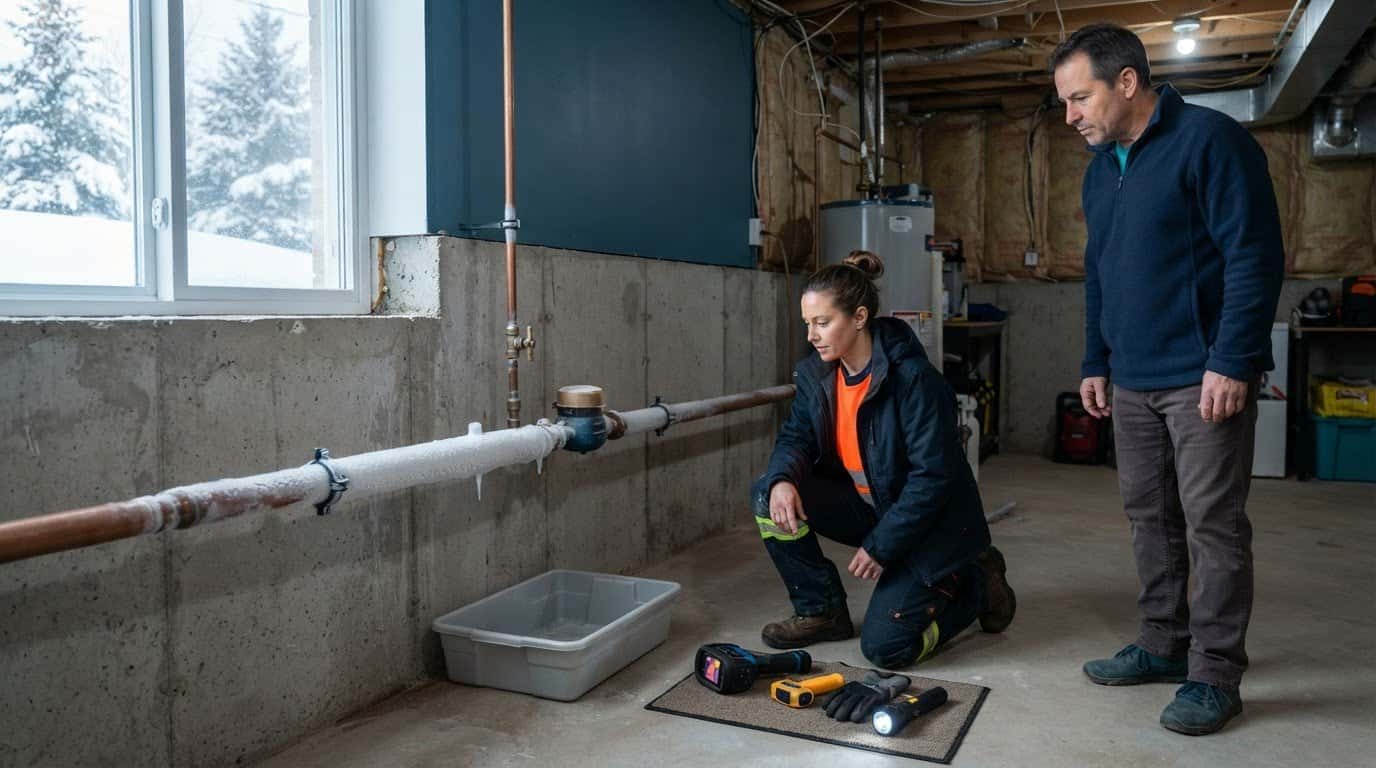
Visible frost is useful information, but it does not reveal the inside of the pipe. Conversely, a concealed section may be affected without frost that you can see. Do not try to confirm freezing by striking a pipe or opening a wall.
Keep the distinction between observation and assumption clear: “There is frost on the visible section” is more precise than “the whole line is frozen.”
Making the area safe and locating the water shutoff
Anticipate a leak as the pipe thaws
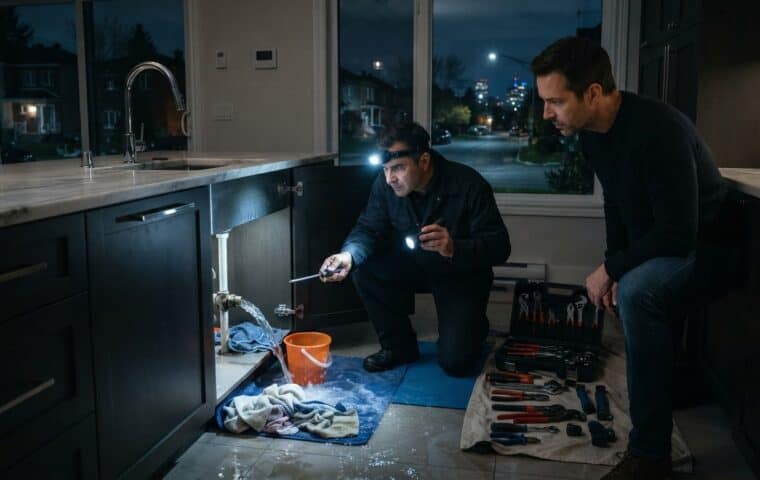
A damaged section may release little water while ice restricts the flow. When that restriction clears, a leak can become apparent. Think about how the water can be shut off before attempting any warming measure.
The CMMTQ recommends closing the main water supply when freezing has affected the plumbing, to limit possible water damage. Follow that precaution only at a recognized indoor valve that can be reached safely. If you do not know which valve controls the affected pipe, describe the installation to the professional and ask for instructions. www.cmmtq.org
A loss of water that may involve municipal service is not a reason to operate every valve in the building. Suspected freezing and an unexplained service interruption must be distinguished before deciding what to handle.
Do not force a valve or improvise a shared shutdown
If the indoor shutoff is seized, leaks or would require force with a tool, stop handling it. Tell the plumber that a working shutoff is not available. An older valve can become another leak point if it is mishandled.
In a multi-unit building, notify the owner, property manager or condominium board when a shutdown may affect other units. Mention if you do not know whether a shared supply serves heating or other equipment. Do not select a valve at random in a mechanical room.
During an active leak, explain whether you were able to close the water, where you did so and whether the flow decreased. These facts are more useful than declaring that a pipe has definitely burst.
If the shutoff cannot be reached, say that clearly when requesting help. Do not create a new access hazard to reach it.
Set a firm boundary around electrical hazards
Do not cross a wet area to reach a valve, appliance or electrical panel. Hydro-Québec’s water-damage guidance explains that operating the panel requires safe conditions, including a completely dry floor, hands and footwear.
If the safety conditions are not met, do not touch anything and leave the hazardous area. Contact Hydro-Québec when power cannot be shut off safely. Call 911 if there is immediate danger or you cannot leave without coming into contact with water or energized equipment. Hydro-Québec
A plumbing problem does not make it safe to handle a wet electrical appliance. Keep other occupants away while the appropriate help is arranged.
Maintaining warmth without improvising a thawing method
Let normally heated air circulate
If the building’s usual heating system is working normally, keep it operating. In a dry room, opening the cupboard doors beneath a sink may let room air circulate around the plumbing. Keep household chemicals out of the reach of children and pets while those doors are open.
The City of Montreal’s tips to avoid frozen pipes include letting warm air circulate around plumbing. This does not mean leaving an exterior door open to reach a pipe or removing part of the heating system. Ville de Montréal
Report a persistent heating failure along with the loss of water flow. Warming one pipe does not address other exposed sections in a building that continues to cool down.
Describe the actual conditions in the affected room if known. The thermostat setting elsewhere in the house does not describe every concealed space.
Rule out flames and makeshift installations
Never use a torch or another open flame to thaw a pipe. The City of Ottawa’s frozen-pipe guidance explicitly warns against this and cautions about insulation and other flammable materials near heat sources. City of Ottawa
Do not attempt a makeshift electrical connection to the pipe, improvise a heating-cable installation or use an intense heating tool inside a cavity. The pipe material, fittings and concealed surroundings all need to be considered.
A small hole through drywall does not make a hidden pipe safely accessible for hot air. Do not cut finished surfaces to attempt thawing without having the location and hazards assessed.
The fact that a method appears simple in a video does not establish that it suits the materials or access conditions in your building.
Understand the qualification about hair dryers
It would be inaccurate to say that no official guidance permits a hair dryer. The City of Montreal’s frozen-pipe procedure mentions one, with close supervision and no contact between electrical equipment and water. Ville de Montréal
That advice is not blanket approval for a concealed pipe, a wet area or plumbing whose condition is uncertain. In those circumstances, refrain from applying direct heat and request an assessment. If someone recommends a warming method, ask which section it applies to and what conditions must be met.
A household appliance is still electrical equipment. Its familiar appearance does not remove the need to assess the surrounding water and access hazards.
Managing faucets and appliances while you wait
Avoid leaving forgotten faucets open
A faucet that produces no water can begin running again when ice melts or the supply returns. Do not leave several fixtures open and unattended after checking them.
Some thawing procedures call for opening a faucet. If you receive that instruction for your installation, record which faucet should remain open, how it should be positioned and what supervision is needed. Report a slow drain, a stopper in place or any other overflow concern.
Running water as a preventive measure and managing a pipe that may already be damaged are different situations. Do not automatically transfer a preventive circulation instruction to an incident involving a leak.
If several people are helping, make sure they know which faucets were opened and why. One person should not unknowingly change a setting that another person was instructed to maintain.
Pause new cycles that require water
Avoid starting a washing machine or dishwasher while the water supply is uncertain. Notify occupants so they do not repeatedly test fixtures or start additional water-dependent activities during the assessment.
Do not drain the water heater or change boiler controls to thaw domestic water piping. If equipment has been emptied, stopped or deprived of water, mention this before it is restarted. The instructions depend on the actual installation.
If the home uses a well instead of municipal water, say so during the first call. A pump, tank or exterior pipe may require a different approach. Do not repeatedly operate equipment in an attempt to restore flow.
The aim is to avoid adding further changes while the original loss of water is still unexplained. Tell the professional about any controls or valves already operated.
Requesting the right help and preparing for an assessment
Describe suspected freezing with specific facts
Request an assessment when flow remains absent or very weak in cold conditions, a pipe appears deformed or a leak is present. You do not need to know the length of the frozen section before asking for help.
Prepare the address, building type, affected fixtures, last known normal operation and heating status. Add the steps already taken: a closed valve, open cupboard, applied heat or stopped appliance. If a heat source was used, identify it and where it was applied.
A wide photograph of a visible pipe can help if taken from a safe position. It does not replace examination of a concealed section or guarantee that a neighbouring fitting is intact.
Explain any change since the first call. Water starting to leak after an earlier report of no flow is a material development that should be communicated promptly.
Check municipal information without assigning the cause too early
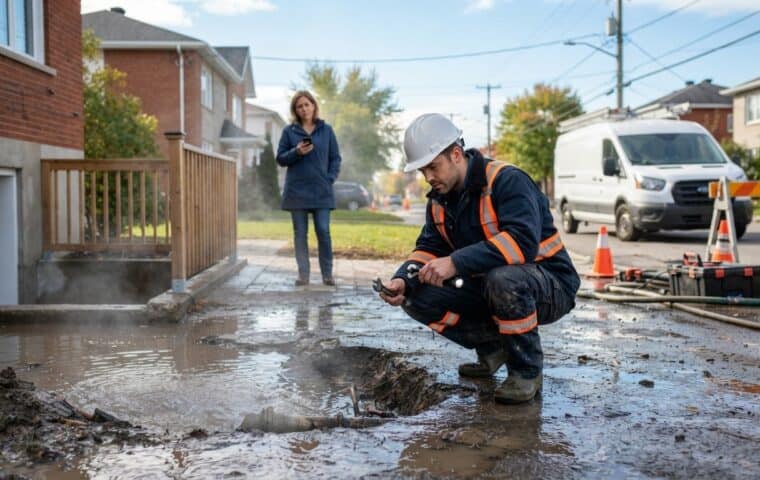
In Laval, check the official drinking-water advisories when several fixtures stop supplying water. A service-interruption notice may explain the loss of flow independently of the cold. Ville de Laval
To report a problem that may involve the public network or request municipal guidance, the City of Laval’s contact page lists 311. Ask which procedure applies to the address rather than assuming that municipal thawing work or reimbursement is available. Ville de Laval
Another municipality’s procedure should not automatically be applied to your property. No water anywhere in the house does not, by itself, locate a frozen section or establish who is responsible for the work.
The information from the City and the observations from the building can be considered together. Neither requires you to operate an exterior municipal valve yourself.
Make the assessment possible without searching inside walls
Prepare a dry route to the water service entrance and sections already visible. If a pipe is concealed behind a fixed cabinet or finish, report that limitation rather than moving the installation.
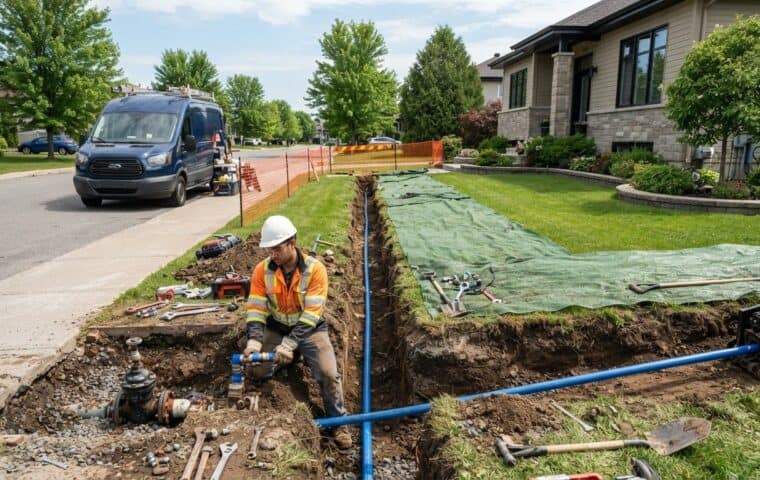
The visit is intended to clarify the problem and determine an appropriate approach. If a leak is found, the water leak repair page describes the corresponding service. A possibly frozen interior pipe does not establish that the entire water service line needs replacement.
Keep known access points available, but leave decisions about opening finishes or taking fittings apart to the assessment. Useful preparation does not require exposing every part of the plumbing.
Watching the return of water without assuming the problem is solved
Observe what changes when flow returns
Water flowing again means a passage is available; it is not a complete check of the pipes’ condition. From a safe area, watch for a new puddle, an audible escape of water or moisture near the affected route.
Note whether water returns everywhere or only at some fixtures. If the supply was closed because damage was suspected, do not reopen it to test the pipe yourself. Ask for the conditions under which service should be restored.
A leak that becomes visible during thawing warrants assessment even if it looks small. The guide to what causes a copper pipe leak covers the material-related diagnosis. Here, the key point is that restored flow and an undamaged pipe are not the same finding.
Also report any section that remains without flow. Improvement at one faucet does not describe the condition of every branch.
Keep the context to help prevent recurrence
Record the affected room, heating status and exposure to cold. Mention previous incidents in the same location. Recurrence can justify examining insulation, air leakage or the pipe route.
Choose corrective measures after the assessment. Wrapping a pipe at random, adding a heating cable or closing an access opening does not replace identifying the vulnerable area. The useful measure must suit the building and remain compatible with maintaining the installation.
Keep any recommendations with the service records so the next cold-weather issue can be compared with this one. An accurate history is more useful than simply remembering that “the pipes froze once.”
Frequently asked questions
Can a pipe be frozen without visible frost?
Yes. The affected section may be concealed in a wall or inaccessible space. A lack of visible frost therefore does not rule out freezing. Describe the affected fixtures and cold-weather context without removing finishes. A loss of flow may also have another cause, so retain that uncertainty when requesting an assessment.
Should I wait for warmer weather to see whether water returns?
Do not simply wait for a temperature change when freezing is plausible. A damaged pipe may start leaking as flow resumes. Locate a safely accessible shutoff and ask for instructions. Urgency also depends on whether there is a leak, whether the heating works and whether the affected area presents hazards.
Should I close the water even if there is no visible leak?
When freezing appears to have affected the plumbing, the CMMTQ recommends closing the main supply to limit possible damage. You must still recognize the valve and be able to reach it safely. If it serves a shared installation or the reason for the water loss is unknown, seek specific instructions rather than handling valves at random.
Can I pour hot water or a product into the sink?
Pouring something into a sink acts on its drainage route, not directly on the pipe supplying it. It is not a method for thawing the water supply. Do not add drain cleaner or antifreeze to drinking-water piping. Winterizing an unoccupied building is a separate procedure from responding to this incident.
Can I leave the house after discovering the problem?
Notify the professional or person responsible for the building before leaving. Explain the supply status, any faucets left open under specific instructions and the access needed for the visit. Arrange supervision if the situation requires it. No visible leak at departure does not guarantee that water will not escape later.
Does restored flow mean the pipe needs replacement?
No. It proves neither that the pipe is intact nor that it must be replaced. The decision depends on the findings and condition of the affected section. Report leaks or deformation and ask what was checked. A repair should follow those observations, rather than the fact that freezing was suspected.
Keeping the right priorities for the next steps
With possibly frozen pipes, observe without taking the plumbing apart, plan for safe water isolation and maintain normal room heat. Avoid improvised methods when the pipe or surroundings are not well understood. Prompt assistance and appropriate monitoring when water returns can then guide decisions about repairs and protection against further cold exposure.