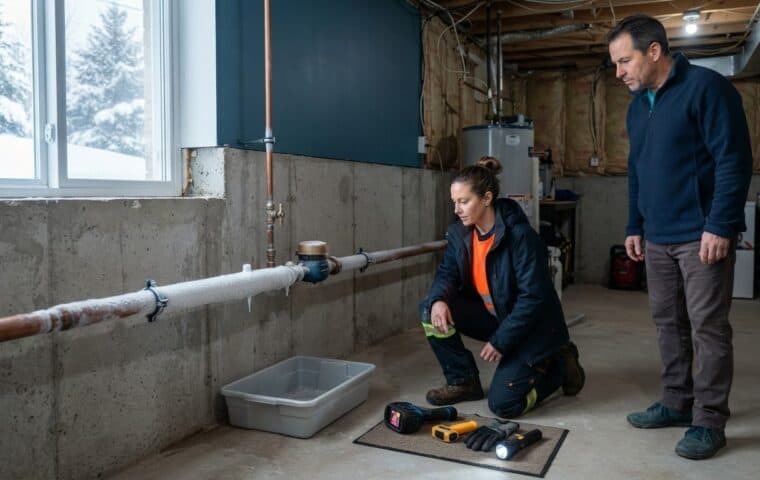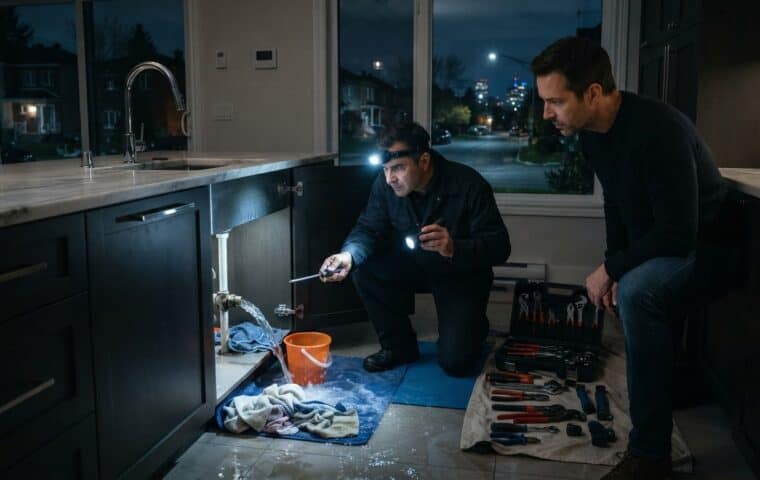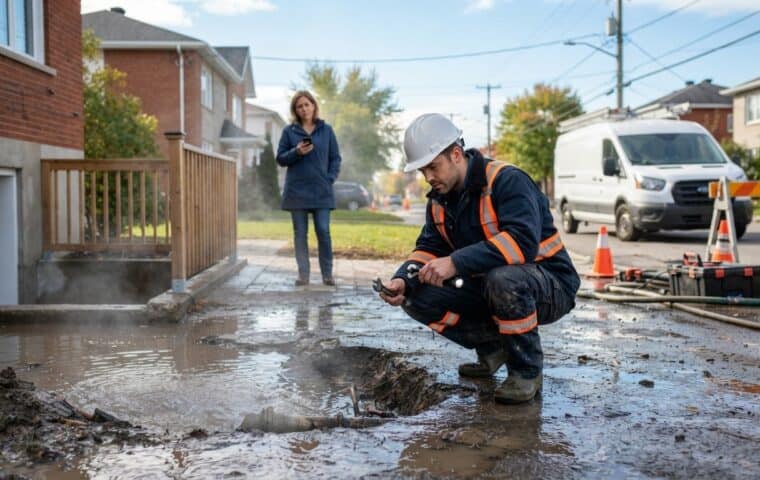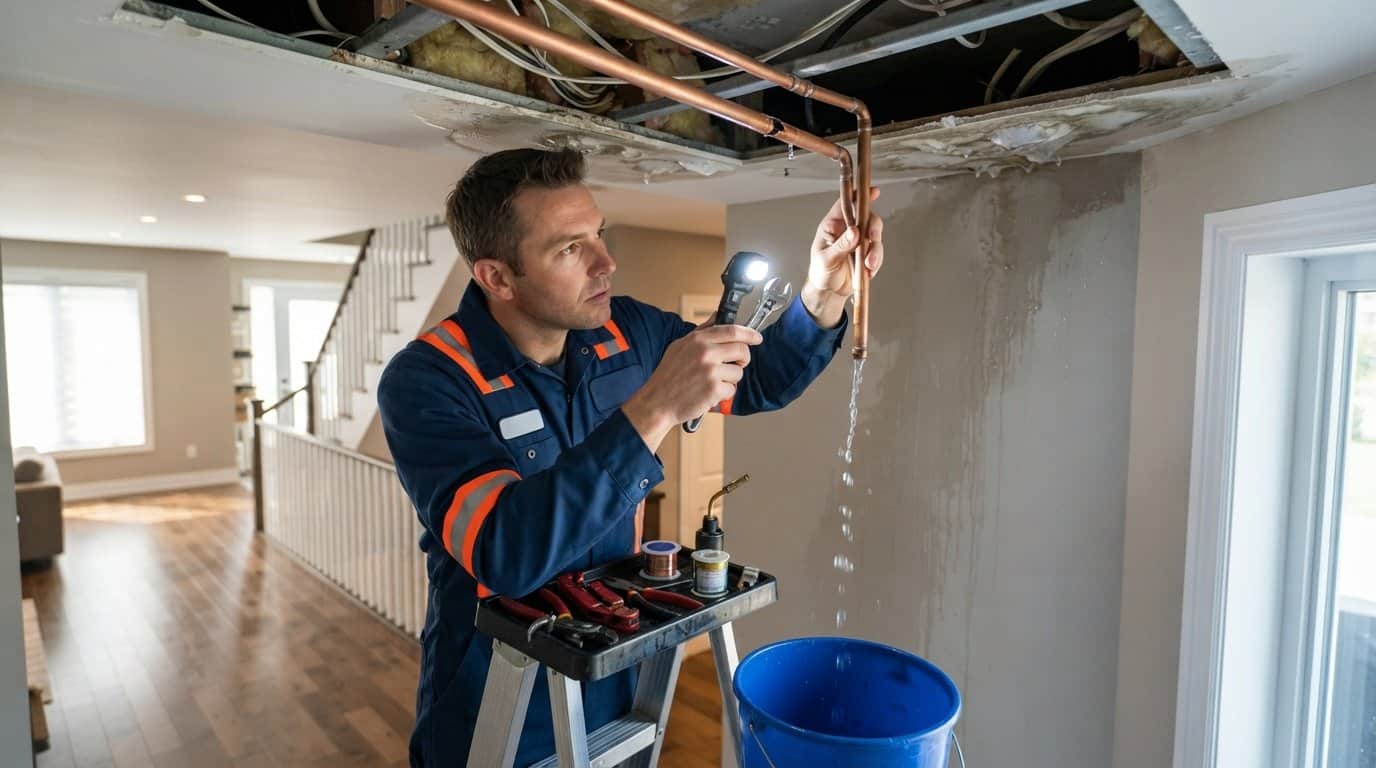
A leak in a copper pipe does not automatically mean that all the plumbing needs replacement. One fitting may have failed, the pipe may have been damaged during renovations or a small area of corrosion may have penetrated the pipe wall.
Conversely, repairing only the visible opening does not always explain why the leak developed. When several small perforations appear within the same plumbing system, the surrounding pipe, operating conditions and history of previous leaks may require a broader assessment.
The location of water on the ceiling does not necessarily reveal the location of the leak. Water may travel along a pipe, joist or the upper surface of the drywall before becoming visible several feet away.
Important: The first question is not only “How can the leak be stopped?” It is also “Is this isolated damage or a sign of a broader problem?”
The short answer: copper leaks do not all have the same cause
The most common causes can be grouped into six categories:
- a failed fitting or joint;
- localized corrosion inside the pipe;
- accelerated wear caused by water flow;
- corrosion affecting the outside of the pipe;
- mechanical stress or repeated movement;
- accidental or freeze-related damage.
The shape of the opening, deposits around the leak, its position on the pipe and the condition of nearby sections can help distinguish these possibilities.
Avoid drawing a conclusion from one clue alone. A green deposit may indicate prolonged moisture, but it does not identify the exact cause by itself. A leak near a fitting does not automatically prove that the fitting is responsible.
What the location of the ceiling stain cannot confirm
When a ceiling stain appears, several sources remain possible:
- a cold- or hot-water supply pipe;
- a plumbing fitting;
- the drain from a fixture upstairs;
- a bathtub or shower seal;
- a toilet;
- a water heater or one of its connections;
- condensation;
- water entering through the roof or building envelope.
The stain shows where the water reached the drywall, not necessarily where it left the pipe.
Water can travel horizontally along the outside of a pipe. It may also follow a joist, collect at the lowest point of the ceiling and then penetrate the paint.
Before concluding that a copper pipe is perforated, confirm that the water is actually coming from a pressurized supply line. The guide to a water stain on the ceiling explains how timing, fixture use and weather conditions can help distinguish a plumbing leak from exterior water infiltration.
Six possible causes of a copper pipe leak
1. A failed fitting or joint
A leak may appear where two sections of pipe connect or near an elbow, tee, valve or other fitting.
Several factors can compromise a joint:
- improper surface preparation;
- an incomplete connection;
- stress on the piping;
- repeated movement;
- gradual deterioration;
- damage caused during later renovations.
The leak may appear immediately after installation, but it can also develop much later if the connection experiences movement or repeated temperature changes.
Deposits around the joint may show that moisture has been present for some time. They do not confirm whether the fitting was improperly assembled, has cracked or is simply being exposed to water travelling from another location.
2. Localized corrosion inside the pipe
Copper performs well under many conditions, but it is not completely immune to corrosion.
Pitting corrosion may attack a very small area on the inner pipe wall. Most of the pipe appears intact while one spot becomes thin enough for water to pass through. This creates some of the tiny perforations commonly called pinhole leaks.
Health Canada’s technical document on copper in drinking water identifies several factors that can influence copper corrosion, including:
- pH;
- alkalinity;
- temperature;
- stagnation time;
- water flow;
- dissolved oxygen;
- certain chlorides and sulphates;
- the age and characteristics of the plumbing system.
This does not mean that any one factor automatically explains a residential leak. Corrosion often results from a combination of conditions involving the water, the piping and how the system is used.
A microscopic opening may be surrounded by a small green, blue or white deposit. This is a useful clue, but examining the damaged section may be necessary to determine the nature of the problem.
3. Wear associated with velocity or turbulence
Water moving too quickly or turbulently may contribute to internal wear in certain locations.
Potentially affected areas include:
- sudden changes in direction;
- elbows;
- reductions in pipe diameter;
- areas near certain valves;
- sections containing an obstruction or irregularity;
- installations operating under unsuitable flow conditions.
This type of wear cannot be diagnosed by looking only at the pipe’s outside diameter. The configuration, connected fixtures and operating conditions must be considered.
A leak near an elbow may therefore be caused by the fitting, mechanical stress or internal wear. Location alone is not enough to choose the appropriate correction.
4. Corrosion affecting the outside surface
The outside of a copper pipe may also deteriorate when it remains in contact with certain materials or a persistent source of moisture.
Possible conditions include:
- prolonged contact with damp materials;
- recurring condensation;
- chemical residue;
- certain cleaning products;
- contaminated or constantly wet insulation;
- unsuitable contact with another material;
- construction residue left on the pipe.
The CMMTQ warns that certain chemical products and cleaners can create a corrosive environment around plumbing components. This resource is available in French.
Inside a closed ceiling, a small leak from another source may keep a copper pipe wet. Visible corrosion then becomes a consequence of the original problem rather than its cause.
5. Mechanical stress or repeated movement
A pipe should be supported and protected against unwanted movement.
Stress may develop when a pipe:
- rests against a rigid edge;
- passes through an opening without adequate clearance;
- is poorly supported;
- repeatedly expands and contracts;
- vibrates when a fixture opens or closes;
- experiences water hammer;
- supports the weight of another component.
The leak may develop in the pipe itself or at the nearest fitting, where movement becomes concentrated.
A banging sound inside a wall or ceiling does not prove that a pipe is about to rupture. It does indicate movement or pressure variation that deserves attention, particularly when a leak has already occurred.
6. Accidental or freeze-related damage
A screw, nail or tool can puncture a pipe while cabinets, lighting, moulding or another finish is being installed.
The opening may leak immediately. In other situations, the fastener remains inside the pipe and temporarily restricts the flow until it is moved or corrodes.
A pipe located near a cold area may also be damaged by freezing. Expanding water can deform the copper, split a section or weaken a fitting.
The leak does not always appear while the pipe is frozen. It may become visible during thawing, when water begins flowing through the damaged line again.
Clues to record before the ceiling is opened
A few observations can help distinguish a pressurized leak from a problem associated with the use of a particular fixture.
Water continues even when no plumbing fixture is being used
A leak that continues without fixture use may originate from a pressurized supply line.
However, some fixtures and appliances refill automatically. A toilet, humidifier, water-treatment device or appliance may start using water without someone opening a faucet.
Closing an accessible shutoff valve may help isolate an area, but only when the valve’s purpose is known and it can be operated safely.
Water appears only when a particular fixture is used
If the leak starts during a shower, bath or washing-machine cycle, the source may involve:
- a supply line;
- a faucet or valve;
- a fitting;
- the fixture’s drain;
- a seal;
- splashing or an overflow.
The timing is helpful, but it does not automatically identify the failed component.
The leak changes with water temperature
A change linked to hot-water use may direct attention toward a hot-water line, a fitting affected by thermal expansion or an appliance operating at that time.
Do not deliberately run hot water to reproduce a substantial leak. When water is actively escaping, shutting off the appropriate supply remains the priority.
Deposits are visible on the copper
Green or blue deposits may result from reactions involving copper, water and air. A white crust may contain minerals left behind as water evaporates.
These marks can indicate that moisture has been present for some time. They do not reveal whether deterioration began inside the pipe, outside it or at a different location farther along the line.
Several small leaks have already occurred
The building’s history becomes especially important when multiple perforations appear in different sections.
Record:
- the date of each leak;
- its location;
- whether the cold- or hot-water line was affected;
- previous repairs;
- the condition of removed pipe sections;
- similar deposits found elsewhere;
- recent renovations or plumbing changes.
Repeated leaks do not automatically mean that the entire system requires replacement. They do justify evaluating more than the single visible opening.
The first steps must remain safe
When water passes through a ceiling, the first priority is reducing risks to occupants and limiting the water supply.
Shut off the water when the valve is safely accessible
Close the appropriate valve only when you know which valve to use and can reach it without passing beneath an unstable ceiling or near wet electrical equipment.
If the local shutoff is unknown, the building’s main valve may stop the supply. Some older valves can be difficult to operate. Do not force a valve to the point of damaging it.
After shutting off the water, open a lower-level faucet if it can be done safely to see whether the pressure and leaking decrease.
Stay away from electrical equipment
A leak may reach a light fixture, electrical box, smoke detector, outlet or concealed wiring.
Do not touch a wet switch, light fixture or appliance. Do not try to reach the electrical panel by crossing a wet area.
Hydro-Québec provides electrical safety instructions for water damage and flooding. When the panel or the route leading to it is unsafe, seek assistance instead of attempting to disconnect power yourself.
Do not puncture a swollen ceiling
A water-filled ceiling may collapse without warning. Puncturing the bulge while standing underneath exposes the person to falling water, drywall, insulation and debris.
The water may also contain contaminants, depending on its source. It could be contacting concealed electrical components.
Keep people and animals away from the affected area. Move belongings only if this can be done without walking under the weakened section.
Stop using the fixture associated with the leak
If the leak appears while a shower, bathtub, toilet or appliance is being used, stop using it.
Avoid repeatedly testing different fixtures. Each attempt may add more water to already saturated materials without confirming the source.
Why a temporary patch does not reveal the cause
Tape, putty or a temporary clamp may sometimes slow an escape of water under very specific conditions. This does not provide an assessment of the copper pipe’s actual condition.
On a pressurized supply line, an unsuitable patch may:
- move out of position;
- conceal a second perforation;
- trap moisture against the pipe;
- interfere with inspection;
- fail while nobody is present;
- create a false sense of security.
The condition of the pipe wall around the opening matters as much as the opening itself. If the adjacent copper has become thin, correcting only the visible point may not be sufficient.
In Quebec, plumbing work remains subject to applicable codes and obligations. The CMMTQ explains the conditions surrounding plumbing work performed by property owners. This resource is available in French and recommends considering the required knowledge, materials and techniques before undertaking plumbing work.
Is it an isolated perforation or a broader problem?
The decision should not be based only on the building’s age.
Clues suggesting localized damage
A limited correction may be appropriate when the source is clearly isolated, such as when:
- a specific fitting has failed;
- a screw punctured the pipe;
- one section was crushed;
- one point rubbed against the structure;
- the damage is associated with an identifiable event;
- the surrounding copper appears sound after inspection.
Even in these situations, the area around the defect should be examined before choosing where to make new connections.
Clues that justify a wider assessment
A broader inspection becomes relevant when:
- several pinhole leaks have already appeared;
- different areas contain similar deposits;
- the copper is thin around the opening;
- problems involve multiple fittings;
- water pressure or plumbing noises are abnormal;
- a long section has been exposed to moisture;
- no clear local cause explains the perforation.
This does not automatically mean that full replacement is required. The objective is to avoid making a decision from one centimetre of pipe when the evidence involves a larger area.
What should be checked around the damaged section?
A useful assessment does not stop at the point where water exits the pipe.
It may include:
- confirming which line is affected;
- distinguishing between cold and hot water;
- locating nearby fittings;
- examining deposits and the shape of the defect;
- checking pipe supports;
- identifying rubbing points;
- assessing the neighbouring copper;
- checking relevant static pressure and pressure variations;
- reviewing the history of previous leaks;
- tracing the water’s path through the ceiling.
Detection tools may help define the wet area or track specific clues. They cannot always replace visual access to the pipe.
Thermal imaging, moisture meters and acoustic equipment provide different information. No single instrument guarantees that a small opening can be found behind several layers of material without creating any access.
Water quality is only one part of the diagnosis
When a copper pipe develops a perforation, it may be tempting to blame the municipal water supply immediately.
Water quality can influence certain corrosion mechanisms, but it is only one factor. Plumbing configuration, temperature, flow, stagnation, materials, construction residue and mechanical stresses may also contribute.
The City of Laval publishes its drinking-water analysis results. This municipal resource is available in French and provides general information about the distributed water. It does not diagnose the plumbing inside a specific house.
Water conditions may change between the treatment plant and the tap according to the service line, building materials and conditions within the property. Targeted testing should therefore answer a defined question rather than serve as an automatic explanation for a pipe leak.
The ceiling is not immediately ready to be closed
Stopping the pipe leak does not mean that the surrounding materials are already dry.
Before closing the access, confirm that:
- the pipe remains dry while pressurized;
- the fittings are not leaking;
- there is no second water source;
- wet insulation has been assessed;
- the cavity can dry properly;
- electrical components were not affected;
- the remaining drywall is stable.
Closing the ceiling too quickly can trap moisture and conceal another leak.
Depending on the extent of the water damage, the plumber, electrician and water-damage restoration company may have separate responsibilities. Repairing the pipe does not necessarily include decontamination, drying or ceiling reconstruction.
Document the damage before cleaning
When the area is safe, take photos or videos of:
- the original ceiling stain;
- visible water;
- affected belongings;
- any required opening;
- the damaged pipe section;
- emergency work performed.
Keep invoices, reports and supporting documents. Before discarding a removed pipe section, ask whether it should be retained to help document the cause.
Infoinsurance recommends contacting the insurer promptly after water damage, limiting further damage and keeping photographs, videos, invoices and receipts.
Coverage depends on the policy and the origin of the loss. Do not assume that the plumbing work or all restoration expenses will automatically be reimbursed.
Frequently asked questions
Does a green stain on copper mean the pipe is perforated?
Not necessarily. The colour may indicate a reaction involving copper and moisture or the presence of deposits.
It may be found near an active leak, an old leak, condensation or water coming from another component. The area must be dried and inspected before reaching a conclusion.
Does one pinhole mean that every copper pipe is defective?
No. A perforation may be isolated.
However, several similar holes, thinning pipe walls or recurring deposits in different locations justify a wider assessment of the system.
Can a copper pipe be repaired without opening the ceiling?
Sometimes access is available from the floor above, an adjoining room or a service panel. In other cases, a targeted opening is needed to see the pipe and complete the work correctly.
Detection equipment may reduce the area that needs opening, but it cannot guarantee a repair without access.
Why is the stain located away from the damaged pipe?
Water may follow a pipe, joist, cable or the upper surface of the drywall before moving downward at the lowest point.
The wet ceiling area therefore shows the water’s final route, not necessarily where the leak began.
Is a leak on a hot-water line more serious?
Any pressurized line can cause substantial damage. Hot water introduces a burn hazard and may accelerate damage to certain materials.
Do not touch the pipe to test its temperature while the leak is active.
Can condensation look like a pipe leak?
Yes. A cold pipe inside a warm and humid space may collect condensation.
Condensation usually develops over a wider surface, while a perforation generally produces a more concentrated point of discharge. This distinction is not always easy to make inside a closed ceiling.
Should the water be tested after a copper pipe leak?
Not automatically. Testing may be useful when there are water-quality concerns or repeated signs of corrosion.
The sampling protocol should match the question being investigated. A general water test may not explain why one specific pipe section failed.
Why did another leak appear near a previous repair?
The adjacent pipe may have experienced the same conditions as the first damaged area. Mechanical stress may also have shifted toward the new connection.
The surrounding copper and piping configuration should be examined instead of assuming that the previous repair is necessarily responsible.
Understand the cause before closing the ceiling
A copper pipe leak may result from a failed fitting, localized perforation, mechanical stress, freezing or a combination of factors.
The objective is not to recommend extensive replacement automatically. It is to determine whether the defect is isolated, assess the condition of the surrounding copper and confirm that the visible water is actually coming from that pipe.
When the leak is active or access to the pipe is required, the water leak repair service can assess the source, supply line and fittings before the ceiling is restored.