A sewer line appears damaged, and someone is already discussing opening your driveway or yard. Before authorizing an excavation, several details should be confirmed: the nature of the defect, its location, the pipe’s depth, who is responsible for the affected section, the applicable permits and the surfaces that will need to be restored.
Repeated backups, tree roots or ground settlement can justify significant work. On their own, however, they do not prove that a complete trench is necessary.
Excavation should be the result of a documented diagnosis, not the first method used to search for the problem.
Excavation is a conclusion, not a diagnosis
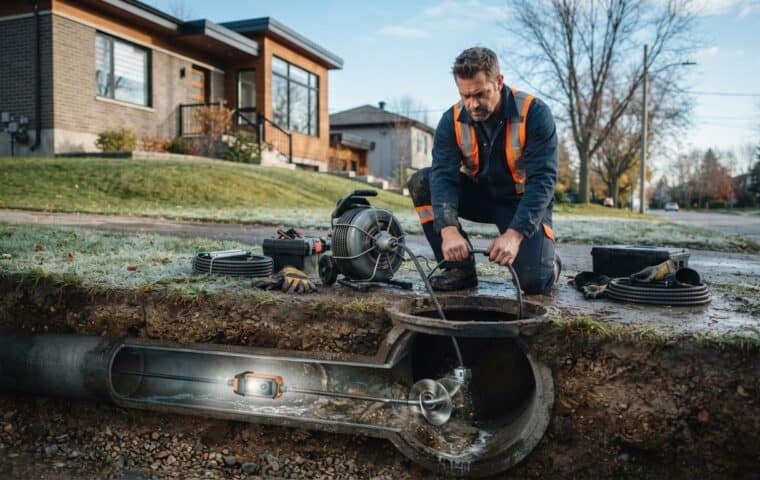
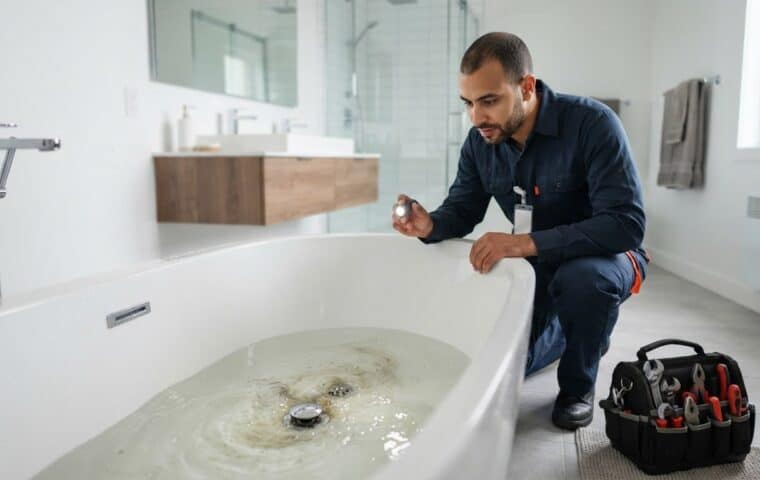
A slow drain or sewage backup may be caused by grease, wipes, paper, mineral deposits or roots that have reduced the pipe’s capacity. In some situations, mechanical cleaning can restore flow without opening the ground.
Excavation becomes more likely when a structural defect is confirmed, such as:
- a crushed or collapsed pipe section;
- a severely displaced joint;
- a break that allows soil to enter the pipe;
- deformation that continuously holds water;
- improper slope that cannot be corrected another way;
- damage extending across a substantial length;
- a leak in a buried pressurized water service;
- deteriorated pipe that can no longer support a reliable connection.
This distinction matters. Cleaning removes an obstruction, while excavation provides access to a pipe that must be repaired, realigned or replaced.
If several fixtures react together, our article about water backing up into another drain explains why the drain where water appears is not necessarily where the defect is located.
Check 1: Confirm the nature of the defect
The first question is not “Where should we dig?” It is “What is preventing the pipe from functioning normally?”
A diagnosis may combine:
- which fixtures are affected;
- when the problem occurs;
- the history of previous drain cleanings;
- the distance at which cleaning equipment encounters resistance;
- how the line behaves after cleaning;
- images obtained from inside the pipe;
- visible exterior signs, such as saturated or sunken ground.
A backup that returns after every cleaning deserves further investigation, but recurrence does not automatically prove that the pipe has collapsed. An obstruction may return because roots are entering through a joint, deposits remain in a poorly cleaned section or the pipe contains a low point that retains water.
Conversely, a structurally damaged pipe may continue carrying some wastewater. The absence of a complete blockage does not rule out a significant defect.
Check 2: Obtain usable images of the pipe
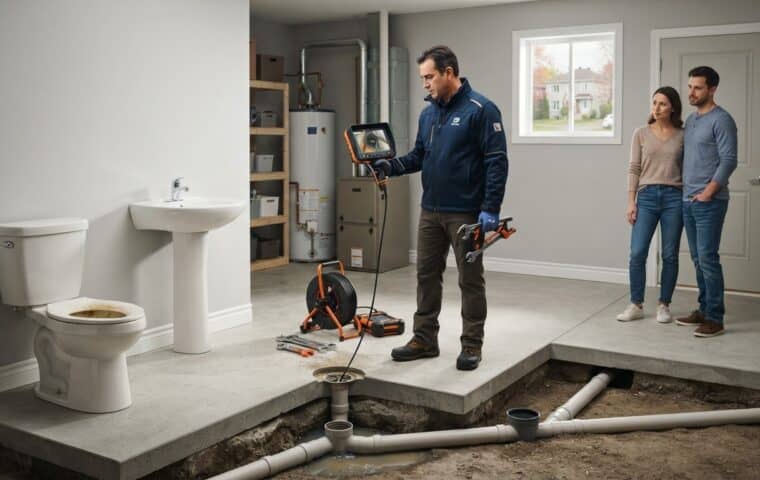
A drain camera inspection can document cracks, root intrusion, deformation, displaced connections and sections where water remains trapped.
To be useful before excavation, the video should help answer several questions:
- What defect is actually visible?
- How far is it from the access point?
- Is the problem isolated or repeated?
- Is the pipe sufficiently visible to support a conclusion?
- Is standing water hiding the bottom of the pipe?
- Did the camera travel through the entire relevant section?
- Does the remaining pipe appear suitable for continued use?
A camera cannot see through a dense obstruction or opaque water. If the pipe is full or completely blocked, enough flow may first need to be restored to obtain interpretable images.
It is also important to distinguish a visible irregularity from a failure that automatically requires excavation. A small amount of root growth, a deposit or a visible joint does not necessarily justify replacing the entire line. The defect must be considered alongside the symptoms, slope, overall condition and likelihood of recurrence.
Check 3: Transfer the defect’s location to the surface
Knowing the distance shown on a camera cable is not always enough to select the excavation point. The actual pipe route may include changes in direction, and the indoor access point may not align with the exterior trench.
When equipped with a transmitter, the camera head can emit a signal that is detected from the surface. This process can help estimate:
- the route followed by the pipe;
- the defect’s position;
- its approximate depth;
- its location in relation to the foundation;
- which surfaces may need to be opened;
- the space required for excavation equipment.
This step reduces the risk of opening an exploratory trench in the wrong place. It does not replace the separate locating of other buried utilities on the property.
Ideally, the report should connect three pieces of information: the image of the defect, its distance from the access point and its marked position at the surface.
Check 4: Distinguish a sewer problem from a water-service leak
A wet or sunken area in the yard does not, by itself, reveal which buried pipe is affected.
A sewer line operates primarily by gravity. A failure may cause backups, odours, slow drainage or the loss of surrounding soil through a break.
A water service remains pressurized. A leak can continue even when no fixture is being used. Possible signs include:
- unexplained running-water sounds;
- reduced water pressure;
- water appearing near the foundation;
- ground that remains saturated;
- unusual water-meter activity;
- deterioration beneath a driveway.
These two pipes do not necessarily follow the same route, and their repairs involve different conditions. Before excavation, the scope should clearly state whether the project concerns the sewer connection, water service or another buried component.
Check 5: Clarify the private section and municipal procedure
It is risky to assume that a shutoff valve, sidewalk or street curb always marks the exact division of responsibility. The applicable boundary depends on the municipality, the connection’s location, the property line and the type of work.
The City of Laval regulates work involving water and sewer connections. Its English permit finder provides the municipal starting point. The detailed technical pages for connection permits and excavation work are currently available in French.
Depending on the project, it may be necessary to confirm:
- whether a permit is required;
- who must submit the application;
- which plans or supporting information must be provided;
- whether an inspection is required before backfilling;
- whether the work enters the municipal right-of-way;
- whether a water shutoff must be coordinated;
- whether temporary occupation of public property is required;
- which section is the owner’s responsibility and which is municipal.
Requirements can change. The procedure for the specific address should therefore be confirmed with the City rather than inferred from an old quote or a rule applied in another municipality.
Check 6: Have buried utilities located
A camera transmitter helps locate the pipe being inspected. It does not automatically locate gas lines, electrical cables, telecommunications, outdoor lighting, irrigation or other buried infrastructure crossing the work area.
Before planned excavation, a locate request should be submitted to Info-Excavation. The organization states that the service is free and that three business days should be allowed for a planned request.
The response may include plans or on-site markings supplied by participating infrastructure owners. Other installations must still be considered because Info-Excavation explains that its service does not necessarily cover private networks or infrastructure belonging to a non-member organization.
Private installations may include:
- a cable supplying a detached garage or shed;
- an irrigation system;
- a line serving a swimming pool;
- landscape lighting;
- an abandoned pipe;
- a drain or pump installed by a previous owner.
Locate markings should remain visible until the work is completed. If the markings appear inconsistent with available plans or physical evidence on the property, the discrepancy should be resolved before digging begins.
Check 7: Define exactly what the quote includes
Two quotes with different prices may not cover the same work. Before comparing amounts, compare their scope.
A sufficiently detailed quote should identify:
- the defect being addressed;
- the approximate location and length of the opening;
- the expected depth;
- the pipe section to be repaired or replaced;
- the material and diameter of the new pipe;
- the proposed connections to existing piping;
- preparation of the pipe bedding;
- testing before the excavation is closed;
- included or excluded permits and inspections;
- disposal or reuse of excavated materials;
- the backfilling and compaction method;
- the surfaces that will be opened;
- the level of site restoration included in the price;
- exclusions and conditions that could change the scope.
Plumbing, asphalt, concrete, interlocking stone, sod and landscaping may be handled by different contractors. The phrase “site restoration” should therefore be defined. It could mean only a granular backfill, or it could include the complete restoration of the driveway.
The quote should also explain what happens if excavation reveals a defect different from the one seen during the camera inspection.
How to choose between a localized repair and a longer replacement
The least extensive repair may be reasonable when one defect has been clearly identified and the adjacent pipe retains acceptable alignment, support and material condition.
A longer replacement may be more appropriate when the inspection reveals:
- several displaced joints;
- cracks at multiple locations;
- major deformation;
- persistent standing water;
- poorly connected previous repairs;
- severely deteriorated material;
- several root-entry points;
- unstable bedding along a substantial section.
Roots provide a useful example. Removing them may temporarily restore flow, but they generally exploit an opening that already exists. Our article explaining why tree roots return after sewer cleaning describes why root removal and structural pipe correction serve different purposes.
The right decision is not necessarily the smallest opening or the longest replacement. It is the option that preserves sections that can reasonably remain in service without simply transferring the risk to the next weak area.
What should the work sequence look like?
Every property presents different constraints, but a well-prepared excavation generally follows a logical sequence.
1. Document the symptoms
The affected fixtures, frequency of backups, previous cleaning work and visible changes to the property are recorded.
2. Confirm and locate the defect
The pipe is inspected when access permits. The defect is connected to a measured distance, the pipe’s route and an estimated surface position.
3. Verify the required procedures
Responsibility for the affected section, permits, inspections, service shutoffs and any occupation of public property are confirmed.
4. Locate underground infrastructure
Networks belonging to Info-Excavation members are identified. Private or otherwise uncovered installations are investigated separately when necessary.
5. Prepare the work area
Vehicles, outdoor furniture and other obstacles are moved. Equipment access, safe movement for occupants and material placement are planned.
6. Open the ground and inspect the exposed pipe
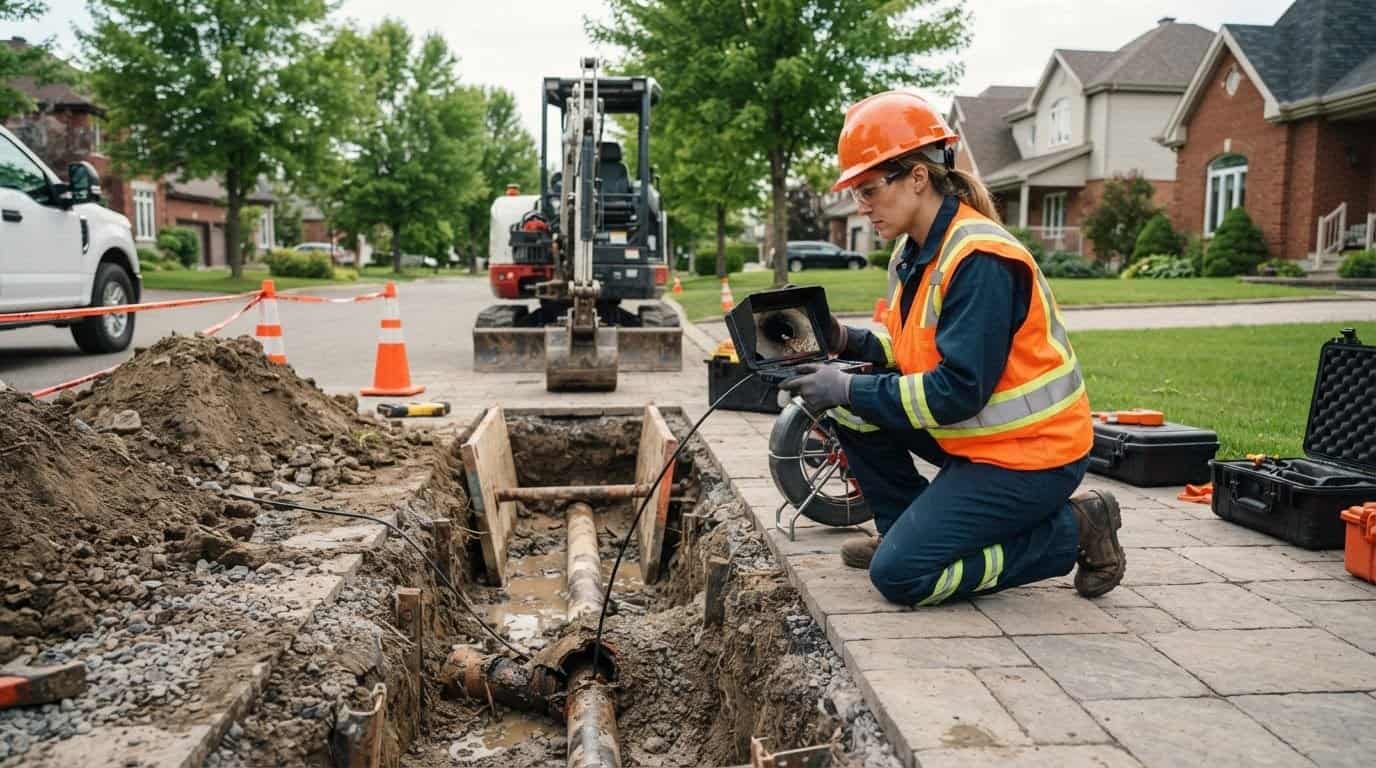
Excavation allows the physical condition of the pipe, soil and connections to be confirmed. Any major difference from the initial diagnosis should be documented before the work is expanded.
7. Repair and verify before closing
The new section, its support, connections and flow are checked before backfilling and before any required municipal inspection.
8. Backfill according to the agreed scope
Materials, compaction and surface finishing should correspond to the quote. Photographs taken before closing the excavation can document work that will no longer be visible.
Trench safety involves more than depth
An excavation can collapse rapidly, particularly when the soil is wet, cracked, previously disturbed or subjected to the weight of nearby equipment.
The CNESST explains the preventive measures for trenches and excavations. It identifies shoring as the preferred method of preventing a collapse while recognizing specific exceptions based on soil conditions, wall slope, whether workers must enter the excavation and whether an engineer has certified the conditions.
The CNESST also states that:
- materials must be placed more than 1.2 metres from the top of the excavation walls;
- vehicles and machinery must normally remain more than 3 metres from the top unless reinforced shoring has been designed accordingly;
- water, cracks or bulging walls may indicate a landslide hazard;
- additional protection is required when an excavation presents a danger to workers or the public.
These decisions belong to those responsible for the worksite. A property owner should never enter an open trench or approach its edge to inspect the pipe.
Warning signs that deserve further explanation
Before authorizing the work, certain situations should be clarified:
- no image or measurement identifies the defect’s position;
- full excavation is proposed solely because the drain clogged once;
- the quote does not state how much pipe will be replaced;
- responsibility between private property and the public system has not been verified;
- no buried-utility locate request is planned;
- restoration of the property remains vaguely defined;
- the pipe is to be covered before applicable verification or inspection;
- an absolute timeline or outcome is promised despite unknown underground conditions;
- the contractor does not provide a verifiable licence number.
The Régie du bâtiment du Québec recommends checking the contractor’s licence and reviewing the classes and subclasses shown in its registry. The CMMTQ member directory, available in French, can also be used to verify a plumbing contractor’s membership.
Questions to ask before authorizing excavation
A short list of questions can prevent significant misunderstandings:
- What exact defect justifies excavation?
- Can you show me the defect in the video?
- Where is it, and how was that position confirmed?
- Is the pipe completely collapsed or still passable?
- Why are you recommending a localized repair or a longer replacement?
- Who is confirming the private and municipal sections?
- Which permits and inspections apply?
- Who is submitting the Info-Excavation request?
- Which private utilities still need to be located?
- Which surfaces will be opened?
- What backfill and compaction work is included?
- Are asphalt, pavers, concrete or sod included?
- What happens if another defect is discovered?
- Which photographs or test results will be provided before the excavation is closed?
Precise answers cannot guarantee that no unexpected condition will be found underground. They can, however, distinguish genuinely unknown site conditions from a project that has not been properly defined.
Frequently asked questions
Does a recurring sewer backup mean excavation is required?
No. A recurring backup may result from a returning obstruction, tree roots, improper slope, a displaced joint or structural damage. The type of defect should be confirmed before selecting the repair method.
Is a camera inspection always possible?
No. A pipe filled with water, completely blocked or collapsed may prevent the camera from reaching the relevant section. Enough flow may first need to be restored, or several forms of evidence may need to be combined.
Does the camera automatically provide the exact location of the defect?
A camera system generally measures distance from the access point, but that measurement must be related to the pipe’s actual route. A transmitter and surface receiver can help estimate the position and depth.
Does Info-Excavation locate the private sewer line?
A locate request covers infrastructure belonging to participating organizations. Info-Excavation explains that private networks are not necessarily included. The sewer connection being repaired and other private installations may require separate locating work.
Is a permit required to repair a buried pipe?
It depends on the municipality, the affected pipe, the excavation’s location and whether the work extends into the public right-of-way. In Laval, the official connection and excavation information should be reviewed before scheduling the project.
Can the curb stop be used to determine responsibility?
Not automatically. The applicable boundary should be confirmed using municipal rules, the property line and the precise location of the defect.
Can only a short section be repaired?
Yes, when the defect is isolated and the retained sections remain sufficiently sound. When several defects are present, an extremely short repair may only postpone the next failure.
How long does sewer excavation take?
The timeline depends on depth, access, soil, surfaces being opened, permits, inspections and the length being replaced. A reliable schedule requires a defined scope.
Can excavation be completed during winter?
An emergency may require work during winter, but frozen soil, snow, access and material availability can change the method. Some finishing work, such as asphalt or landscaping, may need to wait for suitable conditions.
Does insurance cover the work?
Coverage depends on the policy, the cause of the damage and the protection purchased. Keep camera footage, reports, photographs and quotes, and contact the insurer before work begins when circumstances allow.
Dig only after reducing the unknowns
A properly planned plumbing excavation does not begin with an excavator. It begins with a documented defect, a marked position, clarified responsibility, located utilities and a quote explaining what will be opened, repaired and restored.
This preparation cannot eliminate every underground surprise. It can, however, reduce the risk of opening the property in the wrong location, replacing an undefined length of pipe or discovering too late that an essential permit, inspection or finishing item was omitted.
When a broken, sunken or collapsed pipe has been confirmed, our sewer line excavation and repair service explains the available approaches and the information needed to have the project assessed.