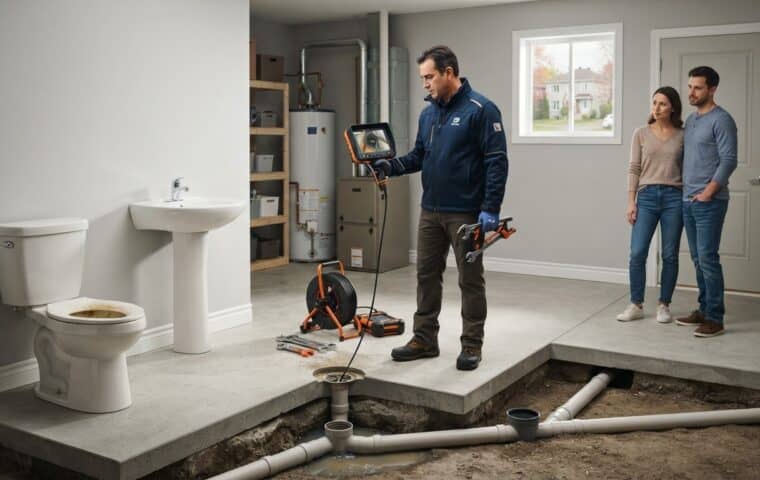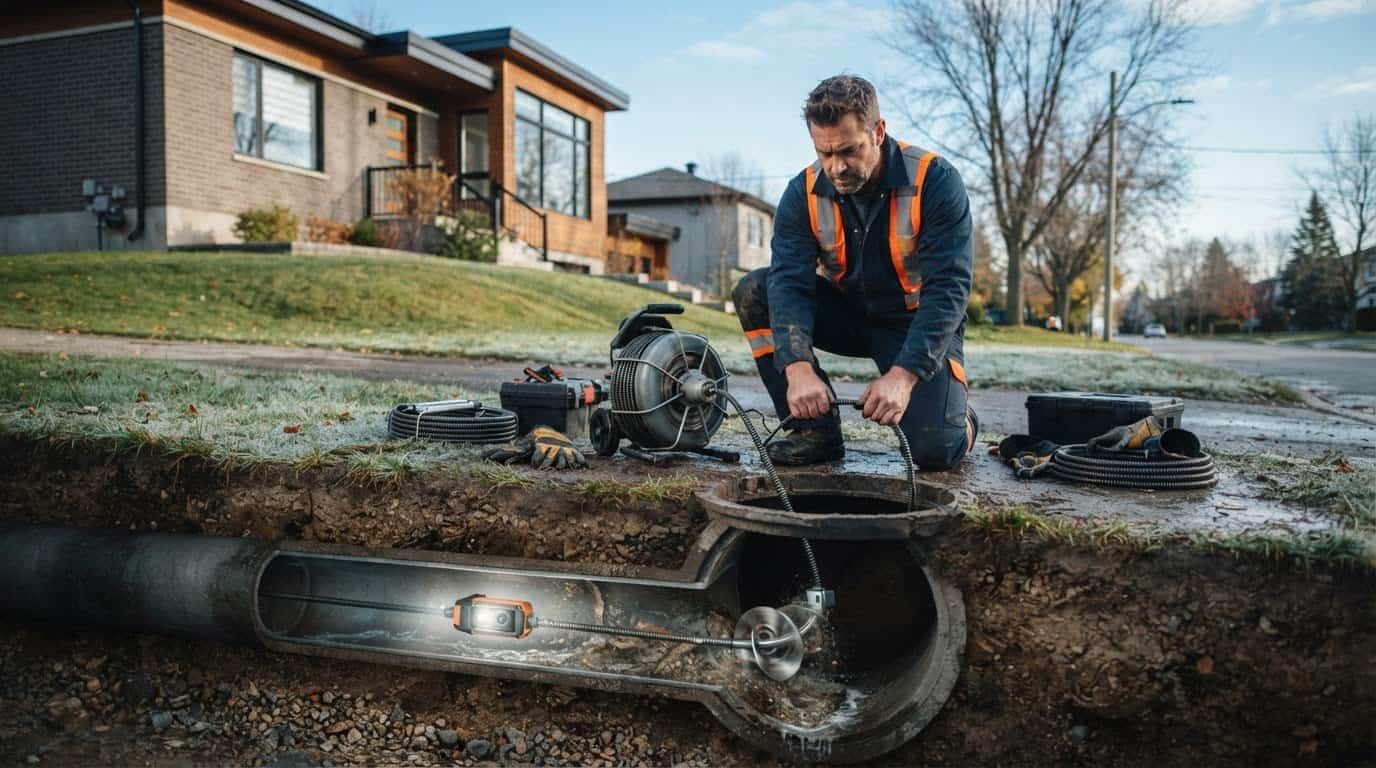
When proposed for drain cleaning, sewer pipe milling generally involves using a suitable rotating tool to remove material that restricts the opening inside a pipe. Depending on the equipment and attachment, the work may target firmly attached deposits, clean the pipe walls or cut certain obstructions. The proposal should identify the material being targeted and the intended method. RIDGID Tools
The desired result is a clearer passage. It does not mean the pipe becomes new, regains lost wall thickness or develops watertight joints. Before approving the work, the useful question is: what will be removed, which section will be treated, and how will the cleaning results be checked?
Key takeaways
- Terms such as pipe milling and mechanical descaling should be explained as a specific objective: removing a deposit, working through an obstruction or preparing a surface.
- Opening a passage through the centre of a blockage does not necessarily provide the same cleaning as an attachment that works on the pipe walls.
- Pipe material, diameter and condition influence attachment selection; a more aggressive tool is not automatically a better choice.
- Breaking material loose and managing the resulting debris are separate parts of the work to have explained.
- The final check should distinguish improved clearance, remaining deposits and the limits of the section treated.
- Cleaning should be kept separate from pipe repair or rehabilitation in both the proposal and the explanation of results.
Table of contents
- What pipe milling means in a drain-cleaning proposal
- The materials mechanical cleaning may target
- Why pipe material and condition matter
- What the proposed work should explain
- How to assess the cleaning results
- Preparing access and handling a change in scope
- Frequently asked questions about sewer pipe milling
- Agree on a cleaning objective that can be checked
What pipe milling means in a drain-cleaning proposal
Ask what the mechanical action is intended to accomplish
Pipe milling, mechanical descaling, reaming and wall cleaning can appear in discussions about work inside a sewer pipe. Do not assume these terms identify exactly the same equipment or scope. Ask the contractor to explain the intended work in everyday language.
Some systems transmit rotation through a flexible shaft to an attachment inside the pipe. For example, RIDGID’s explanation of its FlexShaft machines describes rotating chain knockers that expand to work around the pipe’s inner circumference. This illustrates one cleaning principle; it does not mean every job described as pipe milling uses that particular system. RIDGID Tools
A description such as “remove the attached deposits in this section” is more informative than “run the machine through.” The first identifies an objective that can be discussed and checked. The second tells you only that equipment will be used.
You can also ask how the contractor uses the term “milling” in your proposal. It may describe the action of a particular attachment, while the result you need to understand is the material removed and the passage left behind.
Recovering clearance does not mean enlarging the pipe
Removing accumulated material may free space that the deposits were occupying. A phrase such as “restore the diameter” therefore needs clarification: does it refer to the usable opening after cleaning, or is it being presented as a complete return to the pipe’s original dimensions?
For ordinary cleaning, the objective is to remove the targeted material, rather than turn the existing pipe into a larger pipe. If a proposal mentions grinding the pipe material itself, ask for a separate explanation of that operation and its justification. That goes beyond simply removing an accumulation.
The same distinction helps explain the word “complete.” It might mean the entire planned length was treated, all accessible surfaces were worked on or a particular obstruction was removed. The work description should identify which result is intended. Otherwise, two people can agree to “complete cleaning” while expecting different outcomes.
The materials mechanical cleaning may target
Hard or firmly attached deposits
Specialized equipment is designed to work on certain resistant deposits. Picote’s mechanical descaling accessories, for example, include tools for removing hard deposits, with applications that depend on the attachment and pipe material. picotegroup.com
An uneven surface in a camera image does not, by itself, identify the material or determine how much should be removed. Ask what supports the description of a deposit, how it restricts the opening and what result can reasonably be expected from treating it.
For example, if the proposed work is “descaling the cast-iron section,” clarify whether that means working along several metres of accumulated deposits or treating one limited area. Both descriptions involve cast iron, but they do not define the same job.
The practical decision concerns the deposit that has been identified. A general statement that older pipes can accumulate material does not explain why a particular section needs this treatment now. The recommendation should connect the observed condition to the proposed objective.
Soft obstructions or roots
RIDGID’s FlexShaft attachment documentation distinguishes smooth chain knockers for certain soft obstructions from carbide-tipped attachments intended for scale and light roots in hard-walled pipe types. That distinction does not establish that one attachment is suitable for every material found in a sewer line. RIDGID Tools
If roots are being targeted, ask what the cleaning includes: clearing the root mass, removing surrounding buildup or carrying out a separate treatment. Cleaning the pipe interior and correcting a root entry point are different questions. Our article on why roots return after sewer cleaning develops the second issue.
Keep the explanation focused on the stated work. “Root removal” should not leave you guessing whether the proposal also includes another operation or whether that would require a separate recommendation.
Surface preparation before another treatment
Mechanical cleaning can also be part of preparation for an interior coating project. Picote’s coating preparation manual describes cleaning and surface-preparation requirements before its coating is applied. www.picotegroup.com
In that situation, cleaning is one stage of a larger project. Preparation is not the coating itself, and a cleared passage does not automatically establish that the pipe is suitable for the intended treatment.
Separate the stages in your discussion: the planned cleaning, the surface check and any subsequent treatment. Ask what happens if preparation reveals that the next stage cannot proceed as expected. This keeps an initial cleaning step from being mistaken for a guaranteed final result.
The proposal should also make clear whether you are approving cleaning alone or a sequence of work. That distinction matters if a later decision depends on what becomes visible after the deposits have been removed.
Why pipe material and condition matter
Compatibility applies to the specific attachment
A sewer line may contain several materials, particularly after earlier repairs. Describing it as a “cast-iron pipe” therefore does not necessarily identify every section the equipment will pass through.
Picote’s Original cleaning chains come in several versions. The manufacturer distinguishes chains without carbide teeth for more delicate applications from other versions designed for materials such as cast iron. This shows why the machine’s name alone cannot establish compatibility.
Some attachments in that range are adjustable. Their size can be adapted to the restricted opening during initial cleaning, then readjusted as the available space increases. That helps explain why removing an accumulation may involve a progression rather than one pass with an attachment set to its final dimensions. This principle applies to equipment designed for that adjustment; it should not be transferred to an arbitrary cable or attachment. picotegroup.com
You do not need to select the tool for the professional. You can, however, ask how changes in pipe material will be handled. A useful answer identifies the known sections and any uncertainty that needs to be resolved before proceeding.
A deteriorated pipe needs an appropriate assessment
Cleaning is not automatically risk-free because it takes place without excavation. RIDGID explains that pipe condition should be assessed and that cleaning a pipe in poor condition can cause damage. www.ridgid.com
The discussion should therefore cover why the treatment is being selected despite the observed condition, its intended limits and the circumstances that would lead the operator to stop. A broad statement such as “this machine works in every pipe” does not provide those details.
Also ask how a newly visible defect will be documented. It should be possible to distinguish what was visible before cleaning, what became apparent after material was removed and what remains uncertain. That sequence helps explain the findings, although it does not, by itself, establish what caused a defect.
What the proposed work should explain
The objective and the section being treated
A clear work description connects the targeted material to an identifiable section. Compare “clean the drain” with “work on the deposits in the section accessible from this cleanout to the indicated connection.” The second description helps you understand where the work starts and where it is expected to end.
Ask what “cleaning” includes. Is the objective simply to allow water through, remove wall deposits or prepare the pipe for a later examination? These objectives may be combined, but none should be assumed from the job title alone.
The drain cleaning and unclogging service page describes the general service. For a milling proposal, focus on what this particular mechanical action contributes to the stated objective in your case.
You can summarize the explanation in one sentence before approving the work: “The proposed cleaning targets this material, in this section, for this result.” If one part of that sentence remains unclear, have it explained while the scope is still being defined.
How loosened material will be managed
Debris management belongs in the explanation of the work. Picote’s cleaning-chain manual calls for flowing water or prepared vacuum extraction for dry cleaning. Its instructions show that the tool’s action and the management of loosened material need to be considered together. www.picotegroup.com
Ask how the debris will be handled in your pipe layout. The answer should address the actual job, without assuming material disappears simply because a rotating attachment has worked on it.
You can also clarify the role of water when it is used. High-pressure jetting operates differently: RIDGID’s water-jetter description explains how a jetting hose works on blockages and flushes debris. These descriptions do not establish a universal ranking between mechanical cleaning and high-pressure cleaning. Ask why the proposed method, or combination, fits the particular objective. RIDGID Tools
When the work would stop
The proposal should explain what happens if the equipment cannot reach the planned section or a different condition is discovered. Stopping is not automatically a failed intervention; it may be necessary to reassess the method or pipe condition.
A concrete question is: “If you cannot clean this section as planned, what explanation and findings will I receive before you recommend the next step?” This helps frame the decision without trying to prescribe a technique remotely.
How to assess the cleaning results
Compare the same objective before and after
The most useful check corresponds to what the cleaning was supposed to accomplish. If the objective was to remove an attached deposit, ask what happened to that deposit. If the work was intended to prepare a surface, have the relevant preparation criteria explained.
When comparison footage is available, ask to review the same section using a common reference point. An image taken elsewhere does not provide a direct comparison. You can ask: “Where is the deposit you showed me at the beginning, and what do you see at that location now?”
The purpose is to make the explanation understandable. Our drain camera inspection page describes the role of that examination and its general limitations.
Separate improved clearance from a renewed pipe wall
The explanation of results should distinguish three things: what was removed, what remains visible and what cannot be concluded from the work. That is more informative than a statement such as “everything is fixed” without further detail.
Imagine a job intended to remove a substantial accumulation. Afterwards, the contractor explains that the passage is clearer, but one area could not be fully treated. There are two findings to record: an improvement in the cleaned section and a limitation in the other area. Combining them under “complete cleaning” would hide useful information.
Conversely, a surface that does not look like a new pipe does not automatically demonstrate unsuccessful cleaning. Ask whether the remaining appearance represents material still targeted by the treatment or the condition of the pipe itself. The answer should rest on the observations, rather than the image’s colour alone.
Have the limits of the result identified
Ask the contractor to distinguish the length treated from the total sewer-line length. If a section remained inaccessible, have that stated clearly. Successful cleaning in the portion reached is not a conclusion about the whole line.
Keep a simple note identifying the initial objective, section worked on, explained result and unresolved points. In a managed property, this gives the next person a clearer history than a general entry such as “sewer milled.”
If the discussion then moves to repair, ask for a separate recommendation. Our guide to whether a sewer line needs replacing addresses that decision. It should remain separate from evaluating the cleaning that has just been completed.
Preparing access and handling a change in scope
Prepare the area without opening the pipe
Before the visit, gather reports and invoices you already have. Information about an earlier replacement or interior coating should be passed along. Also tell the contractor whether a chemical drain cleaner has been used, including its name if known.
Make the route to the identified access point available without removing a cleanout cap or opening a manhole yourself. Ask which fixtures will need to remain unused and who will notify occupants. In a multiplex or condominium, arrange for an available contact to coordinate those instructions.
During the work, let the operator control the equipment and working area. Do not enter a manhole or try to help by holding a cable. If wastewater backs up before the visit, stop adding water to the affected drainage system and avoid contact with the liquid.
For a blocked sewer service line outside the building, an additional precaution matters in Quebec. Énergir’s English sewer-unblocking guidance explains the risk of a natural gas line crossing through a sewer and the checks required before clearing it. Mechanical tools or high-pressure jetting could damage that gas line. Have the professional handle the applicable verification. Working without excavation does not remove this precaution. Unlocking a sewer line
Confirm the revised scope if the project changes
In Laval, the City publishes English guidance on water accumulation, infiltration and sewer backup. It helps place a water problem in context. A proposal to clean the inside of a pipe does not automatically resolve an issue involving the public network. Ville de Laval
If the proposed cleaning becomes a project to construct, modify or replace a service connection, confirm the municipal requirements for that revised work. The permit provisions of Laval’s By-law L-11870, available in French, distinguish categories of work. Do not infer the applicable authorization from the term “pipe milling.” info-reglements.laval.ca
Have the change explained before approving the next stage: what new finding changes the objective, what additional work is proposed and which checks remain necessary? For detailed preparation before opening the ground, see our guide to essential checks before excavating a sewer line.
Frequently asked questions about sewer pipe milling
Does pipe milling mean the pipe will be made larger?
In a cleaning proposal, understand it as removing material that occupies the passage unless a different operation is clearly explained. Ask what “restoring the diameter” means and how that result will be checked. Cleaning does not automatically turn an existing sewer line into a larger or new pipe.
Can the machine’s name determine which treatment is appropriate?
No. The objective, intended attachment and section being treated need to be known. Two jobs using the same equipment family may target different material. Ask for an explanation tied to the pipe present, rather than a recommendation based only on the machine’s brand.
Do several passes mean the cleaning is going badly?
The number of passes alone cannot establish that. With certain tools, initial work opens the passage before more extensive wall cleaning. Ask what each stage is intended to accomplish. Progress toward the planned result matters more than an assumed number of passes that should apply to every pipe.
Why keep a record if drainage improves?
It preserves what the work actually covered: targeted material, section reached and explained limitations. That record supports later decisions and the transfer of information between owners or property managers. Improved drainage and a description of what was cleaned provide complementary information.
Does pipe milling necessarily include an interior coating?
No. Cleaning can be a preparation stage, while coating is separate work. Have the two distinguished in the proposal and ask what criteria will allow the next stage to proceed. Completed preparation does not, by itself, mean the treatment has been applied or its suitability confirmed.
What should I ask if the planned section was not fully treated?
Ask where the work stopped, why it stopped and which portion still needs assessment. Have that limitation retained in the explanation of results. The next proposal should explain how it addresses that specific issue, rather than simply repeat the same cleaning description.
Agree on a cleaning objective that can be checked
To understand a sewer pipe milling proposal, seek clear answers to four questions: what material is being targeted, which tool is suitable, what section will be treated and how the result will be explained.
You can then separate completed cleaning from a possible repair and understand the stated limitations. To discuss a proposal concerning your drain or sewer line, contact Plomberie Laval. Describe the suggested treatment and share the documents available so the next decision can be clarified.