Low pressure throughout the house, a continuous running-water sound or wet ground between the street and foundation may point to the water service line. However, these signs do not prove that the underground pipe must be replaced.
A partly closed valve, defective pressure regulator, restriction in the indoor plumbing, municipal work or a leak after the pipe enters the building can produce similar symptoms.
Before opening the ground, three questions need to be answered: Does the problem affect the entire building? Is it located before or after the indoor main shutoff valve? Is there enough evidence of a defect in the buried service line?
The short answer: isolate the source before discussing replacement
The water service line supplies the building from the municipal distribution system. Because it remains pressurized, a perforation can release water continuously, even while every fixture is turned off.
A service-line problem becomes more plausible when several indicators occur together:
- pressure has decreased at every fixture;
- flow drops sharply when two fixtures operate simultaneously;
- water can still be heard when nothing is being used;
- part of the property remains wet without recent rain;
- water appears near the point where the pipe enters the foundation;
- recorded consumption increases without explanation, when a meter is present;
- the visible indoor section is old, corroded or made from a concerning material;
- checks inside the building do not explain the problem.
One sign alone is not always conclusive. A reliable diagnosis compares the behaviour of the indoor plumbing, the condition of accessible piping, exterior conditions and municipal information before recommending underground work.
Pressure and flow do not describe exactly the same problem
In everyday language, a small amount of water coming from a tap is often described as “low pressure.” The symptom may actually result from either insufficient supply pressure or a restriction that limits flow.
Understanding the difference helps direct the initial checks.
Only one fixture is affected
If the problem occurs only at the bathroom sink or shower, the water service line is unlikely to be responsible.
The more likely items to check include:
- the faucet aerator;
- the mixing cartridge;
- the showerhead;
- a local shutoff valve;
- a kinked flexible connector;
- buildup inside a small pipe.
Cold water is normal, but hot-water flow is weak
When only the hot water has poor flow, the cause may be related to the water heater, a valve or the hot-water distribution system. A defective water service line would normally affect the building’s cold-water supply as well.
The entire house is affected
A building-wide reduction deserves a broader investigation. Possible causes include:
- a partly closed main shutoff valve;
- a defective pressure regulator, if the installation has one;
- a clogged filter or water-treatment device;
- a restriction in the indoor main supply pipe;
- a significant leak after the service enters the building;
- a corroded, crushed, undersized or leaking water service line;
- a temporary pressure reduction in the municipal system.
A building-wide problem directs attention toward the main supply, but it does not yet locate the defect.
Careful checks to make before discussing replacement
Several observations can be made without dismantling plumbing or manipulating municipal equipment.
Compare several fixtures
Test the kitchen faucet, a bathroom sink and a fixture on another floor separately. Note whether the problem is the same everywhere or limited to one area.
Then observe what happens when two fixtures operate simultaneously. A major reduction in flow during combined use may indicate a restriction, but it does not reveal where that restriction is located.
Determine when the problem began
A sudden loss of pressure suggests different possibilities than a gradual decline over several years.
A sudden change may coincide with:
- municipal work;
- a valve being closed or adjusted;
- a recent pipe failure;
- work performed on the plumbing;
- a clogged treatment device.
A gradual decline may correspond to internal corrosion in an older pipe, accumulated deposits or a diameter that no longer meets the building’s current demand.
Listen while everything is turned off
After closing the taps and confirming that toilets, the washing machine, dishwasher and connected appliances are not using water, listen near the main shutoff valve.
A continuous sound may indicate flowing water, but sound can also travel through pipes from an appliance, a neighbouring unit or the distribution network. It should be interpreted with other evidence.
Examine the property without digging
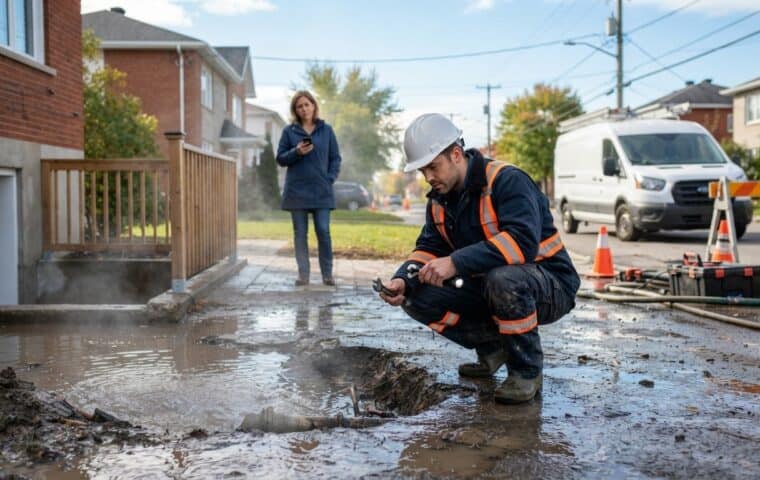
Persistent wet ground, a depression or unusually green vegetation may be compatible with an underground leak.
Before drawing a conclusion, other possible sources should be considered:
- roof drainage;
- irrigation;
- a foundation drain;
- a sump pump;
- a sewer line;
- melting snow;
- groundwater;
- a naturally low area.
Surface water does not identify which pipe is affected or who is responsible for it.
Inspect where the pipe enters the building
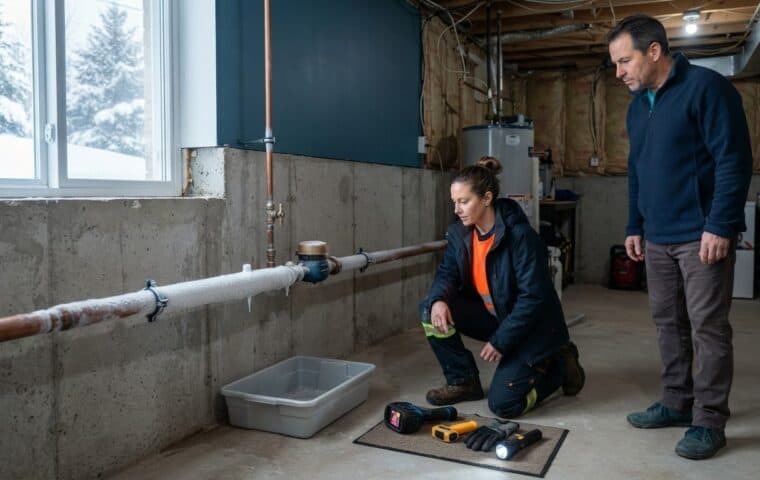
The visible section near the foundation may provide clues about the pipe material and condition of its connections. Look for moisture, corrosion, deposits or evidence of a previous repair.
Do not scrape, cut or attempt to bend a questionable pipe. Older piping may be weakened, and the visible section does not always identify the material used throughout the underground route.
How to distinguish an indoor leak from an underground leak
The defect’s location completely changes the required work.
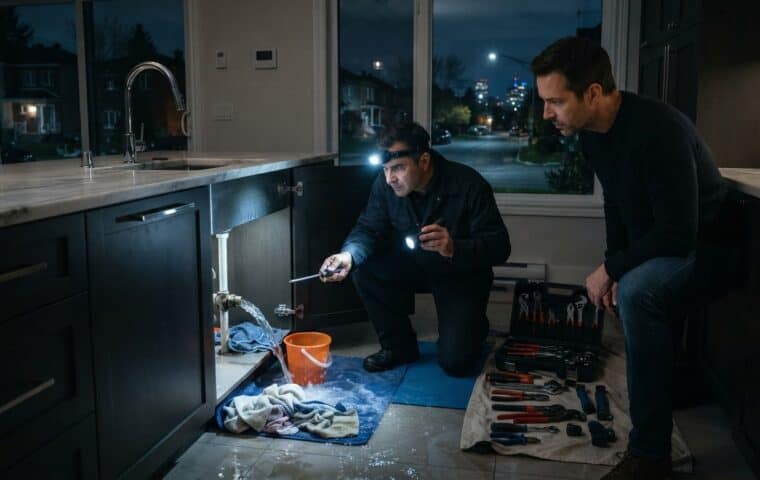
A leak located after the main indoor shutoff may come from interior piping, a fixture, the water heater or a concealed connection. The situation may call for leak detection inside the building rather than automatic replacement of the buried service line.
A leak between the municipal system and the building entry may require exterior locating and, depending on the defect, repair or replacement of the water service line.
The assessment may include:
- inspecting accessible indoor connections;
- comparing pressure or flow at different points;
- isolating certain fixtures or equipment;
- reviewing consumption when a meter is available;
- specialized listening or other detection methods;
- checking the presumed route of the service line;
- coordinating with the municipality when the public section may be involved.
If water is visibly leaking indoors, the water leak repair page explains situations that may be corrected without excavating the property.
When does replacement become a reasonable possibility?
Complete replacement is not the only answer to every leak. A localized repair may be appropriate when an isolated defect is accessible and the rest of the service line remains in suitable condition.
Replacement becomes more reasonable when:
- the pipe material is severely deteriorated;
- several leaks or previous repairs are present;
- the pipe is heavily corroded internally;
- its diameter restricts supply throughout the building;
- its route or connections do not permit a reliable repair;
- the service line contains lead;
- the remaining section is likely to fail shortly after a localized repair;
- applicable requirements call for more extensive correction.
The decision should compare the immediate cost of repair with the risk of reopening the same surfaces for another failure.
An older service line is not automatically made of lead
The building’s age may increase the likelihood of certain materials, but age alone cannot confirm a lead water service line.
The Government of Québec explains that lead service lines were installed mainly in single-family homes and buildings with fewer than eight apartments, particularly between 1940 and 1955, and sometimes into the 1970s. Its official information about lead in drinking water also states that Québec’s maximum allowable concentration is 5 µg/L.
The visible pipe inside the building may not tell the entire story. The private and municipal portions can be made from different materials.
For this reason:
- a visual identification should be confirmed;
- water testing should follow the proper sampling protocol;
- boiling water does not remove lead;
- cold water should be used for drinking and cooking;
- a filtration device should be certified for lead reduction and maintained according to the manufacturer’s instructions;
- the municipality should be consulted about the public portion.
The Government of Québec states that when both the public and private portions of a service line are made of lead, they should be replaced at the same time to resolve the problem properly.
The City of Laval also publishes a municipal plan for reducing lead in drinking water. This local document is available in French.
Who is responsible for the pipe?
The curb-stop box, sometimes called a service box or “bonhomme à eau,” is an important part of the connection. However, it should not automatically be presented as the exact legal boundary in every situation.
Responsibility may depend on:
- the property line;
- the defect’s position;
- the connection’s configuration;
- municipal regulations;
- the section of the system where work is required.
In Laval, Bylaw L-11870 governs water and sewer connections, drainage and certain work on private property or within the street right-of-way. The City provides an English permit finder as a municipal starting point. Its detailed page about connection permits is currently available in French.
Before authorizing work, confirm:
- where the defect is located;
- where the property line lies;
- which section is the owner’s responsibility;
- which section is the City’s responsibility;
- who must apply for the permit;
- who coordinates the shutoff and restoration of service;
- whether a municipal inspection is required before backfilling.
A property owner should never attempt to operate a valve located within the municipal right-of-way.
Open trench or limited-excavation method?
Two replacement projects may use very different methods. The choice depends on the route, existing pipe material, soil, depth, obstacles and the techniques actually offered by the contractor.
Open excavation
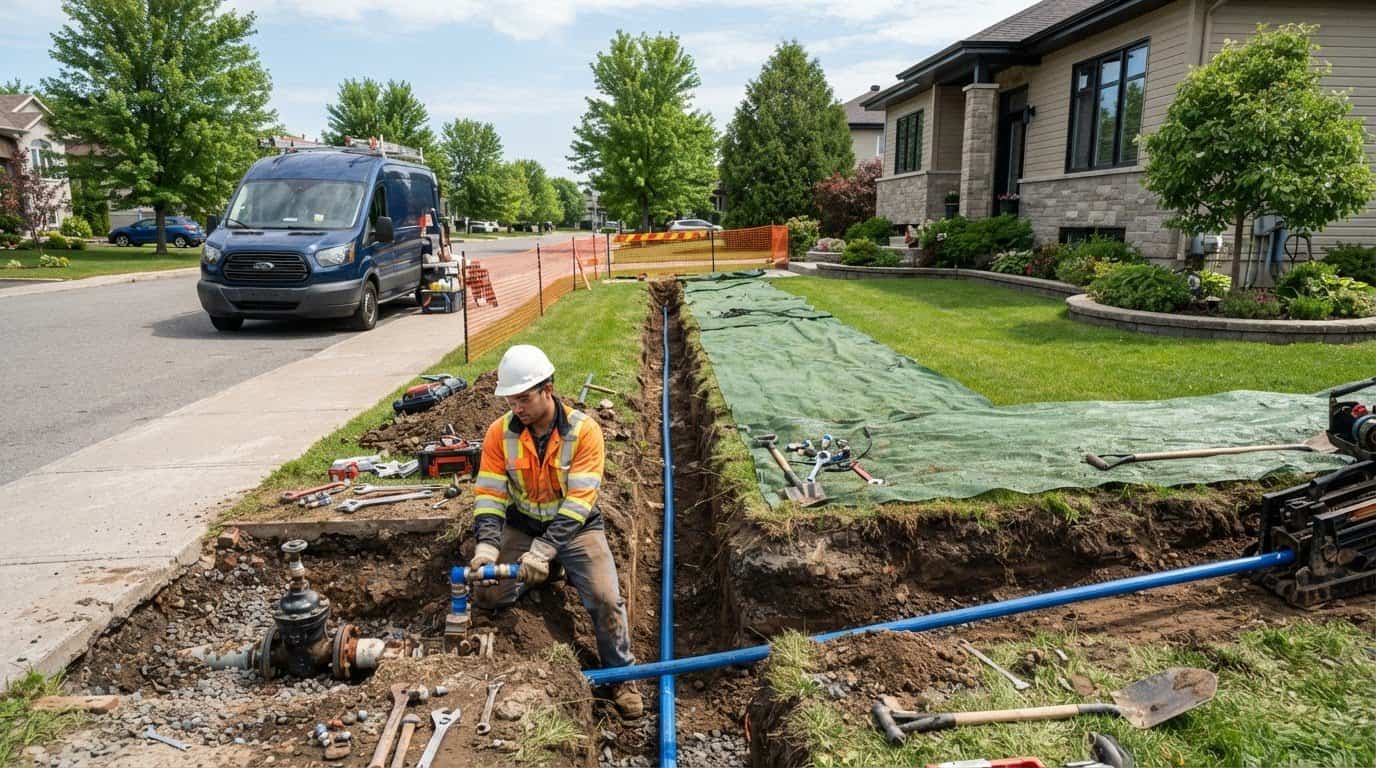
A trench provides direct access to the pipe and surrounding soil. It may be appropriate when the project requires:
- correcting the route;
- preparing new pipe bedding;
- working around several connections;
- avoiding obstacles;
- inspecting unstable ground;
- replacing a pipe that cannot be used as an installation path.
The effect on grass, asphalt, concrete or interlocking stone should be clearly described in the quote.
Replacement through limited access points
Some configurations allow a new pipe to be pulled or inserted from targeted access points. This approach may reduce the amount of surface opened, but it is not suitable for every property.
Its feasibility may be limited by:
- changes in direction;
- a collapsed or inaccessible existing pipe;
- intermediate connections;
- bedrock;
- nearby buried utilities;
- insufficient equipment access;
- municipal requirements;
- an incompatible pipe material or diameter.
The term “trenchless” does not necessarily mean “excavation-free.” Openings may still be required near the foundation, connection point or a change in direction.
No installation method should be promised before the actual route and site conditions have been evaluated.
What must be verified before digging begins
Replacing a water service line requires more than an agreement between the owner and contractor.
Permits and municipal requirements
The applicable procedure should be confirmed with the City before scheduling the project. Required plans, inspections, fees, processing times and water-shutoff procedures can vary according to the scope.
Buried-utility locating
A locate request should be submitted through Info-Excavation. The organization states that this service is free and that three business days should be allowed for a planned request.
Info-Excavation also explains that private installations and networks belonging to non-member organizations are not automatically covered.
Additional locating may therefore be required for:
- a cable supplying a detached garage or shed;
- an irrigation system;
- a pipe serving a swimming pool;
- outdoor lighting;
- an abandoned installation;
- the private service line being repaired.
Access to the property
The contractor should check access width, slopes, steps, trees, fences and which surfaces can support the equipment.
Worksite safety
A trench can collapse even on a residential property. Depth, soil conditions, water, nearby machinery and worker access all affect the required protective measures.
Our guide to the essential checks before excavating a sewer line provides more information about utility locating, trench safety and backfilling scope. Although it focuses on sewer lines, those excavation-planning principles also apply to a water service project.
What should the quote specify?
A serious estimate should contain more than the words “water service line replacement.”
It should define:
- the section covered by the work;
- the starting and ending points;
- the proposed pipe diameter and material;
- the installation method;
- included indoor connections;
- foundation penetration and sealing;
- valves being replaced or retained;
- municipal coordination;
- included or excluded permits and inspections;
- the locate request;
- surfaces that will be opened;
- disposal or reuse of excavated materials;
- backfill and compaction;
- restoration of grass, asphalt, concrete or pavers;
- conditions that could change the price;
- testing planned before the excavation is closed.
Ask whether plumbing and exterior restoration are part of the same contract. Backfilling, paving and landscaping may be separate scopes.
Verify qualifications without assuming which licence subclasses apply
The project may combine plumbing, excavation, grading and surface restoration. Required licences therefore depend on the work each contractor will actually perform.
The Régie du bâtiment du Québec recommends checking the contractor’s licence, including:
- the company’s legal name;
- its licence number;
- licence classes and subclasses;
- any restrictions;
- the security associated with the licence.
The CMMTQ member directory, available in French, can also be used to verify a plumbing contractor’s membership.
Instead of relying on a licence subclass listed in a general article, ask the contractor to identify the licences covering the plumbing and any other work included in the contract.
When should you act quickly?
Prompt attention is justified when there is:
- an active leak near the foundation;
- water infiltration threatening the basement;
- a sudden and substantial pressure loss;
- ground settlement that is getting worse;
- continuous water flow with no fixture operating;
- a failure that prevents normal water service;
- a risk of freezing or structural damage.
Reduce water use if it is worsening the damage. If the municipal section may be involved, contact 311 so the situation can be directed to the appropriate City department.
Do not enter an excavation or attempt to operate municipal equipment.
Frequently asked questions
Does low pressure mean the water service line must be replaced?
No. An aerator, valve, filter, pressure regulator, indoor plumbing or the municipal network can cause a similar symptom. The buried main supply pipe should be confirmed as the source before replacement is considered.
Why does flow drop mainly when two taps are used?
A partly restricted or undersized pipe may supply one fixture but not allow enough water for several simultaneous uses. A partly closed valve or clogged filter can produce the same effect.
How can an underground leak be identified?
Continuous water sounds, wet ground, unexplained consumption and lower pressure can direct the investigation. Professional locating may still be required to distinguish a water service leak from drainage, groundwater or an indoor plumbing problem.
Can responsibility be determined from the curb-stop box?
Not with certainty in every case. The defect’s position, property line and municipal rules should be verified before responsibility is assigned.
Should a lead water service line be replaced?
Lead is a potential source of drinking-water contamination. The Government of Québec recommends simultaneous replacement when both the municipal and private sections are made of lead. The situation should be confirmed with the municipality and, when appropriate, through testing performed under the proper sampling protocol.
Does boiling water remove lead?
No. Lead does not evaporate. Boiling water can increase its concentration as water evaporates.
Is a trenchless method always possible?
No. The route, bends, condition of the old pipe, soil, bedrock, nearby utilities and available working space may make open excavation necessary.
How long does replacement take?
The timeline depends on length, depth, access, soil, installation method, municipal procedures and surface restoration. A shutoff lasting only a few hours may sometimes be possible, but it should not be guaranteed before the project is defined.
Who shuts off the water on the municipal side?
The procedure must be coordinated with the City according to the connection’s configuration. A property owner should not operate municipal equipment.
Does insurance cover a failed water service line?
Coverage depends on the policy, cause and protection purchased. Document the damage, retain reports and quotes, and contact the insurer before work begins when circumstances allow.
Confirm the cause before opening the ground
A water service line should not be replaced solely because one tap has poor flow or part of the yard is wet. The proper approach is to eliminate indoor causes, confirm a leak or restriction in the main supply, locate the affected section and verify municipal responsibility.
Once the defect and project scope have been documented, it becomes possible to compare a localized repair, a more extensive replacement and the access methods compatible with the property.
If an underground leak, lead service line or significant restriction is confirmed, the water service line replacement page explains the service, the situations addressed and the information needed to have the project assessed.