A noise in a drain, a puddle discovered when you get up or a leak that is still running at midnight do not necessarily call for the same response. The immediate question is not which part has failed: is anyone in danger, is water still entering or backing up, and is the damage spreading? If so, seek help without waiting for morning. If the problem has stopped and the area remains safe, you may be able to stop using the affected fixture, record what happened and arrange a follow-up as soon as possible.
Night makes the situation harder to assess. Visibility is poor, other occupants may be asleep, and you may be tempted to “test it one more time” to find the cause. This guide helps you make a cautious decision from what you can observe. It distinguishes immediate danger, an active problem and a stable symptom; it cannot replace an on-site assessment or instructions from emergency services.
Key takeaways
- Stay away from any area where water is touching or may reach electrical equipment. Protecting people comes before finding the leak.
- A leak you cannot contain, wastewater backing up or damage that keeps spreading warrants a call during the night.
- An isolated noise or slow drain without an overflow may sometimes be monitored until morning, provided you stop using anything that could make it worse and reconsider if conditions change.
- Do not run a tap or flush a toilet to confirm a suspected backup. Record what has already happened.
- When you call, give the address, building type, how the problem has changed, any hazards and the steps already taken. Confirm availability and the terms of the visit.
Table of contents
- Make the first decision: danger, active problem or stable situation
- Recognize signs that call for help during the night
- Take safe steps without attempting a repair
- Observe and document without forcing a diagnosis
- Notify the right people for the building and situation
- Prepare the call and wait without making things worse
- Follow up once the situation is stable
- Frequently asked questions
Make the first decision: danger, active problem or stable situation
Start with safety. If someone could receive an electric shock, reaching the problem would require crossing water near an electrical installation, or the situation otherwise poses an immediate threat to occupants, move people away and seek the appropriate emergency help. Do not go into a flooded basement to reach the electrical panel. Hydro-Québec explains that water damage can create an electrical hazard and that you should leave the area and ask for help if the power cannot be shut off safely. Finding a plumbing problem is never worth taking that risk. www.hydroquebec.com
If there is no immediate danger, ask whether the problem is active. Is water still flowing after the fixture is turned off? Is a wet mark spreading across the floor, wall or ceiling? Is water rising into a shower, toilet or drain? Is the level increasing in a sump pit or around an appliance? These observations may justify a call at night. They do not, by themselves, establish whether the cause is a fitting, a pipe, the building’s drainage system or something outside.
Finally, identify what appears stable without treating that word as a guarantee. A small leak stopped by an accessible shut-off valve, one slow sink that is not overflowing, or a single unusual sound may be dealt with in the morning if the area stays dry or protected and nobody needs to use the affected fixture. If you cannot isolate the source, the symptom returns, water spreads, or the only usable toilet becomes unavailable, reconsider rather than relying on your first decision.
There is no universal amount of water below which it is always safe to wait. A few drops collected in a visible container are different from moisture passing through a ceiling, wall or the unit below. Access and control matter too: do you know where the water is appearing, can you stop the relevant use, and can you check again without entering a hazardous area? If the answer is no, it is reasonable to call and describe the situation even though the cause remains unknown.
Recognize signs that call for help during the night
An ongoing supply-side leak calls for a prompt response when it does not stop after an accessible valve has been closed and water is reaching building materials, belongings or another unit. You may see a pipe or fitting; water can also emerge far from its source after travelling inside a wall or ceiling. Report roughly how quickly it is escaping, the area affected and what happened after any safe attempt to shut it off. Do not open a wall to “save time” before the problem is assessed.
An active sewer backup changes the immediate steps. If water is coming back out of a fixture or drain, stop using fixtures that discharge water and tell other occupants not to add more. Even water that looks clear may be unsafe if it has come back through the drainage system. Keep your distance and ask for help. Do not test the blockage by flushing again or running the washing machine. Our guide to the reliable signs and possible causes of a sewer backup (in French) explains how to interpret the event; the question here is safety and whether to call during the night. plomberie-laval.ca
Water spreading quickly through a basement might come from a water supply, infiltration, sump pit or drainage system. Do not choose a repair from the puddle alone. The concern is greater when outlets, appliances, cords or the electrical panel are near the water. Do not cross it to check a pump or move a plugged-in appliance. Our article on water in the basement after heavy rain discusses the different entry points when the area can be observed safely.
By contrast, one slow drain, without rising water or an overflow, does not automatically require a plumber to travel in the middle of the night. Stop using the fixture if its level could rise, and watch for other signs without deliberately repeating the test. Gurgling alone does not establish that the main drain is blocked; our guide to a gurgling drain explains that question in detail. If another fixture begins to react, water backs up or the only toilet becomes unusable, the urgency changes. plomberie-laval.ca
No hot water, without a visible leak or other hazard, can generally be reported and scheduled without handling the water heater at night. A tank releasing water or a wet area near its electrical components is a different situation. Do not remove a panel or touch wet electrical equipment. Describe what you can see from a safe distance and report any active flow.
Take safe steps without attempting a repair
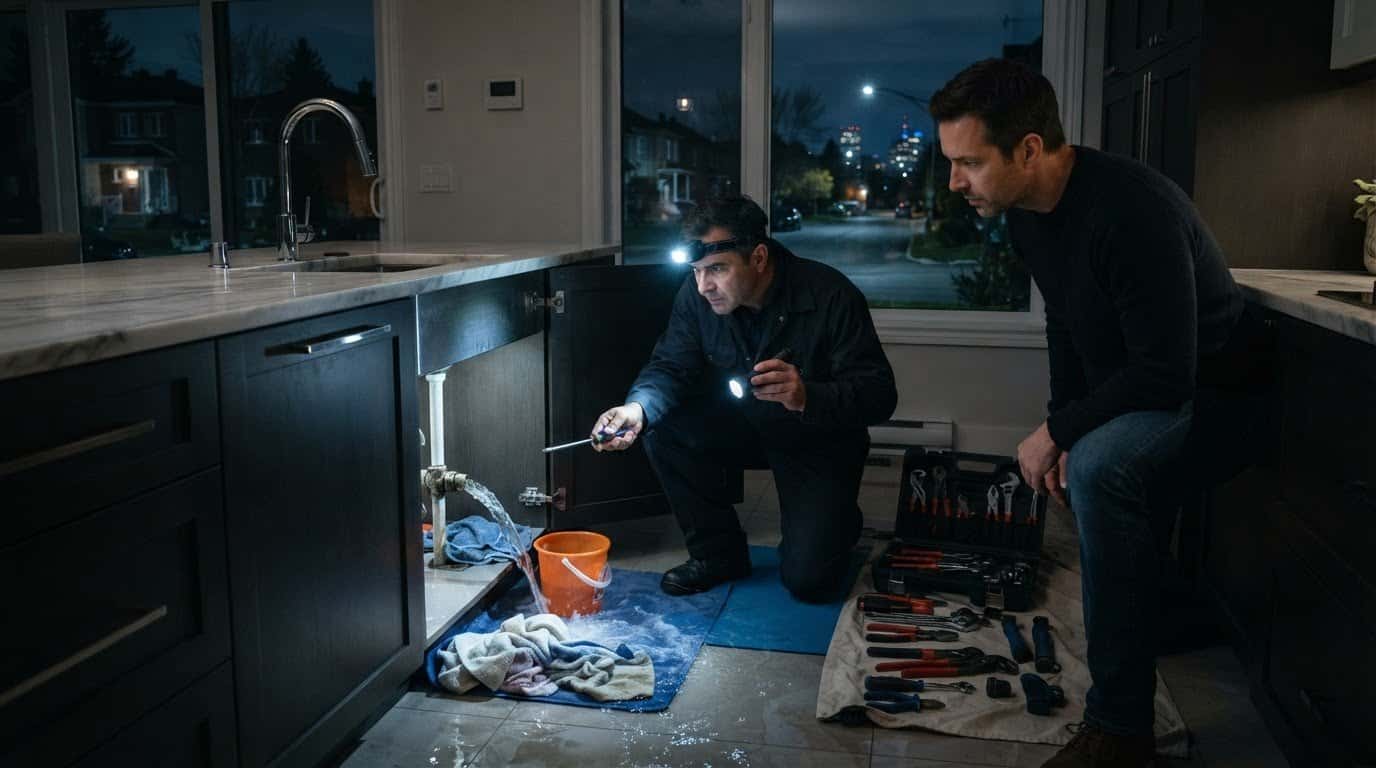
For a water-supply leak, you may consider closing the fixture’s shut-off valve or the interior main shut-off if you know where it is and can reach it from a dry, safe area. Act only if you know which valve to use and it moves normally. Do not force an old valve or cross flooded ground to reach it. After closing it, observe from a distance whether the flow slows. If it continues, say so when you call; that information may affect the priority or the type of assistance required.
For water backing up from a drain, the main step is different: stop adding water to the drainage system. Tell other occupants not to use the toilets, showers, washing machine or dishwasher connected to the affected drainage system, as far as you can determine. Do not pour in chemical drain cleaner or insert a tool into water that may be contaminated. Tell the professional if a product has already been poured into the drain. Keep children and pets away.
If water is approaching an outlet, cord, pump, water heater or electrical panel, do not touch the water or equipment. Hydro-Québec distinguishes between a situation in which you can act before water enters and one in which the building is already wet. Advice to shut off the power never means walking through water to reach a breaker. Follow its water damage and flooding safety instructions and seek qualified help if access is unsafe. www.hydroquebec.com
Move belongings only from a dry area and without approaching potentially contaminated water or an electrical hazard. You might place a container beneath an accessible drip, protect an item that is still dry, or close a room off to limit access, if those actions are safe. They do not correct the cause. Do not dismantle a trap, handle a submerged pump or turn on an appliance “to see whether it works now.” Your aim overnight is to protect people, limit incoming water when you safely can, and make it easier for the right person to take over.
If authorities order an evacuation during flooding, follow their instructions. The Gouvernement du Québec also advises against crossing flooded areas, where hazards can be hidden. Those instructions take priority over saving equipment or collecting more observations. Gouvernement du Québec
Observe and document without forcing a diagnosis
Once immediate hazards have been addressed, note the time, location, changes and affected fixtures. Was the water already present when you found it? Can you still see more arriving? Did you see it rise through a drain, or did you only find a puddle nearby? Was a shut-off valve closed, and what happened afterward? Separating what you saw from what you assume helps avoid directing the eventual investigation toward the wrong system.
A short video or photo taken from a safe place can show how a stain or water level is changing. Do not delay a call for a better picture or approach a dangerous area for a camera angle. If several units are affected, neighbours’ observations can help establish the timeline, but they do not prove that the municipal network caused the problem. Likewise, heavy rain provides context; it is not an automatic diagnosis of a sewer backup.
Explain what happened while nobody was knowingly using water, based only on what has already occurred. There is no need to open a tap or flush a toilet to reproduce the incident. In a multi-unit building, one occupant may not know that someone upstairs is using the plumbing; say what you know and what remains uncertain. “There was water around the floor drain at 1 a.m., but I did not see it come out” is more reliable than “the city sewer backed up” without a corresponding observation.
If the problem seems to have stopped, record what supports that conclusion. A floor that is dry for the moment does not prove that hidden moisture is no longer entering behind a finished surface. From a safe place, watch for a growing mark, a returning drip or another fixture becoming affected. This reassessment matters if you plan to wait until morning. If you must sleep and cannot check an installation that may overflow, call for advice instead of assuming it will remain stable.
Notify the right people for the building and situation
In a single-family house, the plumber’s role concerns the plumbing and building. If water is overflowing in the street, a sewer opening poses a hazard or several properties appear affected, also report what you see to the municipality through its appropriate channel. Water in your basement does not automatically establish that the public network is responsible. The City of Laval distinguishes water accumulation, infiltration and sewer backup and explains how a service connection is assessed. Ville de Laval
In a rental unit, notify the landlord or the person responsible for building emergencies when water threatens other units, a shared water shut-off may be needed, or access to a pipe is controlled. In a condominium, notify the condo board or property manager according to the building’s procedure. These calls need not delay an assessment of an active leak or backup. They help arrange access to shared systems and warn affected neighbours.
In Montréal, the City asks residents to report a sewer opening that overflows near a home or presents a danger, and directs potentially dangerous situations requiring immediate municipal attention to 311. That specific municipal guidance is available in French. Contact procedures and hours vary by municipality and situation. If someone is in immediate danger, use emergency services rather than relying solely on a municipal request. montreal.ca
If water must be shut off outside the building because the indoor valve does not solve the problem, do not attempt to operate municipal equipment yourself. Tell the plumber what you tried and ask which service must be contacted for the address. For a Montréal property, the City publishes an English procedure for requesting a water service shut-off; elsewhere, check the local procedure. montreal.ca
Prepare the call and wait without making things worse
Begin the call with the current risk before going through the entire history: “Water is still coming out beneath the sink even after I closed the fixture valve,” or “Water is rising through the floor drain; we have stopped using the fixtures.” Then give the full address, building type, floor, access details and callback number. Explain when you noticed the problem, whether it is getting worse, whether electrical equipment or other units are at risk, and what you were able to do safely.
Ask whether someone can actually attend your address, the expected arrival window and what precautions are recommended while you wait. Clarify any service-call fee, overnight billing terms and what must be assessed on site before a repair price can be given. If availability cannot be confirmed and damage is progressing, continue seeking appropriate help. A service advertised as available 24 hours a day does not by itself guarantee a particular response time for every address.
While you wait, keep a dry, safe route to the affected room clear and, if possible, to an accessible shut-off valve. Tell the other occupants which fixtures must remain unused. Keep your phone available; if conditions change, report that change rather than waiting for the estimated arrival. Do not turn the water or electricity back on merely to demonstrate the problem while a hazard remains.
Plomberie Laval says it receives urgent requests at 450-241-0488, day and night, in Laval, on the North Shore and in the Montréal areas it serves. Its English plumbing services page describes the work offered. Availability and the arrival window must be confirmed during the call. This guide helps you describe and prioritize the situation; it cannot replace the plumber’s assessment. plomberie-laval.ca
Follow up once the situation is stable
An overnight service visit may stop water from escaping without completing the permanent repair. Ask what was found, what was done, what must remain out of service and what you should avoid until follow-up. If a part must be ordered or a pipe examined more closely, ask how the next stage will be documented and arranged. Do not assume that the absence of visible water the following morning means that moisture inside building materials is gone.
Keep any photos taken safely, important times, messages, the work order and the invoice. Report damage promptly to the landlord, condo board or insurer as appropriate; each may request different documentation. If water came from a drain or a flood, do not begin cleaning while the area is still hazardous. The Gouvernement du Québec’s post-flooding guidance addresses safety and drying damaged materials. Gouvernement du Québec
Return to the question that remains open: why did the problem happen, and does anything else need checking before normal use resumes? A temporary intervention, a cleared drain or a closed valve may not answer that question. Investigating the cause and any additional work belongs to the follow-up, informed by what you observed overnight. This keeps a decision made under pressure from becoming a final conclusion about the condition of the whole system.
Frequently asked questions
Can a small leak wait until morning?
It may sometimes be followed up in the morning if an accessible valve has stopped it, the area remains safe and no damage is spreading. A drip disappearing into a wall or reaching the unit below may need faster attention than a larger volume collected in a visible, contained area. If you cannot control or monitor it, call and describe the situation.
Should I shut off the water to the entire house?
Not automatically. A known, accessible fixture shut-off valve may be enough for a single fixture. If the leak continues, the interior main shut-off may need to be considered, but only if you know how to operate it safely. Do not force a valve or cross water near electrical equipment to reach one.
Is a gurgling drain at night an emergency?
An isolated sound, without a significant slowdown or rising water, is not proof of an emergency. Stop using the fixture if it might overflow and note the sound for follow-up. If water backs up, several fixtures react or the only toilet becomes unusable, the decision changes: report those facts during a call.
What should I do if wastewater comes up in the basement?
Tell occupants to stop using fixtures that add water to the drainage system, keep people and pets away, and avoid contact with the water. Do not add drain cleaner or try to open the pipe. If water threatens electrical equipment, move farther away and seek help suited to that hazard. Have an active backup assessed without waiting.
Can I wait for the plumber in a basement with water on the floor?
Stay in a dry, safe part of the building. Do not walk through water to reach an appliance, the electrical panel or the place where you think the leak began. If access or remaining in the area is unsafe, leave it and follow the instructions of the appropriate emergency service. Tell the plumber about the hazard before arrival.
Who should I call if the street is flooded or a sewer opening is overflowing too?
Report the outdoor problem to the municipality as well as describing the damage inside the building to the appropriate professional. Give the address, the exact location of the overflow and what you can see without approaching it. Water in the street does not prove that every indoor leak has the same cause. If people are in immediate danger, contact emergency services.
At night, the decision rests on three things: danger to people, water still entering or backing up, and damage that keeps spreading. Stay away from electrical and contamination risks, limit water use only when you can do so safely, and pass on precise observations. A stable situation may be followed up in the morning; an active or uncertain one warrants a call to establish the next step.