Is water staying in your kitchen sink or draining much more slowly than it used to? Start with what you can see without opening a pipe: the position of the stopper, debris caught at the drain opening, the behaviour of both basins and the condition of the cabinet below. These checks may reveal a simple obstruction at the surface or give you a clearer description of the problem. They cannot tell you with certainty where a restriction lies inside the plumbing.
Set a limit before doing anything else. Do not add water to a basin that might overflow. Do not try to clear a sink that may contain a chemical drain opener or water coming back from a shared drain. The steps below are for a kitchen sink in a house, apartment or condo in Laval. They keep the inspection visible and leave the trap and pipe connections intact.
Key takeaways
- First check whether a basket strainer, stopper or other accessory is simply blocking the sink opening.
- With a double-basin sink, recall what both basins did during normal use; do not fill them to force the symptom to appear.
- Water inside the cabinet may indicate a leak as well as a drainage problem. Look without loosening fittings.
- If a dishwasher cycle already made water rise in the sink, note when it happened and avoid running another cycle until the drainage is checked.
- Do not use a corrosive product, boiling water or a plunger if a drain opener has been poured in or the water may be contaminated.
- If the visible checks do not explain the slowdown, or water appears at another fixture, stop testing and arrange an assessment.
Table of contents
- Start with the water level and the type of problem
- Check the drain opening and sink accessories
- Observe both basins and the dishwasher
- Look beneath the sink without opening pipes
- Decide whether a limited attempt is appropriate
- Describe the problem and reduce new buildup
- Frequently asked questions
Start with the water level and the type of problem
Before reaching for a tool, look at the water level. If it has stopped rising and is draining slowly, you can observe the sink during ordinary use. If it no longer drains, turn off the faucet and leave the sink unused. Emptying a pot of water into it “to see what happens” adds volume without locating the blockage. Move vulnerable items away from the area if you can do so safely, and avoid leaning over liquid whose contents you do not know.
Ask one practical question: is the water staying in the basin, or is the main concern a puddle inside the cabinet or on the floor? Both can happen together, but they are different observations. Restricted drainage can raise the level in the sink. Moisture beneath the faucet, a supply hose, the drain basket or a fitting may instead suggest a leak. A wet floor by itself does not establish that the drain is clogged.
If water emerges from another plumbing fixture while the kitchen sink is used, stop using the affected plumbing. Our guide Why Is Water Backing Up Into Another Drain? explains those interactions between fixtures. The checks in this article end before deliberately recreating a backup. Even an isolated slow sink cannot establish from a description alone whether the restriction is in its trap, its branch line or a pipe farther away.
Recall the sequence without causing another overflow
Recent events are more useful than a string of new tests. Did drainage slow after rinsing a greasy pan, washing a large load of dishes or no obvious event? Did someone set the stopper to soak cookware? Did the change happen suddenly or over several days? These details describe the circumstances; none identifies the material or exact location of a blockage on its own.
Ask the other occupants what has already been done. Was a drain opener or bleach poured into the sink? Did a small object fall through the opening? Did the dishwasher empty just before the water level rose? If you cannot establish what product might be in the retained water, do not handle it. Keep the container or photograph its label for the person who will work on the drain.
Check the drain opening and sink accessories
A kitchen-sink basket may serve two purposes: catching scraps and, in some positions, acting as a stopper. When water pools, visually check whether the stopper is closed. Some designs close when pressed, while others turn or depend on the position of a movable piece. Lift or reposition only an accessory meant for the user to handle. Do not force it or unscrew the drain assembly attached to the sink.
If no chemical has been used and the water does not appear to be backing up from another drain, a removable basket can be lifted out according to its instructions so that caught scraps can be discarded. Take the material out of the sink rather than pushing it through the opening. Drain Cleaning: Safe Maintenance and Warning Signs covers accessible components in more detail for a fixture that otherwise drains normally. Removing a basket does not clean the trap or the line beyond it.
Look for a separate screen covering the opening, a sink mat, a poorly seated stopper or debris spread across the basket holes. If water passes normally once an accessory is returned to its proper position, you have found a restriction at the opening. Watch what happens during later ordinary use. If the basin remains slow with a clear opening, do not assume that the whole drain is clear; the affected area may be out of sight.
A stuck component is not something to pull free
Leave a screwed-down screen, a ring that turns with the drain fitting or an unfamiliar mechanism alone. Loosening a part can compromise the seal when the sink is used again. If you moved a basket intended for user maintenance, return it as the manufacturer directs and check that it is not itself covering the outlet. Similar-looking sinks may use different assemblies. A video showing someone removing another model’s stopper is not proof that yours comes apart the same way.
Do not reach blindly into a basin full of water to find an object. Broken glass, a sharp utensil or a drain chemical may be hidden beneath the surface. If you know that something fell into the opening, report that fact rather than pushing a tool down after it. The useful check is limited to what you can actually see and safely identify.
Observe both basins and the dishwasher
In a double-basin sink, the two sides often join a common section of drainage. Think back to what happened during the last normal use instead of running water to recreate it. Was only one basin slow? Did water used on one side appear on the other? Are both holding water? The pattern is useful to describe, but it does not prove which fitting or pipe contains a blockage.
A stopper left closed in one basin can make that side appear to have a drainage failure while the other works. By contrast, water rising in the second basin as the first one empties is a reason to stop adding water. Do not plug one side and fill the other to “isolate” the pipe. More water could escape through a weakened connection or turn a manageable condition into an overflow.
Depending on the installation, the dishwasher may connect to the drain beneath the kitchen sink. If water rose in a basin during an existing cycle, note approximately when it happened: near the beginning, middle or end of the program, if you know. Note whether the sink had already been slow before the appliance ran. Do not start a test cycle when the basin is no longer draining. The machine may discharge into a route that is already unable to accept enough water.
Timing alone does not prove that the dishwasher is faulty. Its discharge may simply make a shared drainage restriction visible; the actual connection must be checked on site. Similarly, a basin that seems to drain better is not necessarily safe to keep using while the other side is filling. Record how much water appeared and when, without trying to pick a “working” side by repeated trials.
What if the sink has a garbage disposal?
Some kitchens have a garbage disposal. Never put your fingers or an improvised tool into its opening, even if the appliance appears to be off. Use only the checks permitted in the instructions for your particular model. If it hums, stops or leaves water in the sink, do not assume that a reset button will also clear a drain line. Describe the appliance’s behaviour separately from the water level. If a chemical product has already been poured in, do not operate the disposal or run the dishwasher to push the product downstream.
Look beneath the sink without opening pipes
Open the cabinet and look from a dry place. Are there drops on the outside of the trap or drainpipe? A mark beneath the drain basket, near a dishwasher connection or at the back of the cabinet? Damp cardboard, a musty smell or an old stain? Visible moisture is worth reporting as a possible second problem. The location of a drop does not always show where the water started; it may have travelled along the outside of a pipe before falling.
A dry cabinet does not prove that every joint is sound. Some leaks show up only while water is draining. If there is already a puddle, do not run the faucet to trace it. Photograph the visible marks, move absorbent belongings if you can avoid wet electrical equipment, and ask for an assessment. Slow drainage in the basin and leakage under the sink may call for two separate findings.
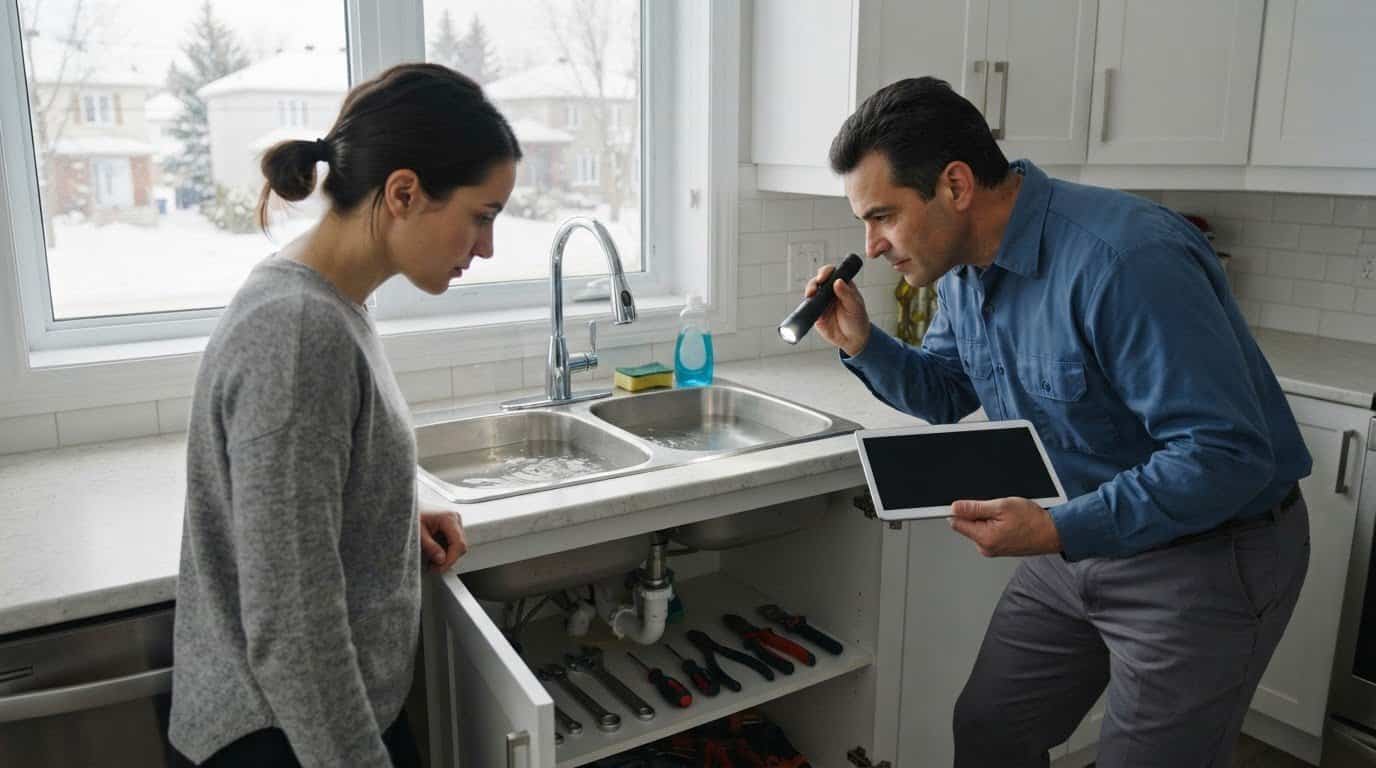
Do not loosen a slip nut to “take a look” inside the trap while the basin still contains water. Opening the connection may release the retained water and displace a seal. A fitting put back unevenly may leak afterward. Do not open a cleanout to check how high water is standing inside a line. The accompanying image shows a visual examination of an open sink cabinet; it is not an instruction for the homeowner to dismantle the visible parts.
If a receptacle, extension cord or appliance connection is wet, stay away from that equipment and the damp area. Do not reach for an electrical connection while standing in water. A cabinet with a dishwasher or garbage disposal can contain both plumbing and powered components. The area must be made safe before anyone investigates the drain further.
Decide whether a limited attempt is appropriate
A closed stopper or scraps caught at the opening may account for an immediately visible restriction. Once the accessory is correctly positioned, observe drainage during ordinary use only if the basin is not about to overflow and no chemical is present. Better flow does not guarantee that buildup farther along the line has disappeared. If the sink remains slow, stop repeating the same checks: the next question concerns an area you cannot see from the basin.
A sink plunger may be an option for an apparently local clog only when you are sure that no drain opener has been used, there is no leak or wastewater backup, and the fixture and visible connections appear sound. Use a clean plunger intended for a sink rather than a toilet plunger on a food-preparation fixture. With a double-basin sink, follow the tool and fixture instructions for the other opening. Do not force the tool. Stop if a fitting moves, water appears under the cabinet or one cautious attempt makes no improvement. Repeated plunging does not establish that a clog is deeper in the pipe.
This option is ruled out once a drain opener has been poured in, even if the water level seems lower. The manufacturer’s directions for one kitchen drain gel specifically warn that plunging can splash product left behind a clog. Follow the label of the product actually used, do not combine it with another chemical, and tell the person working on the sink what went in. Health Canada explains the hazards of household chemicals and mixing them. The CMMTQ’s French-language guidance also advises against corrosive drain openers.
Do not pour boiling water into a full basin or onto plumbing whose materials and condition you do not know. It adds more water, may splash and does not tell you what is restricting flow. Recipes meant for maintaining a working drain are not a way to test a sink full of water, particularly when another product may already be present. Feeding a wire, auger or pressurized stream into an unknown connection also goes beyond these visible household checks.
Stop immediately if the level rises, another drain reacts, a leak spreads, a chemical odour appears or you cannot identify what is in the water. If liquid comes back through a drain and spills out, avoid contact and keep children and pets away. After the situation has been assessed and made safe, use the Government of Quebec’s English cleanup guidance for water accumulation or a sewer backup for the affected area.
Describe the problem and reduce new buildup
If the sink still does not drain normally, gather facts you already know: approximately when the change began, the water level, the stopper’s position, any reaction in the second basin, the dishwasher’s last drain cycle and any visible moisture below. Mention every product used by name, along with anything attempted and what happened afterward. A photograph taken without risking an overflow may show the level or damp area. You do not need to say “the trap is clogged” if nobody has confirmed it.
In a rental property, tell the owner or manager what you observed and whether another unit has reported a problem. In a condo, promptly report a backup that may involve shared drainage. Responsibility depends on the building and cannot be established merely by pointing to the kitchen sink. One slow sink needs a different description from wastewater appearing at several fixtures. The drain cleaning and unclogging service page explains the assessment and intervention when a visible check is no longer enough.
The City of Laval’s English guidance says not to put cooking oil or waste that can obstruct pipes into sinks and other plumbing fixtures. Wiping grease from a pan and removing food scraps before rinsing dishes reduces what enters the drain. Those habits do not clear the current blockage or prove that grease caused it. If the sink slows again after it has been cleared, Why Does a Kitchen Sink Clog Again After Being Cleared? examines the first intervention and what may need checking next.
Frequently asked questions
Water is staying in only one basin. Does that prove its pipe is clogged?
No. First check whether that basin’s stopper is closed or an accessory visibly covers the drain opening. The behaviour of one basin does not show the full route of the connections below. If the other basin reacts during normal use, note it and stop adding water. Do not fill both sides to decide which pipe is responsible.
Can I remove the strainer while water is standing in the sink?
Only if you know it is ordinary kitchen water, no drain chemical has been used and the piece is designed to lift out without a tool. Remove debris caught on its surface rather than washing it down. If the source of the water or the component’s mechanism is uncertain, leave it alone and ask for advice.
Can I keep using the dishwasher if the sink is blocked?
Avoid starting it when its discharge could add water to a sink that is already holding water. Note whether an earlier cycle made water rise in a basin. That timing is useful, but does not prove that the appliance is broken or identify a clog’s location. The actual drainage connection needs to be checked.
Can I plunge the sink after pouring in a drain opener?
No. The product may still be in the water or pipe and could splash during plunging. Do not add another cleaner to try to neutralize it. Keep the label and tell the person who will work on the drain what product was used and when. If someone may have been harmed by exposure, Health Canada says to contact a poison centre or physician promptly.
Does a puddle below the sink mean the trap is blocked?
Not necessarily. The water might come from a drain fitting, the sink basket, the faucet, a supply line or another source. A clog and a leak can also occur together. Look at the visible marks without loosening parts or running more water into an already full basin. Report the slow drainage and puddle as separate observations.
The water drained away overnight. Is the problem solved?
That fact alone is not enough. A narrow passage may let a small volume through over time but still be unable to handle the next normal use. Observe only ordinary use if the situation is stable, and arrange an assessment if drainage remains slow. If the sink was cleared before and the problem has returned, keep the details of that earlier work.
Should I call the City because my kitchen sink drains slowly?
One slow kitchen sink does not establish a problem in the municipal sewer. Begin with the visible checks and have the affected plumbing assessed if they do not explain it. A backup affecting several properties or evidence of a public-network incident may call for a report to the City. Do not assign municipal responsibility from a single symptom in the kitchen.
A slow kitchen sink calls for a check limited to what is visible and safe. The stopper’s position, accessible accessories, the already observed behaviour of both basins and marks in the cabinet help guide the next step. If water accumulates, appears at another fixture, may contain a chemical or comes with a leak, stop testing and pass those observations along for an appropriate assessment.