The kitchen sink was draining normally after the blockage was cleared. A few days or weeks later, water starts pooling in the basin again. Did the same clog come back? Maybe, but the symptom alone cannot tell you. Some material may have remained, a new restriction may have formed, or a different section of the drainage path may now be involved.
Before choosing another treatment, compare today’s problem with the one that led to the first clearing. What was actually cleared, what was checked, and what has changed since? Those answers can prevent a repeat of work that restores flow without explaining why the problem keeps returning. They also help determine whether the sink needs a local check, more thorough cleaning, or an inspection of a relevant pipe section.
Key takeaways
- Water flowing at the end of a clearing shows the immediate result. It does not prove that the cause of a recurring blockage was identified.
- Note how long the sink drained normally, when it slows now, and what the first visit established. The timing is context, not a diagnosis.
- The restriction could be near the sink or farther along the line serving it. The appearance of the kitchen does not reveal the route of the hidden pipes.
- Bring the first invoice or report, any identified findings, and a short timeline to the next assessment.
- A camera can answer a specific unanswered question about an accessible pipe. A second slow drain does not make a camera inspection automatic.
Table of contents
- Why the problem can return after the water starts flowing
- What the timing and pattern can tell you
- What to learn from the first clearing
- Possible causes without assuming which pipe is affected
- Useful observations and actions to avoid
- When to reassess, clean, or inspect
- After the work: keep the findings that matter
- Frequently asked questions
Why the problem can return after the water starts flowing
Clearing a blockage addresses an immediate problem: wastewater is moving too slowly or has stopped, and a passage needs to be restored. Depending on the cause and the work performed, that improvement may last. But an empty sink at the end of a visit does not describe the condition of every part of the drainage route. A passage may have been opened through a larger accumulation, leaving material on the pipe walls or farther along an unexamined section. Alternatively, a properly cleared pipe can receive new material later.
Three questions help separate these possibilities. Did the sink drain normally immediately after the work? Was a particular object or type of buildup found and removed? Was the affected section examined, or was the work limited to restoring a passage? These are different levels of information. An invoice saying “drain cleared” may accurately state the outcome without establishing what caused the blockage in the first place.
A recurrence also does not, by itself, prove that the earlier work was done poorly. New debris, a remaining restriction beyond the area reached, and a pipe condition that catches material can produce similar symptoms. The next decision should follow what was actually treated and what is happening now, rather than a rule based only on the number of days since the visit.
This guide deals with a kitchen sink that slows down again after a previous clearing attempt. If you need a general overview of work for a currently blocked drain, the drain cleaning and unclogging service page covers that separate question.
What the timing and pattern can tell you
How soon the sink slows again is useful context, but it cannot identify the cause on its own. If it never drained well after the first visit, the problem may not have been fully resolved, or the final flow check may not have reproduced the conditions under which the trouble appears. If it worked well for a period, consider how the kitchen was used during that time and whether the slowdown developed gradually or appeared suddenly.
Describe how the change shows up. In a double-basin sink, does water collect in only one basin or do both seem affected? Does the problem appear during a large discharge, after the dishwasher runs, or even when the kitchen has had little use? A brief sound carries different information from water that actually rises. Depending on the installation, these details can help a plumber decide whether to start with accessible connections, a kitchen branch, or a shared section. They do not map concealed piping by themselves.
If another fixture reacts at the same time, the question may extend beyond the kitchen sink. Water rising in a different drain while the kitchen is in use deserves particular attention. Our guide, Why Is Water Backing Up Into Another Drain?, explains that pattern in detail. Stop adding water if a backup occurs. You do not need to recreate it several times to show that it happened.
Write a brief timeline: when the first blockage started, when and how it was cleared, how well the sink drained just afterward, when the slowdown returned, and what was happening during later episodes. “It keeps clogging” then becomes something more useful: “It drained normally for three weeks, then water began collecting during heavy kitchen use; the bathroom drains have not changed.” That is an observation a plumber can investigate, not a claim about the location of the clog.
What to learn from the first clearing
Before scheduling exactly the same work again, review what you know about the first attempt. An invoice, service note, photographs, video, or messages with the company may contain more useful detail than the name of the equipment you remember seeing. If someone used a household tool before the visit, include that in the history as well. There is no need to open a connection now to reconstruct the earlier work.
Gather or ask about these points:
- Which fixture and access point were used? A tool entered through the sink opening, an accessible connection, or another access point may not have reached the same length of pipe.
- What work was done? Was an obstruction opened, material removed, or a section cleaned? The tool’s name alone does not establish what the person found.
- How was the final result checked? Was the sink filled and drained normally? Was flow watched for only a few seconds? Mention any improvement that felt incomplete from the start.
- Was the cause observed or only suspected? Retrieved material, identifiable footage, and a theory based on kitchen use offer different levels of certainty.
- What could not be checked? A tool that would not advance, limited access, or water obscuring a view can leave part of the route unexamined. That limit matters before anyone draws a conclusion about the entire line.
You do not have to know the home’s pipe layout to ask a practical question: “At the end of the first visit, what had we confirmed, and what would still need checking if the sink slowed again?” The answer can help distinguish a limited first intervention from a newly observed problem. It may direct the next visit toward an accessible connection or a section that was not previously examined.
Do not treat a video clip as a complete map of the building. If a camera was used previously, ask which pipe it entered, from which access point, in which direction, and how far it travelled. Clean-looking footage from one section does not rule out a restriction elsewhere. Knowing that a camera was used is different from knowing which line it inspected.
Possible causes without assuming which pipe is affected
In a kitchen, material can collect at the strainer, in the trap, at a connection, or farther along a drain line. Cooled grease, food residue, and small objects are possible contributors. But grease visible near a sink does not establish that it caused this recurrence or show where the restriction lies. More than one factor can also be present.
One possibility is that a path was opened through accumulated material without fully removing the deposits that restrict the line. Water moves more freely for a while and later slows again. Another is that an object or stubborn buildup remains beyond the point reached during the first attempt. A third is that new material accumulated after a successful clearing. The time between episodes and the earlier findings can help compare these possibilities, but they cannot rank them with certainty from a description alone.
In some cases, the pipe, a fitting, or the way the drainage route is configured contributes to repeated blockages. Two clogs do not automatically prove an improper slope, broken pipe, or need for repair. A claim like that calls for evidence from the relevant section and an explanation of how the finding relates to the sink’s behaviour. The practical question is: what observation distinguishes returning buildup from an issue with the pipe itself?
The dishwasher is worth mentioning when its use coincides with the symptom. Depending on how it is connected, its discharge may share part of the sink’s drainage route and make limited flow more noticeable. That timing does not prove the dishwasher is defective or that it created the clog. Note whether water appears in the sink during its cycle and whether that happened before the first clearing.
Finally, do not assume that a problem affecting one kitchen sink has the same cause as a blocked underground sewer. Roots, a sagging sewer line, and sewer replacement belong to other investigations, especially where several fixtures are backing up. They are not the default explanation for an isolated sink. The actual spread of the symptoms should set the scope of the next check.
Useful observations and actions to avoid
If the sink still drains, observe it during ordinary kitchen use. Do not repeatedly fill the basin just to force the symptom to appear. Note whether the slowdown is constant or intermittent, whether both basins are involved, and whether the cabinet underneath is wet. A photograph of standing water or a short video taken during normal use may help, provided you do not risk an overflow to obtain it. If the cabinet is damp, mention that separately: a leaking connection and slow drainage in the basin may call for different checks.
If the sink is fully blocked or water rises elsewhere, stop sending more water into the affected drains. Avoid running an appliance whose discharge could make the backup worse. Keep people away from wastewater. Several affected fixtures, an overflow, or active water damage call for an assessment without first identifying the exact pipe yourself.
Do not pour one drain opener after another into a slow or blocked line, and never mix household chemical products. Health Canada advises reading product labels and warns that mixing household chemicals can produce harmful gases. If a product has already been used, tell the person working on the drain what it was. Forcing an improvised tool into a concealed pipe could also damage a component and make the original problem harder to evaluate.
Removing debris caught in a removable strainer is an ordinary surface task, but it will not explain every returning blockage. The guide Drain Cleaning: Safe Maintenance and Warning Signs covers accessible routine care. This article begins where that care and the first attempt to clear the sink have not explained why poor drainage returned.
When to reassess, clean, or inspect
A new assessment makes sense when slow drainage returns soon after work, grows worse, or never fully went away. Provide the timeline and the invoice or report from the first visit. The person on site can compare the current behaviour with the earlier findings, check accessible parts, and propose work suited to the section in question. A second episode does not automatically call for the same tool or a camera.
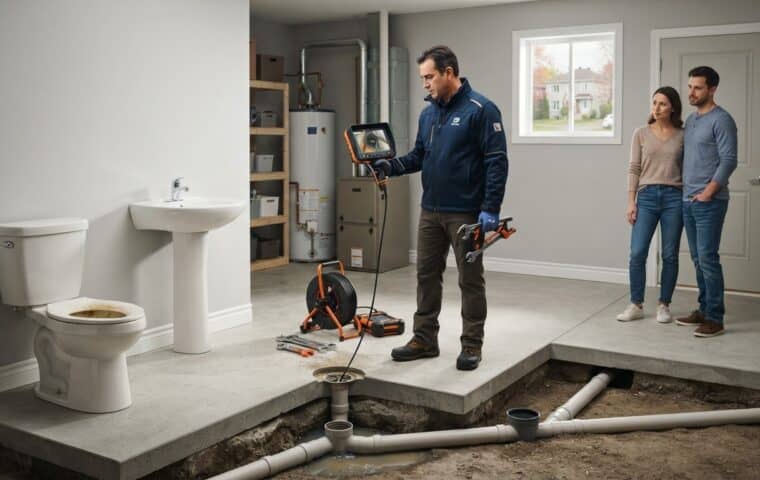
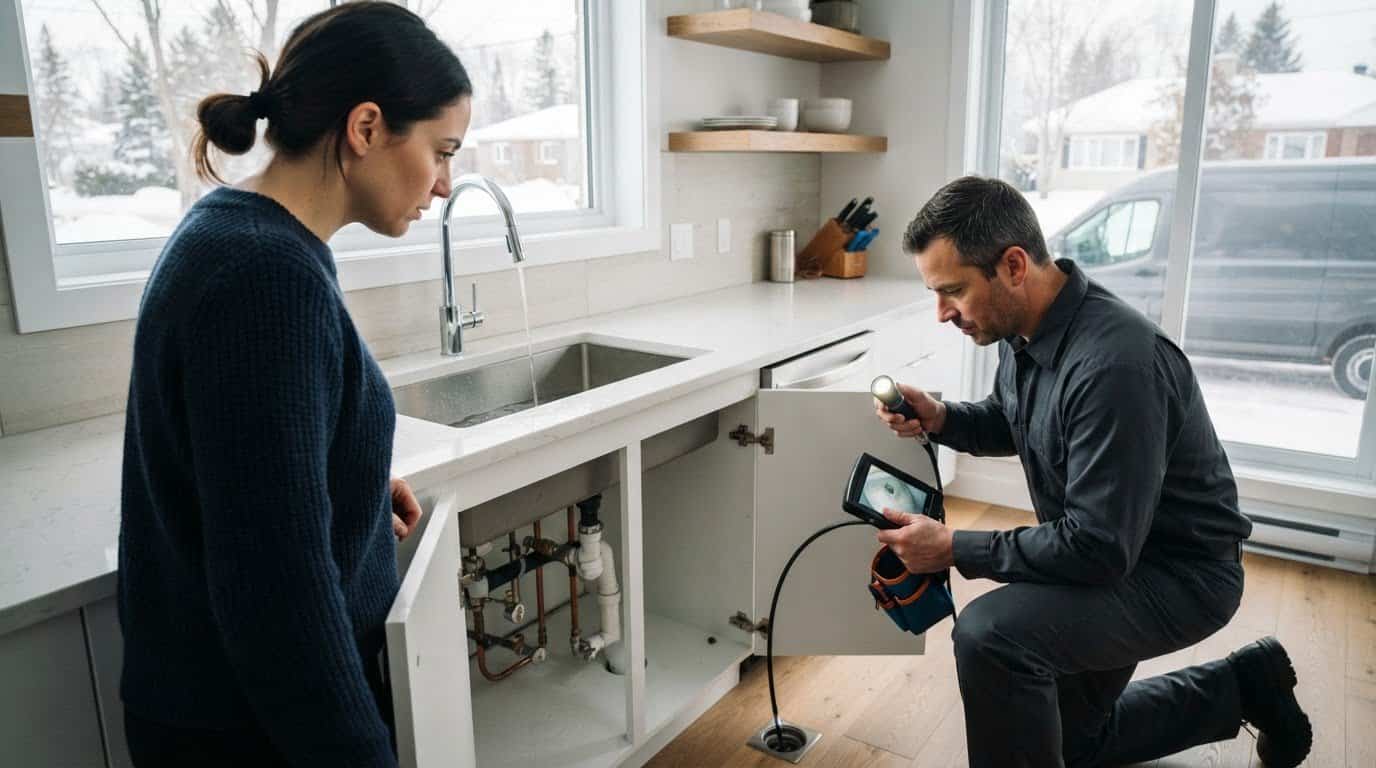
If deposits were identified in a reachable section, cleaning that section may address accumulation more thoroughly than simply reopening a narrow passage. If the cause remains unclear or a pipe defect is suspected, a drain camera inspection may help examine the section the camera can actually travel. The footage should answer a defined question: where is the restriction, what is visible in this section, and what remains out of view? It cannot establish the condition of a branch it never entered.
Sometimes an accessible connection or trap provides enough information without a camera. In other cases, a complete blockage prevents the camera from advancing until flow is restored. The order of work depends on the conditions found at the property. Before agreeing to a larger repair, ask what finding supports it and how the proposed work would address the recurring symptom. A documented explanation is more useful than a promise based only on the fact that the sink clogged twice.
If a kitchen sink is slowing again in Laval, Plomberie Laval can assess the current signs alongside the previous work. Explain whether the kitchen sink alone is affected or whether other fixtures react. That distinction helps direct the visit without guessing how the pipes run behind the walls or below the floor.
After the work: keep the findings that matter
At the end of a second intervention, ask what was found, which section was involved, what was done, and how the result was checked. “The water runs” describes the sink at that moment. It may not establish that the cause of repeated trouble has been corrected. If the cause could not be confirmed, ask what remained uncertain and what future sign would justify another check. That gives you something concrete to watch for.
Keep the service record and, if available, images labelled with the pipe section and access point. If the symptom returns, you can compare the same facts: affected fixture, conditions when it appeared, section treated, finding, and result. An unlabelled video will usually be less useful to the next person than a short report identifying where the footage was taken.
If the material found shows that kitchen habits contributed, adjust them accordingly. The City of Laval advises keeping cooking oil and waste that can block a pipe out of sinks and other plumbing fixtures. These habits reduce the material entering the system; they do not fix a faulty connection or pipe. Base the follow-up on what was found, rather than assigning a cause before the work begins.
Frequently asked questions
Did the exact same clog come back?
Not necessarily. The same symptom could result from material left behind, new buildup, or a restriction at another point along the route. Compare how the sink drained after the first work, how long the improvement lasted, and what was actually found. Without those details, it is not possible to say that it is the identical clog.
Why is the sink slow now if it drained after the clearing?
Flow may have been restored without identifying a recurring cause, or a new restriction may have developed afterward. Ask which section was cleared, whether material was removed, and how the final flow was tested. Those details help focus the second assessment.
Should I ask for exactly the same clearing again?
Not automatically. Repeating a limited first intervention may make sense in some circumstances, but doing so without investigating why the symptom returned may produce another short-lived improvement. Share the earlier report and explain what changed before selecting the next method.
Is a camera required after a second blockage?
No. It can help when a question about the location or condition of an accessible pipe remains unanswered. A visible fitting may explain the problem without a camera, while a dense obstruction may prevent one from seeing farther along. The question to answer determines whether inspection is useful.
Could the dishwasher be responsible?
Its discharge may make restricted flow more obvious if it shares part of the kitchen sink’s drainage route. That does not automatically mean the appliance is faulty or caused the blockage. Note whether the symptom appears during its cycle and include that observation in the assessment.
What should I bring to the second visit?
The first invoice and service report, any images tied to an identified section, and a short timeline of the symptoms. Mention products used since the last visit and any other fixtures affected. You do not need to draw the entire plumbing system yourself.
What if water rises in another drain?
Stop using fixtures that add water to the drainage system and arrange an assessment. Do not repeat discharges to recreate the event. A reaction between fixtures changes the scope of the investigation, but it does not establish the exact blockage location by itself.
In short: When a kitchen sink clogs again, start with the timeline, the findings, and the limits of the first intervention before repeating the same clearing. Have the relevant section checked, then ask for a clear account of what the next visit confirmed.