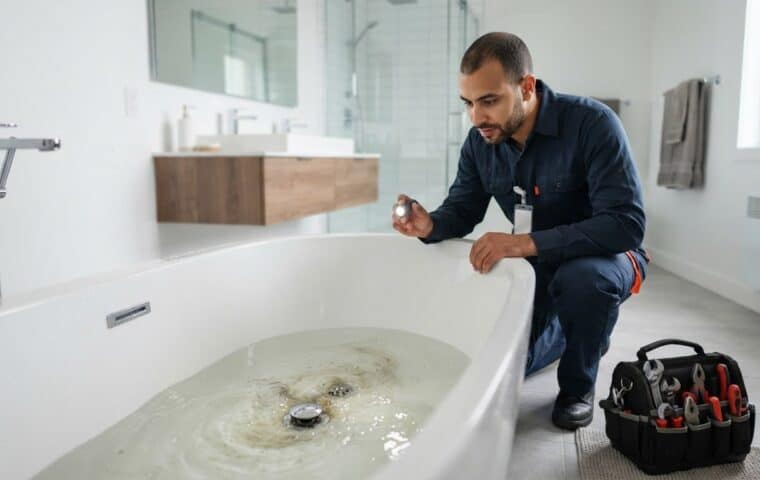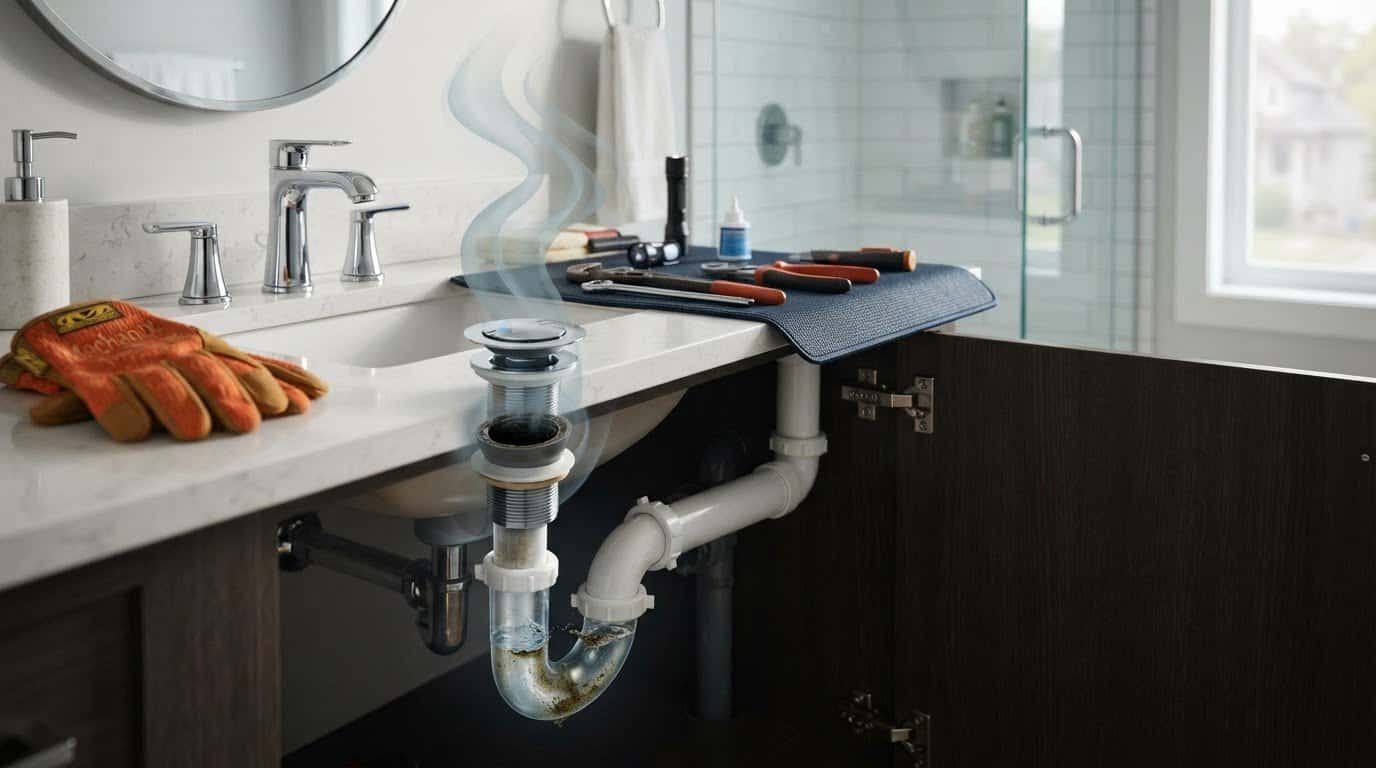
The bathroom smells unpleasant near the sink, yet the water drains normally. Does that mean the drain needs to be unclogged? The smell alone does not establish that. Residue around the drain opening, an overflow opening if the basin has one, moisture inside the vanity, or a problem with the drainage system could each deserve attention. Air moving through a small bathroom can also make an odour seem to come from a different place.
The useful starting point is to note where the smell seems strongest, when it appears and what else has changed. Those observations cannot diagnose hidden plumbing from a distance. They can, however, help you choose a sensible first check instead of treating every bathroom odour as a blocked sewer line.
Key takeaways
- A sink can drain well and still smell bad. An odour alone does not prove a clog or a sewer backup.
- Compare the area near the drain opening, a visible overflow opening if one exists, and the inside of the vanity. Do not disconnect fittings or put your face close to an opening.
- A musty smell together with damp cabinet materials calls for a search for the water source. Pouring something into the drain will not fix a leak.
- A rarely used sink may lose some of the water held in its trap. If the smell returns despite regular use, that explanation may be incomplete.
- Record when the smell returns and whether other fixtures have symptoms before deciding between accessible cleaning, a leak check and a plumbing assessment.
Table of contents
- First locate the odour and note when it appears
- Drain opening or overflow: check the right area
- Under the vanity: look for moisture
- When the trap or another pipe becomes a possibility
- A short observation sequence without taking anything apart
- Choose the next step from what you actually found
- Frequently asked questions
First locate the odour and note when it appears
Turn off the faucet and let the room return to its usual condition. Is the smell noticeable when nobody has used the sink, or mainly after water goes down the drain? Do you notice it on entering the bathroom, only when standing by the basin, or most clearly when you open the vanity? Perfume, cleaning products and a damp towel can make comparisons difficult. Record the circumstances before trying to call the smell a “sewer odour” or a “drain odour.”
Notice what has not changed, too. If the shower, toilet and any second basin work as usual, that is worth mentioning. It does not rule out a plumbing problem, but it helps keep the first investigation proportionate. If several fixtures start gurgling, draining differently or showing rising water at the same time, you are no longer dealing with only an odour near one sink.
Timing offers another clue. A smell noticed only when opening a vanity that has been closed for days may call for a different first check than a smell that returns at the drain opening every time the sink is used. After a long absence, note whether the sink and the other drains in the room have been used. If you notice a smell after cleaning, record the product used and where it was applied. That sequence matters, but it does not prove the product caused the odour.
There is no need to lean over every opening and repeatedly inhale to “trace” the smell. The bathroom exhaust fan, an open door and air moving through the vanity can shift an odour without moving its source. Observe what repeats during ordinary use. If dirty water actually rises through a fixture, stop adding water to the system. Our guide to reliable signs of a sewer backup covers that different situation in detail.
Drain opening or overflow: check the right area
The drain opening is where water leaves the basin. Depending on the model, a stopper or movable component sits there. Visible residue can collect around these accessible parts while the opening still passes water freely enough for the sink to empty normally. That gives you a reason to check the visible surface and the accessories intended for user care. It does not establish that a pipe farther downstream is blocked.
Our guide to safe drain maintenance explains which accessible accessories may be cleaned according to their product instructions and where that task stops. The question here is different: if the odour returns, which area appears to be associated with it? Cleaning a visible component and noticing an improvement can help narrow the search. It cannot prove that you have found every source of the smell.
Some bathroom sinks also have a small overflow opening higher up in the basin. It gives rising water an additional path before it spills over the rim, although it does not guarantee against an overflow. Not every basin has this feature. The CMMTQ explains in its French-language Quebec guidance on sink overflows that a sink without one may be installed when the applicable certification and code conditions are met. Look at the fixture in front of you instead of assuming it has a concealed channel because another sink does.
If there is an overflow, report a smell noticed near that opening separately from one you associate with the main drain opening. Depending on the basin’s design, water and residue may pass through an area that is less visible than the bowl. That makes the overflow a possible place to investigate, not proof of contamination or a particular plumbing fault. Do not push a rigid tool or a mixture of cleaners into an opening whose path you do not know. Check the manufacturer’s care instructions for your model, and seek advice if those instructions are unavailable or the smell persists.
An improvement just after surface cleaning does not settle the question by itself. Does it last through ordinary use, or does the smell return the next day or only after certain activities? That distinction is more useful than concluding that “the whole drain was dirty” because the room smelled better for a few hours.
Under the vanity: look for moisture
An odour may seem to rise from the sink when it is stronger inside the vanity. Open the cabinet without handling the pipe connections. Look for a base panel that is wet, swollen, stained or unusually soft. Notice whether stored items are damp or smell musty. A mark could have several explanations: water spilled onto the countertop, splashes that have run down a surface, a leaking fitting or general room humidity. Its appearance alone will not identify the source.
A musty or earthy smell deserves closer attention when the cabinet is damp. Health Canada advises checking around sinks and pipes for damp areas and repairing leaks promptly. It also notes that mould can sometimes be hidden and have a musty odour. That does not mean a smell proves there is mould in this particular vanity. It means you should look for the source of moisture instead of assuming a product poured down the drain will address it.
If a fresh drop appears while you use the faucet normally, note approximately where you saw it. Stop using the sink if water continues wetting the cabinet. Do not tighten fittings at random, particularly if a component moves or you cannot tell which connection is involved. Moisture that grows while the sink has not been used also needs checking. It may not follow the same path as a drip visible only when water drains away.
Look at the surfaces around the basin as well: the joint at the counter, the back edge, wet objects and the area near the faucet. Water can enter a cabinet from above; the presence of a smell below a sink does not prove its trap is leaking. The water leak repair page covers situations involving a leaking pipe or fitting. The drain maintenance guide covers accessible cleaning. Your observations help indicate which question deserves attention first.
There may be more than one issue. A little residue at the drain opening and a damp cabinet base can occur together. Cleaning the opening might reduce one smell while the moisture continues to affect the cabinet. If the odour keeps returning, compare the conditions after ordinary use rather than treating the first improvement as a complete diagnosis.
When the trap or another pipe becomes a possibility
A plumbing trap retains water to help prevent gases from moving back through the drainage system into the room while allowing wastewater to flow away. Quebec’s English-language plumbing code, published by the RBQ and National Research Council describes the required water seal and its role. Seeing a curved pipe under a sink does not let you confirm from a photograph, or from outside the vanity, that its water seal is intact or that its connections are airtight.
A sink that has not been used for a long time, such as one in a guest bathroom, may lose part of that water seal through evaporation. If nothing else is abnormal, gently running some water and observing the sink during its next normal uses is a simple check. Our gurgling drain guide addresses rarely used drains and the limits of adding water in more detail.
If the sink is used every day and the odour returns quickly, repeatedly adding water is unlikely to answer the whole question. A connection that lets odours escape, a disturbed water seal or an issue elsewhere in the drainage system may need an on-site check. Gurgling associated with other fixtures changes the assessment, too. It does not, by itself, prove that a vent is blocked or that the main sewer line has a clog.
The bathroom exhaust fan and the plumbing vent serve different purposes. The fan moves humid air out of the room. Plumbing venting is part of how the drainage system and traps function. Turning on the fan may change where the odour is noticeable, but it cannot diagnose a vent pipe. If the pattern points toward a shared line or venting problem, describe the symptoms and let a qualified person assess the plumbing.
The difference between “near the sink” and “inside a specific pipe” matters. A photo of the vanity can show where a plumber may begin looking, but it cannot show the route of the pipe behind a wall or the state of the water seal. The same caution applies to smell: an odour is a reason to investigate, not a map of the drainage system.
A short observation sequence without taking anything apart
If you need to describe the problem, try to record the same details over a few ordinary sink uses. There is no need to fill the basin, block the outlet or cycle through several products to reproduce an odour. A short, consistent record is more useful than an improvised stress test.
- Locate the smell as best you can. Is it noticeable throughout the room, near the drain opening, near a visible overflow, or when you open the vanity? Do not identify it by breathing directly over the drain.
- Note the timing. Is it present when the sink is idle, after using the faucet, after a shower, after cleaning, or after several days away? A single episode may not establish a pattern.
- Look at what is visible. Note residue at the opening, moisture inside the vanity, or a stain that grows. Photograph a visible sign if you can do so without moving a fitting.
- Check the extent. Do the other bathroom fixtures drain as they normally do? Is water actually rising through a fixture, or is there only an odour? The answer changes the priority.
- Keep a short history. Record the cleaning products already used and any recent repair or replacement. A smell noticed after a stopper was replaced is worth reporting, but the sequence does not prove the new part was installed incorrectly.
These notes help avoid focusing only on the most visible part. The drain opening may draw your attention even though damp material is inside the cabinet. Conversely, a smell noticed in a bathroom does not establish that the building’s sewer line is obstructed. The point is to choose the next area to inspect without dismantling the installation yourself.
Avoid mixing cleaners or trying one drain opener after another until the smell fades. Health Canada says never to mix household chemical products. If you have already poured a product into the sink, keep its name and tell anyone who may work on the drain. A fragrance can also make the original odour harder to assess. A temporary change in smell is not proof that the source has been corrected.
Choose the next step from what you actually found
If the smell seems confined to accessible surfaces around the drain opening, with no dampness or other symptom, start with the care permitted for your fixture. Follow its instructions and do not assume a deep clog needs clearing when the sink drains normally. If the basin has an overflow and the odour appears associated with that opening, mention it specifically. The overflow’s path and appropriate care depend on the fixture design.
If the cabinet is damp, finding and stopping the water source takes priority over treating the drain. If the sink has barely been used, a reduced trap water seal is reasonable to consider while observing what happens after normal use. If the odour persists despite these limited checks, returns quickly, or comes with gurgling or changed drainage, a plumbing assessment can identify what actually needs attention. A drain camera is not automatically the first response to a smell near one sink.
Water rising through a fixture, visible wastewater or several fixtures reacting together calls for a different response. Stop using fixtures that may add more water to the affected drainage system and avoid contact with the liquid. Do not continue running the sink to repeat the event. The linked sewer backup guide explains those warning signs without treating an isolated smell as a backup.
In Laval, Plomberie Laval can assess a persistent odour with the observations you have gathered: the area where it is strongest, when it appears, whether the vanity is damp, how the sink drains and whether other fixtures react. Describe what you can see and smell rather than naming a clogged sewer pipe before it has been checked.
Frequently asked questions
Can a bathroom sink smell bad when water drains normally?
Yes. Normal drainage does not tell you whether residue is present at the opening, whether an overflow exists or whether materials inside the vanity are damp. It also cannot rule out every plumbing issue. Note where the odour is noticeable and whether another symptom appears before choosing an intervention.
How can I tell whether the smell comes from the drain or the vanity?
Compare ordinary conditions. Is the smell stronger when the cabinet door opens? Is its base wet, stained or swollen? Is there visible residue around the drain opening? These observations guide the search, but moving air can be misleading. A persistent problem may still require an on-site check.
Does every bathroom sink have an overflow opening?
No. Some basins have a secondary opening higher in the bowl; others do not. Check the actual fixture and its model instructions before assuming an overflow channel is present or trying to clean it. Its absence alone does not mean the basin is defective.
Will pouring water into the drain get rid of the smell?
It may help when a rarely used sink has lost some of the water in its trap. An improvement does not prove that was the only cause. If the sink is used regularly, the smell returns quickly, or other symptoms appear, have the situation assessed rather than repeating that step indefinitely.
Does a musty smell mean the drain is leaking?
No. It can accompany damp materials, but the water might come from a fitting, from above the vanity, from condensation or from another source. Note where and when the dampness appears. Materials that remain wet or an active leak warrant attention without assuming the trap is responsible.
Should I use a drain opener to remove the smell?
An odour alone is not a reason to treat the sink as a blocked pipe. A drain opener will not tell you whether the source is at the opening, near an overflow or in a damp cabinet. Do not mix products. If you have already used one, keep the product name available for the person who examines the installation.
When should the plumbing be checked?
Arrange an assessment if the odour persists, returns quickly despite limited checks, or is accompanied by dampness, changed drainage or noises associated with other fixtures. If water rises through a drain or fixture, stop using the affected plumbing and avoid contact with that water. Describe the observations instead of guessing which pipe is at fault.
The next step depends on the location, not the label you give the smell. When a bathroom sink drains normally, the drain opening, a possible overflow and the vanity call for different checks. Note what repeats during normal use and have the findings assessed if the cause remains unclear. There is no need to dismantle the fittings or assume a clog based on the odour alone.