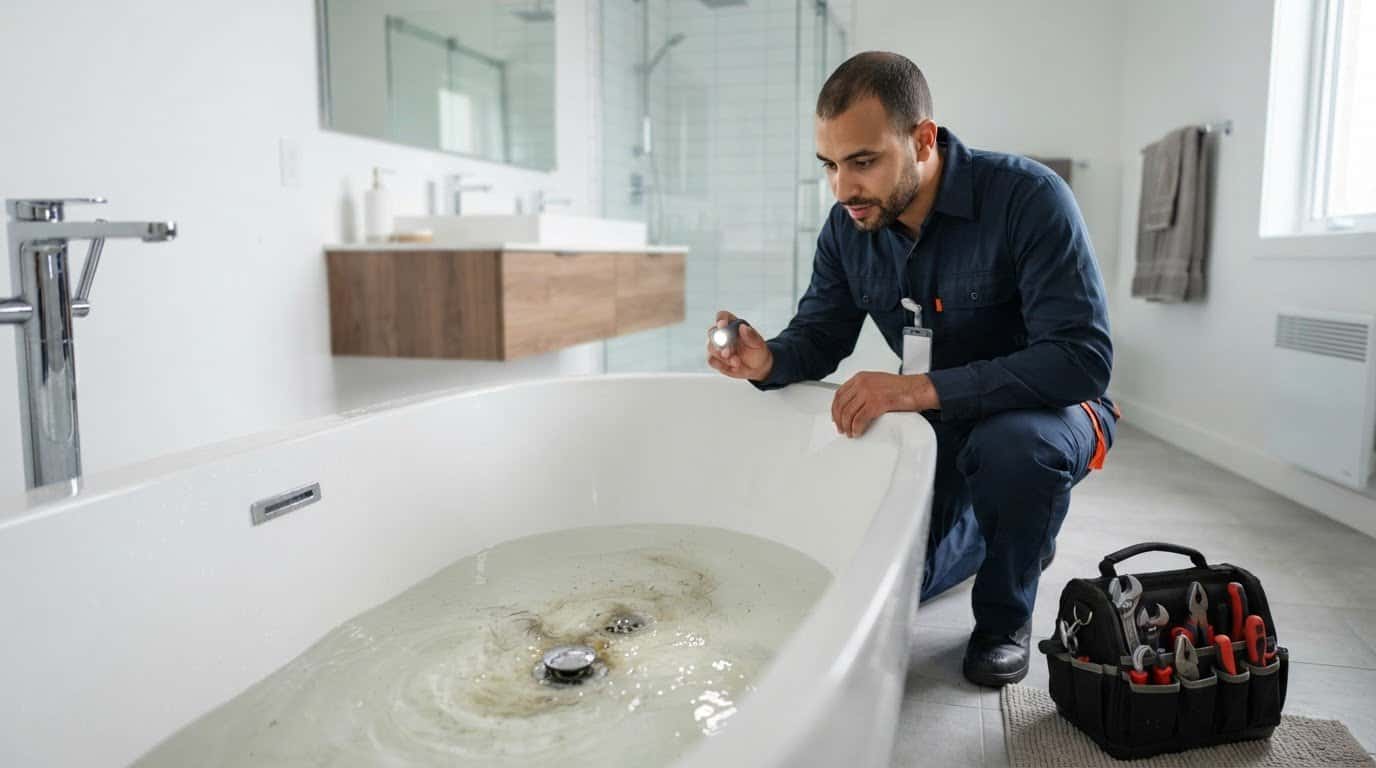
A bathtub that drains slowly may have a stopper that does not open fully, hair collecting around the drain opening or a restriction farther along the drainpipe. Before trying to clear the pipe, check the stopper’s position and describe exactly what happens: does water collect around your feet during a shower, or does the problem mainly appear when you empty a bath?
These situations provide different information. Checks you can make at the surface may help determine the next step, but they do not reveal the condition of concealed plumbing. If water rises through the drain when you are not using the tub, a leak appears or a chemical drain opener has already been used, stop your checks and report the situation.
Key takeaways
- A partly closed stopper can restrict drainage even when there is no debris blockage in the pipe.
- Water building up during a shower and a bath taking longer to empty are separate observations worth describing.
- Visible hair may contribute to slow drainage, but its presence does not prove it explains the entire problem.
- The mechanism matters: toe-touch, lift-and-turn and lever-operated stoppers do not all work the same way.
- Slow drainage that begins after a stopper replacement should be reported before assuming the pipe is clogged.
- Backflow, a leak or standing water containing a drain opener marks the limit of household checks.
Table of contents
- Understand how your bathtub drains
- Check whether the stopper opens properly
- Distinguish different drainage problems
- Examine clues specific to the bathtub
- Know when to stop checking
- Prepare for a useful assessment
- Frequently asked questions about slow bathtub drainage
- Choose the next step
Understand how your bathtub drains
The drain opening, stopper and pipe have different roles
The drain fitting is the assembly at the opening through which water leaves the tub. The stopper closes that opening so you can take a bath. Beneath the fixture, water passes through the drainage plumbing, including a trap and a branch pipe. In many bathrooms, those components are concealed beneath the floor or behind an enclosure.
Understanding these parts helps you ask the right question. If the stopper stays too close to its seat when it should be open, it can restrict water at the entrance. If the opening works normally, a restriction may still exist beyond the visible area. A shiny drain fitting or a screen that appears clear does not show what is inside the pipe.
Access also depends on the installation. An alcove tub, a freestanding tub and a tub-shower combination may use different arrangements. Do not move a bathtub to find its trap or remove a secured panel as part of this initial check. What looks accessible from the room may still be connected to concealed fittings.
The overflow is not a solution to slow drainage
When a tub has an overflow opening, it is usually higher on the wall of the fixture. It allows water to drain when the level reaches that height, within the installation’s capacity. It does not guarantee that the tub can never overflow and should not be used to test a suspected drainage problem.
The overflow generally connects to the bathtub’s drainage assembly. It is therefore not an independent outlet that can bypass any restriction. If the main drain is slow, do not add more water while relying on the overflow opening to handle it.
On some models, the overflow plate also carries the stopper control. Operating that control normally and unscrewing the plate are different actions. The first is ordinary fixture use; the second may affect the assembly and its seals. Leave the plate secured during your initial observations.
Check whether the stopper opens properly
Identify the control before handling it
Start with the normal operating movement for your model. A toe-touch or push-button stopper usually alternates between closed and open positions. A lift-and-turn stopper may need to be lifted or rotated. A lever can operate a mechanism that is partly hidden inside the drain assembly.
Observe whether the stopper reaches its usual open position. A button that pushes down but no longer rises as before, a lever resting between positions or a crooked component is worth reporting. Do not pull with pliers or assume a stopper must unscrew because it resembles one shown in a video.
If standing water prevents you from seeing the mechanism clearly, do not put your hand into liquid whose contents you do not know. Wait until a safe observation is possible or have the fixture checked. Identifying a stopper does not require reaching blindly around it.
An insufficient opening is a real possibility
For certain ClearFlo and PureFlo bathtub drains, KOHLER provides guidance on adjusting a clicking stopper that does not appear to open far enough. This illustrates a possible problem with the mechanism, but does not establish that your bathtub uses the same assembly. Kohler Assist
The practical lesson is to identify the model before adjusting anything. Opening height, components and approved procedures vary. Instructions for one product are not a universal method for every bathtub drain.
If normal operation does not produce the expected open position, find the correct instructions or have the mechanism examined. Pouring in a drain opener will not establish whether a mechanical component is operating properly. Keep that question separate from the condition of the pipe.
A recently replaced stopper changes the first check
Did drainage slow down after someone installed a new stopper, filter or accessory? That timing matters. An incompatible or poorly positioned accessory can reduce the passage at the opening even when it looks clean.
Find the packaging or part number if possible. Explain what was changed and whether the previous mechanism operated differently. Do not randomly reinstall an old assembly to compare results. A replacement needs to suit the existing fitting and operate as intended.
If a professional installed the component, describe the change to them. If you added it yourself, stay within the checks its instructions allow the user to perform. Two components fitting into the same opening does not prove that they are interchangeable or correctly assembled.
Distinguish different drainage problems
Water builds up during a shower
In a tub-shower combination, water enters continuously while you shower. If a puddle gradually forms around your feet, drainage is not keeping up with incoming water under those conditions. That observation does not measure the drain’s capacity or locate an obstruction.
Note whether the buildup is new, whether it appears quickly or only after several minutes, and whether the stopper was fully open. You may already know these details from recent use. There is no need to extend a shower to measure the problem.
If the level continues rising, turn off the water. A longer shower will not provide a more reliable diagnosis and will add water to an outlet already struggling to drain. Do not stand in water that may contain a chemical drain opener, even if it looks like ordinary bathwater.
A bath empties, but more slowly than before
After a bath, the tub contains a stored volume of water. Emptying time depends on factors such as the amount of water, the tub’s shape, the stopper opening and the drainage installation. A number of minutes found online is not a universal standard for proper operation.
A change from the same bathtub’s usual behaviour is more useful. If it previously emptied without difficulty but now retains a comparable amount of water much longer, describe that change. Also check that the faucet is off: water continuing to enter the tub changes your impression of how quickly it is emptying.
Do not fill the bathtub repeatedly to establish an average. The purpose is to explain a real change, rather than measure plumbing performance yourself. Information from the last ordinary use is generally more useful than a series of deliberate tests.
A small puddle remains after the tub empties
A thin film of water, a localized puddle and a tub that remains substantially full are different observations. Once the faucet is off, look at where water remains: around the drain fitting, beneath the stopper or elsewhere on the bottom.
A puddle away from the opening may lead someone to examine the tub’s bottom profile or how the fixture is levelled, particularly following installation. It does not prove that the drainpipe is obstructed. Conversely, water remaining across much of the bottom while drainage is clearly slow calls for an assessment of the system.
Do not adjust the feet, support or position of the bathtub. Take a photograph if you can do so safely. The image can help distinguish water moving poorly across the tub’s surface from water having difficulty passing through the drainage assembly.
Examine clues specific to the bathtub
Hair and residue around the drain opening
Hair and soap residue can restrict the passage near the entrance or farther along the pipe. Visible buildup shows that debris is present at that location. It does not show how deep the material extends or the condition of the rest of the route.
When the tub is empty, with no backflow and no chemical product present, you can remove hair lying on the accessible surface. Avoid pushing the material into the opening. Removing an attached component, inserting a hook or opening a fitting goes beyond this surface check.
For accessory-cleaning methods, see our guide to safe drain maintenance and its limits. The key question here is whether a visible obstacle explains the bathtub’s behaviour or slow drainage remains unexplained. An improvement after removing surface hair is useful information, but does not establish the condition of concealed plumbing.
A dropped object or a sudden change
Did a cap, piece of a toy or small accessory fall near the drain just before the problem started? Report that event even if you do not know whether the item actually entered the opening.
A sudden slowdown does not prove that an object is present. However, a specific event provides more useful information than a guess based on the age of the house. If the item remains completely accessible at the surface, retrieving it may be straightforward. If it has disappeared into the mechanism, do not push it farther with an improvised tool.
Keep a similar item or a photograph to show its size. That information can help guide the assessment without creating another disturbance in the drain assembly. Explain what you saw rather than claiming you know where the object is now.
Recent renovation or a leak during draining
If the bathtub has drained slowly since installation, say so. The assessment may need to consider the mechanism and connection, rather than only residue accumulated through use. Do not conclude that an installation error occurred without an examination.
Moisture at the base of the tub or a stain on the ceiling below during draining is another important observation. It may indicate a sealing problem separate from the slowdown. Stop using the bathtub and pass that information to the person assessing the situation.
Distinguish water leaving through the drain from water escaping through a leak. A falling water level is not reassuring if water appears elsewhere in the building. Report both observations together so the assessment does not focus only on drainage speed.
Know when to stop checking
When the problem extends beyond the bathtub
If water rises in the tub while another fixture empties, the question extends beyond the stopper opening. Stop adding water to the affected drainage system and do not deliberately reproduce the reaction.
Our article Why Is Water Backing Up Into Another Drain? addresses that situation. For a noise without backflow, the guide to a gurgling drain explains possible causes and relevant observations. A sound alone does not confirm a venting problem.
These signs change the scope of the assessment. Do not try to solve a problem involving several fixtures by handling only the bathtub stopper. Information about the other affected fixtures should be passed on rather than investigated through repeated household tests.
When a chemical drain opener has already been used
If a product has been poured in, stop actions that could splash the liquid, including plunging, inserting a tool or taking the assembly apart. Keep the container and report the product name, when it was used and any other substances that may have been added.
Health Canada advises following the label and never mixing household chemical products. Some mixtures can produce harmful gases. Adding vinegar, bleach or another drain opener is not a safe way to neutralize the first product. Canada.ca
Water becoming clear again does not establish that chemical residue is gone. Tell the plumber before work begins, even if the product appeared to have no effect. This information matters to the person choosing how to access the drain and handle retained liquid.
Prepare for a useful assessment
Describe the stopper as well as the water flow
A useful description might be: “The stopper is a push-button model. It does not rise as far as it used to. Water has been collecting during showers for three days, but no other fixture has shown a change. No chemical product has been used.”
If the mechanism operates normally, explain that too. A photograph of the drain fitting and its control may help identify the model, but does not replace an examination of concealed plumbing. Mention a recent installation, replaced component or dropped object if one preceded the slowdown.
Keep ordinary access to the bathroom available. Do not remove an enclosure or move the tub to prepare for the visit. If you have the installation instructions or the replacement part’s packaging, keep them available for reference.
Match the assessment to the problem
A stopper that no longer reaches its open position and slow drainage despite a functioning mechanism do not necessarily require the same work. The examination should distinguish a fixture-control problem from a restriction in its drainage route.
When an obstruction is being considered, our drain cleaning and unclogging page describes the corresponding service. A slow bathtub does not automatically justify a complete sewer inspection, excavation or replacement of the tub.
Ask which part was checked and what supports the recommendation. If a component is replaced, keep its reference number. If the symptom returns, that information will provide a more precise history for the next assessment, rather than starting again with an uncertain description.
One slow fixture does not identify a municipal problem
In Laval, the City’s English guidance on water accumulation, infiltration and sewer backup explains the steps for different situations. For a sewer backup, it identifies calling an RBQ-licensed plumber who is a CMMTQ member as the first step so the source can be assessed. Ville de Laval
A bathtub draining slowly, without an observed backup, does not establish that the City’s system is responsible. If an assessment identifies an issue that may involve the public portion, follow the applicable municipal process. Do not assign responsibility based on the symptom alone.
In a rental property or condominium, notify the owner or manager when an intervention is needed. Report the facts without deciding for yourself whether a pipe is private or shared. The building’s arrangement and the location of the problem matter.
Frequently asked questions about slow bathtub drainage
How long should a bathtub take to drain?
There is no single time that applies to every bathtub and water volume. Compare current behaviour with how the same fixture operated previously. A new, persistent slowdown deserves a check even if the water eventually disappears. Do not refill the tub repeatedly just to time it.
Does a clicking stopper mean it is fully open?
No. The click indicates that the mechanism responded, but does not confirm that it reached the correct position. Observe its usual opening without pulling on the component. If it remains unusually low, consult the model’s instructions or have the control checked rather than forcing it.
Why is the bathtub slow when the bathroom sink drains normally?
The two fixtures do not necessarily follow the same route immediately after their drain openings. A functioning sink therefore does not rule out a problem with the bathtub mechanism or drain connection. It also does not guarantee that the entire shared pipe is unrestricted.
Does a slow freestanding bathtub need to be moved?
Not as an initial check by the occupant. Examine the visible control and find the model information. Moving the tub can affect its connections and seals. The access method should be determined according to the installation, without pulling or lifting the fixture at random.
Can boiling water make the tub drain faster?
This guide does not recommend that step. It cannot distinguish a mechanical stopper problem from a hidden restriction and can create a scalding risk. Heat compatibility also depends on the materials. Do not pour more liquid into a tub already holding water or containing a chemical product.
Should the bathtub be replaced if the problem continues?
Slow drainage alone does not justify replacing the fixture. The assessment should determine whether the problem involves the mechanism, drainage plumbing or another component. A replacement recommendation should be supported by an identified defect and an explanation, rather than based only on how slowly the bath empties.
Choose the next step
Start by separating three observations: the stopper position, the water’s behaviour in the tub and any recent changes. An unusual control movement, an added accessory or a localized puddle may direct the assessment differently from slow drainage during every shower.
If these observations do not explain the slowdown, have the bathtub assessed instead of trying a succession of remedies. When backflow, a leak or chemicals are involved, stop household checks and provide the information you already have.