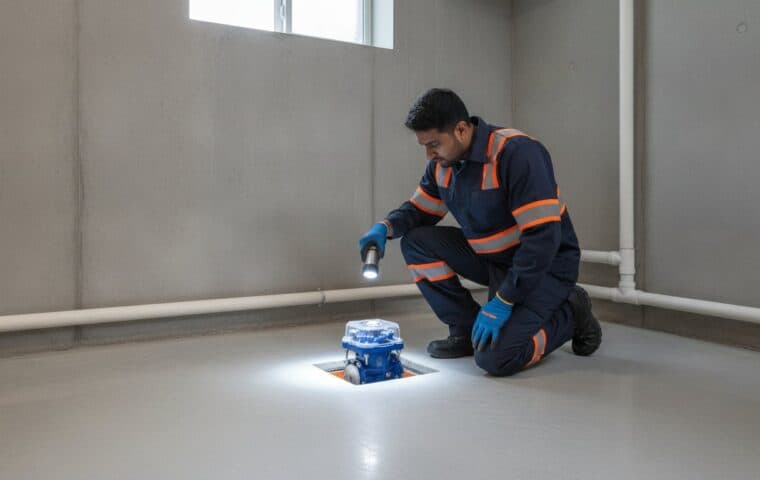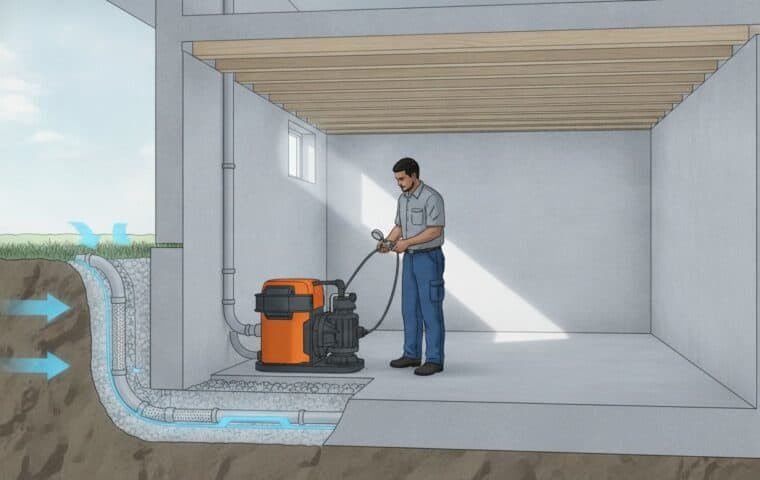
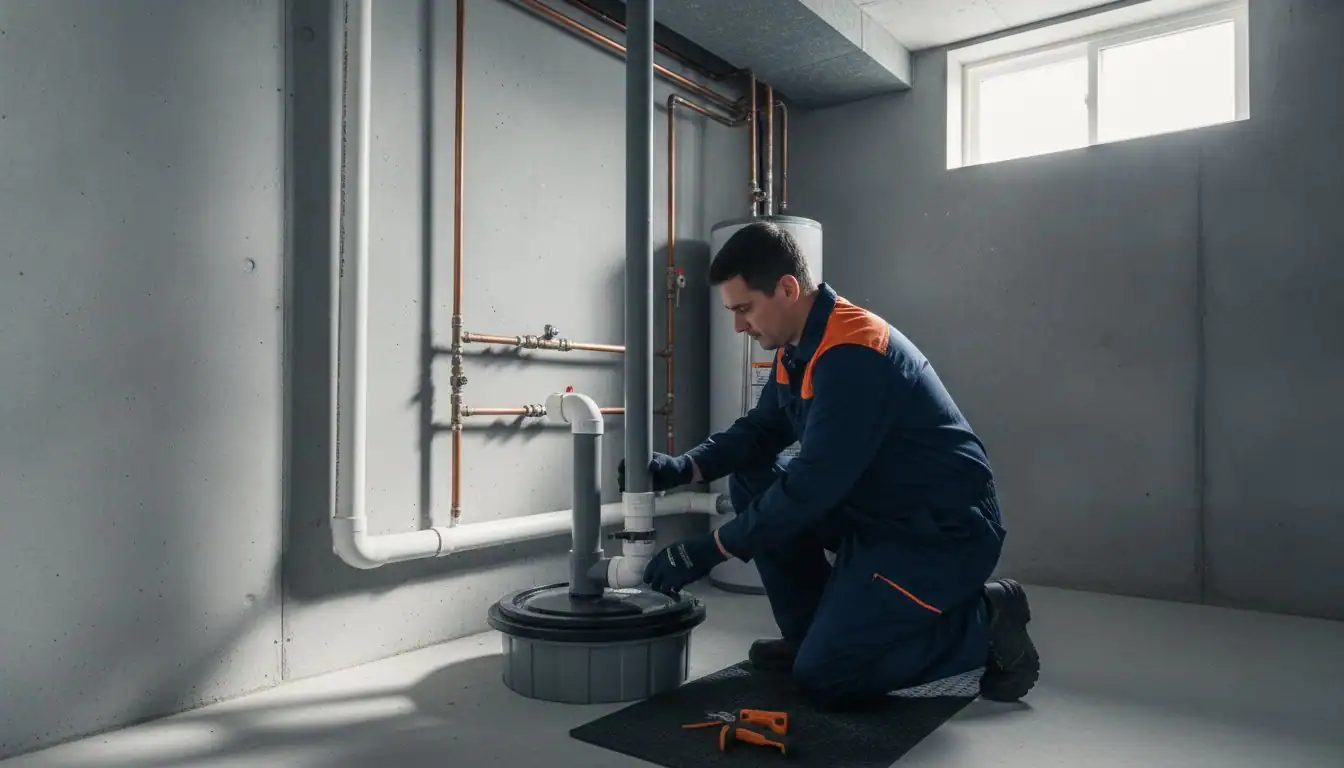
A quiet sump pump is not necessarily a healthy one. The basin may simply not have received enough water to activate the pump recently. Conversely, hearing the motor run does not confirm that water is reaching the intended discharge point.
To assess the situation, observe one complete cycle: water enters the basin, the float rises, the pump starts, the water level falls, water moves through the discharge line and the pump stops. A problem at any point in this sequence can reduce your basement’s protection.
The most useful warning signs are usually visible or audible. You do not need to dismantle the equipment to notice that a pump hesitates, restarts constantly, allows too much water to return or can no longer lower the water level.
Important: If the floor is wet near the pump, an outlet or another electrical device, do not touch the plug or step into the water. Electrical safety takes priority over any inspection.
The short answer: observe the complete cycle
A sump pump does not work alone. It is part of a system that includes the basin, float switch, electrical supply, discharge pipe, fittings, check valve and final discharge point.
A normal cycle should follow this sequence:
- Water enters the basin.
- The float moves freely.
- The pump starts before water reaches the top.
- The water level visibly drops.
- Water moves through the discharge line without an apparent leak.
- The pump stops at the intended level.
- Only a limited amount of water returns after shutoff.
There is no universal cycle duration. Basin volume, incoming flow, pump capacity and vertical lift all affect how the system operates.
The most revealing clue is therefore not a precise number of seconds, but a change from the pump’s usual behaviour. A pump that becomes louder, slower or much more active deserves attention.
Eight signs that may indicate a problem
1. The water rises, but the pump does not start
This is the most urgent warning sign. The float may be trapped against the basin wall, the power supply may be interrupted or the pump may have failed.
Do not try to move the float by hand when water is close to electrical equipment. Do not unplug the pump while standing on a wet floor.
From a dry location, note:
- the approximate water level;
- whether the motor can be heard;
- the status of accessible alarm lights;
- when the problem began;
- whether the building has recently lost power.
If the water continues rising, the situation has moved beyond a preventive check. Keep people away from the area and request assistance.
2. The motor runs, but the water level falls slowly
An audible motor does not necessarily mean the pump is moving enough water.
Possible causes include:
- a partially restricted discharge line;
- an outlet blocked by debris, ice or snow;
- a check valve that does not open properly;
- a leak in the piping;
- a pump that has lost capacity;
- incoming water exceeding the available pumping rate.
Observe the level from a safe distance. Stop checking if the level does not fall, the pump becomes unusually hot or its normal operating sound changes to a hum.
A pump that runs without moving water may sustain additional damage. The fault may also be in the discharge line rather than in the motor itself.
3. The pump runs continuously
A continuously running pump may be receiving a large amount of water, but that is not the only explanation.
The float may be stuck in the raised position. Discharged water may also be flowing back toward the foundation and re-entering the basin. This creates a loop in which the pump repeatedly handles the same water. A frozen or partially blocked discharge line can also reduce the flow enough that the pump never catches up.
Extended operation may be expected during rapid snowmelt or heavy rainfall. It becomes concerning when:
- the water level no longer falls;
- the pump keeps running after the incoming flow subsides;
- the motor develops a new sound;
- the discharge line vibrates strongly;
- the same behaviour occurs during dry weather.
A pump that runs continuously should not be left unattended simply because its motor is still operating.
4. It starts and stops constantly
Very short cycles place additional demand on the motor and may reveal a weakness elsewhere in the system.
Possible causes include:
- a float with insufficient clearance or travel;
- a basin that is too small for the incoming flow;
- a check valve that allows a large volume of water to fall back;
- an unsuitable float adjustment;
- irregular incoming flow;
- a pump whose capacity does not match the installation.
Do not change the float length or electrical settings without the manufacturer’s instructions for that specific model. An improvised adjustment may delay activation and allow the water to rise too high.
Instead, note the approximate number of cycles, the starting level and how much water returns after each shutoff. These observations can help with diagnosis.
5. A large amount of water returns after shutoff
The check valve on the pump’s discharge line limits water from flowing back into the basin when the motor stops.
A small change in water level may be normal, depending on the configuration. A substantial return accompanied by rushing water or an almost immediate restart may indicate:
- a check valve that does not close correctly;
- deposits interfering with the mechanism;
- improper installation;
- a leaking connection;
- a discharge-line configuration problem.
This valve belongs to the sump pump system. It should not be confused with a sewer backwater valve used to protect certain plumbing fixtures from reverse wastewater flow.
6. A new noise or vibration appears
The normal sound varies by pump model and installation. A change from the usual sound is often more informative than the volume itself.
Listen for:
- humming without a falling water level;
- repeated banging at shutoff;
- grinding;
- scraping;
- vibration transmitted through the piping or floor;
- a harsher start than usual.
An object may be interfering with the pump inlet or float. A support may also have loosened. In other cases, the noise comes from internal motor wear.
Do not place your hand or a tool into the basin to locate the sound. A visual check from above is safer than improvised handling.
7. A leak appears along the discharge line
A discharge pipe may look functional while allowing some of the pumped water to escape.
Without touching wet components, look for:
- drops near a fitting;
- a recent moisture mark;
- a displaced clamp;
- piping that moves when the pump starts;
- water spraying beneath the cover;
- a visible crack.
A leak reduces the amount of water actually leaving the basin and may direct water onto the basement floor. It can also worsen quickly during extended pump operation.
The pipe should not be held together temporarily with tape or an improvised fastener. Pressure, vibration and repeated cycles require fittings intended for the installation.
8. The alarm or backup system does not respond
A high-water alarm does not pump water. It warns that the water has reached an abnormal level. A secondary pump or backup power source performs a different function.
If your system includes these components, visually check:
- status lights;
- displayed warnings;
- the battery’s exterior condition;
- the date shown on the battery;
- visibly loose or corroded connections;
- alerts recorded after a power outage.
A battery does not provide unlimited runtime. Its duration depends on its capacity, condition, incoming water and the number of pumping cycles required.
The presence of a battery does not eliminate the need to assess the actual risk. A backup pump must still move water to the discharge point against the installation’s lift and piping resistance.
What you can check without dismantling the pump
A preventive observation should remain simple and safe. It should not require removing the pump, opening an electrical enclosure or modifying the piping.
Access to the basin
Boxes, furniture and permanent flooring should not obstruct access. The cover should be stable and in good condition.
Depending on what is connected to the basin, requirements may apply to its cover and venting. The CMMTQ technical guidance on lift pumps explains, in French, that certain sumps connected to foundation drainage require an airtight cover and proper venting.
Do not drill through the cover or change its configuration simply to make occasional access easier.
Clearance around the float
When the float is visible, check whether it appears able to rise without striking the basin wall, pump, cable or discharge pipe.
A shifted pump, poorly positioned cable or object inside the basin may limit the float’s movement. The pump could then start too late, stop too early or remain activated.
Keep this check visual. Do not force the mechanism while the equipment is powered.
Visible debris
Sand, soil and other small debris may accumulate inside a sump. The Société d’habitation du Québec’s interior-sump inspection sequence, available in French, includes checks of drainage, debris, the cover, float, alarm and discharge piping.
This document is a preventive-maintenance reference for buildings. It does not mean every homeowner should remove the pump or work inside an unfamiliar basin.
Stop if removing debris would require moving the equipment, opening a sealed component or working near wet electrical connections.
The visible discharge line
Visually follow the pipe from the pump through the accessible portion of the basement.
Look for leaks, movement, an unstable fitting or a pipe that contacts the structure and vibrates whenever the pump starts.
Do not dismantle the check valve or fittings while water remains in the basin. Water held inside the vertical discharge pipe may fall back quickly when a connection is opened.
How to observe a cycle safely
The safest opportunity is often a natural cycle when water enters the basin during rainfall or snowmelt. You can then observe the pump from a dry position.
Note:
- the level at which the pump starts;
- the delay between float movement and startup;
- how quickly the water level falls;
- any vibration or leakage;
- the level at which the pump stops;
- how much water returns afterward.
Some manufacturers provide a testing procedure using clean water. Follow that method only when you understand the basin’s configuration and the manual for that specific model authorizes it.
If permitted, add water gradually from a dry position. Never force the float, fill the basin to overflowing or allow the pump to run dry.
If the pump does not start as expected, stop the test. Adding more water will not correct a failed electrical supply or a jammed mechanism.
The pump’s check valve does not prevent a sewer backup
Two components with similar names are often confused.
The sump pump check valve is installed on the discharge line. It limits water from falling back into the basin after the motor stops.
A sewer backwater valve is installed on a drainage branch to block reverse wastewater flow from the sewer system. It protects the fixtures connected to that branch but does not empty a sump basin.
A sump pump is therefore not the solution to every basement water problem. Our guide to water in the basement after heavy rain explains how the point of entry helps distinguish sump overflow, groundwater infiltration, a plumbing leak and a sewer backup.
If wastewater rises through a toilet, shower or floor drain, the drainage system and the applicable backwater protection must be assessed instead. The article Which Fixtures Does a Backwater Valve Actually Protect? explains why one valve does not automatically protect every basement fixture.
When several fixtures drain slowly or make unusual sounds, the guide to a gurgling drain can help distinguish a local restriction from a problem farther along the drainage system.
The discharge line is part of the protection
Even a properly operating pump cannot move water effectively when its discharge line is obstructed, frozen, damaged or directed incorrectly.
When the outdoor outlet is visible and safely accessible, check that it is not blocked by:
- ice;
- compacted snow;
- leaves;
- soil;
- an object placed in front of the outlet;
- a crushed section of pipe.
Do not use a flame, chemical product or aggressive tool to thaw a discharge line. An unsuitable method may damage the piping or introduce another hazard.
Discharged water should not immediately return toward the foundation. However, the permitted destination depends on the installation and municipal requirements.
The Régie du bâtiment du Québec’s sump pump selection guidance, available in French, states that the connection required by the municipality must be verified. Required pumping capacity also depends on drainage, piping and site conditions, not only the horsepower printed on the motor.
For a local reference, the City of Laval publishes English guidance on flooding and spring freshets. Municipal instructions and the building’s drainage configuration should be checked before redirecting a discharge line.
Alarm, battery and secondary pump: three different roles
These components can complement each other, but they are not interchangeable.
High-water alarm
The alarm warns that water has reached an abnormal level. It provides an opportunity to react earlier but removes no water.
A local alarm is only helpful when someone can hear it. Some systems can send notifications, subject to their power supply and communication connection.
Backup power or battery-powered pump
Depending on the configuration, a battery may power compatible equipment or operate a separate backup pump.
Its suitability depends on:
- the incoming water flow;
- the probable outage duration;
- the discharge lift;
- the backup pump’s actual capacity;
- battery condition and maintenance;
- the potential consequences of an overflow.
A battery that is never checked can create a false sense of security.
Auxiliary pump
A second pump may provide additional capacity or take over under specific conditions. It still requires a suitable activation level, discharge route and power source.
Adding another pump without checking the capacity of the piping or discharge point does not guarantee that more water can leave the property.
When should these checks be performed?
There is no single schedule for every installation. The manufacturer’s manual, the basin’s behaviour and the building’s exposure should take priority.
In Quebec, an observation before spring snowmelt is especially useful. The Société d’habitation du Québec’s interior-sump inspection sequence is also scheduled for April in its preventive-maintenance reference.
An additional check is reasonable:
- before forecast heavy rainfall;
- after an extended power outage;
- after a high-water alarm;
- after work near the basin or discharge pipe;
- after a long period without an observable cycle;
- when the sound or cycling pattern changes;
- after an overflow or significant infiltration event.
This does not necessarily mean performing a complete cleaning. The first objective is to confirm that access remains clear and the system can complete its cycle.
What a simple check cannot correct
Observation may reveal a problem, but it cannot turn an unsuitable installation into an adequate one.
A basic check cannot correct:
- an undersized pump;
- excessive discharge lift;
- an undersized basin;
- an improper connection;
- a line that regularly freezes;
- an unauthorized discharge point;
- deficient foundation drainage;
- water entering through a foundation crack;
- a sewer backup;
- damaged electrical equipment.
Pump capacity cannot be evaluated from motor horsepower alone. Available flow changes with vertical lift, pipe length and diameter, elbows and other sources of resistance.
When a system falls behind during every significant rainfall, repeating a basic cleaning may not address the cause. The basin, pump and full water route must be assessed together.
When should you stop checking?
Stop immediately if you notice:
- water near an outlet or electrical panel;
- a burning smell;
- sparks;
- an extremely hot motor;
- a cracked discharge pipe;
- a substantial leak;
- water rapidly approaching the top of the basin;
- humming without water movement;
- contaminated water rising through plumbing fixtures;
- no way to reach the basin without stepping into water.
Hydro-Québec provides English instructions for electrical safety during water damage and flooding.
The Government of Quebec also advises people not to touch anything when water begins entering a basement and to contact Hydro-Québec when electrical service must be interrupted.
These precautions apply even when the pump is only a few steps away. Entering the water to reach a plug or float may expose you to an electrical hazard that cannot be seen.
What should you record before requesting an assessment?
A few precise observations can make the problem easier to explain:
- the date and time the symptom began;
- weather conditions;
- the approximate water level;
- whether the motor was operating;
- the cycling frequency;
- the sound you heard;
- the amount of water returning after shutoff;
- any visible leak;
- the condition of the accessible discharge outlet;
- any recent power outage;
- the pump’s known age and service history.
Photos taken from a dry position may also show the basin, cover, discharge pipe and available working space. Do not remove a protective component or approach wet electrical equipment merely to obtain a photograph.
Frequently asked questions
Is it normal to see water in the sump basin?
Yes, depending on the installation and soil conditions. Water in the basin does not automatically indicate a failure.
The level becomes concerning when it continues rising without activating the pump, approaches the top or remains abnormally high after a cycle.
Can I pour a bucket of water into the basin to test the pump?
Only when the configuration is known, the floor and electrical connections are dry, and the manufacturer’s instructions authorize this procedure.
Add water gradually. Never force the float, overflow the basin or continue the test when the pump does not start.
Can I clean the bottom of the basin myself?
A small amount of clearly accessible debris may sometimes be removed by following the manufacturer’s instructions and a safe shutdown procedure.
If cleaning requires lifting the pump, opening the discharge pipe, removing a sealed cover or working near wet electrical connections, the work should be left to a professional.
Why does the pump run when it is not raining?
Water may come from foundation drainage, a high water table, snowmelt, discharged water returning toward the foundation or another source.
Occasional operation is not necessarily abnormal. New continuous operation during dry weather should be investigated.
Why does the pump restart a few seconds after stopping?
Water may be returning because of a failed check valve, an unsuitable piping configuration or a substantial incoming flow. A small basin or poorly positioned float can also cause short cycles.
Does the pump’s check valve need to be cleaned every year?
There is no universal schedule for every valve and pump model. The appropriate frequency depends on the manufacturer, installation and amount of sediment.
A substantial return of water or very short cycles may justify inspecting the valve without waiting for a fixed date.
Is a battery backup always necessary?
No. Its usefulness depends on the frequency of outages, how much water continues entering without electricity and the consequences of an overflow.
When a battery system is used, its pumping rate, runtime and condition must match the actual risk.
Should a sump pump be replaced after a specific number of years?
Age is one clue, but not a final diagnosis. The number of cycles, water quality, pumping demand, history of overheating and condition of the discharge line also affect service life.
Uncertain starting, new noises, reduced performance or repeated failures are more informative than one universal age limit.
Watch the right signs before the water rises
The most useful observations do not require dismantling the equipment. Confirm that the float can move, the pump starts, the water level falls and a large amount of water does not immediately return to the basin.
A visual check can reveal a risk, but it should never become an improvised electrical repair or piping disassembly.
If the cycle is abnormal, the water continues rising or the system’s configuration needs correction, review the available sump pump installation, diagnosis and replacement service so the basin, pump and discharge line can be assessed as one system.