A sewer line has just been cleared, wastewater is flowing normally again and the problem appears to be solved. Yet several months or years later, the same symptoms may return. Why? Because cleaning removes the roots growing inside the pipe without necessarily sealing the opening through which they entered.
Cut roots can grow back when the joint, crack or damaged section remains accessible. However, regrowth is neither immediate nor predictable according to a universal schedule. It depends on the pipe’s condition, the size of the entry point, surrounding vegetation and how completely the line was initially cleared.
Key point: Root cutting can restore drainage. Only correcting the entry point can provide a lasting barrier against roots entering the same location again.
How Do Roots Enter a Sewer Line?
Roots naturally explore the soil for water, oxygen and favourable growing conditions. They do not intentionally target sewer lines, and they generally do not penetrate a fully intact, watertight pipe simply because it carries wastewater.
According to the North Carolina Cooperative Extension, roots primarily exploit existing vulnerabilities, including:
- a joint that is no longer watertight;
- a crack in the pipe wall;
- a displaced connection;
- a perforation;
- an improperly sealed cleanout cap;
- a defective previous repair.
A very small root can enter through a narrow opening. Once inside, it finds moisture and continues growing. Its branches can then catch toilet paper, organic matter, grease and other debris.
The resulting blockage is therefore not necessarily made entirely of roots. It is often a combination of plant fibres and waste trapped between them.
Why Does the Problem Return After Root Cutting?
Cleaning addresses the material obstructing the inside of the pipe at the time of service. It does not necessarily change the structural condition of the sewer line.
The Entry Point Remains Open
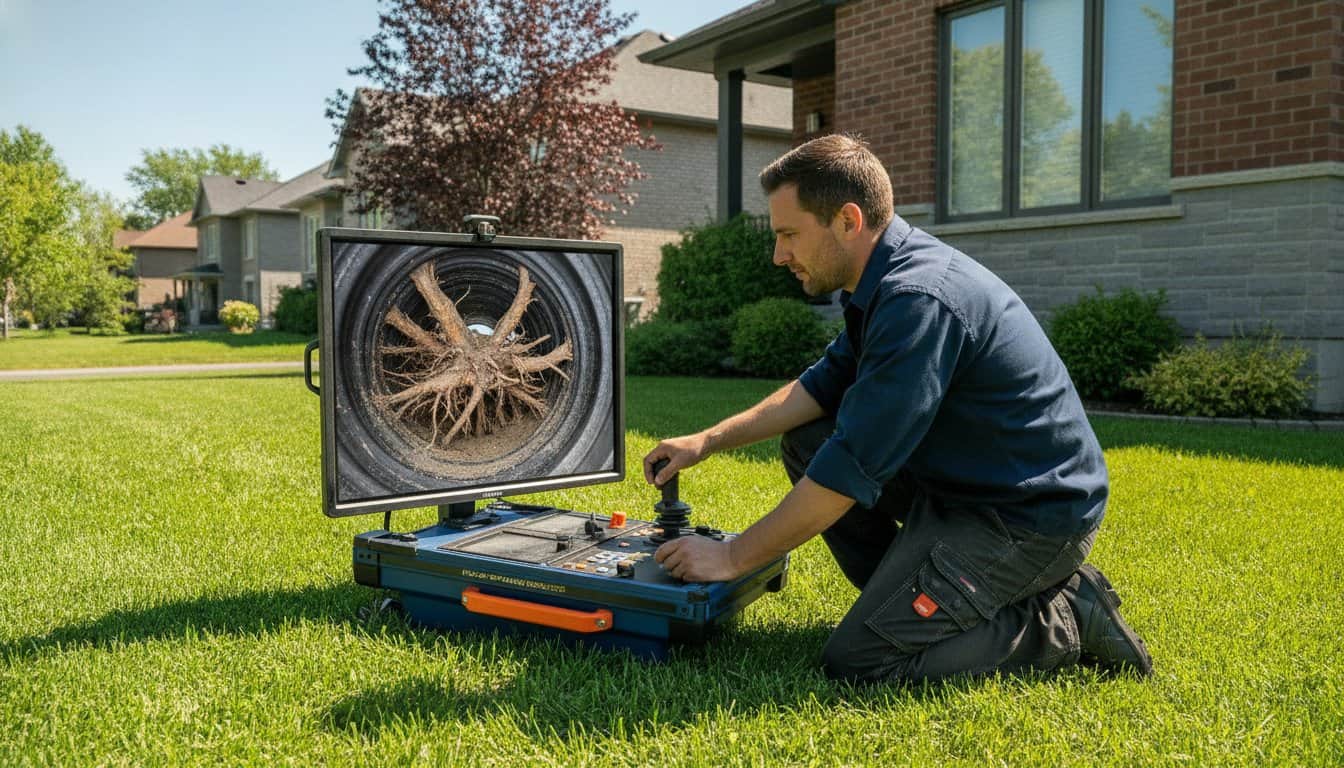
When a cutting head or another tool removes roots from inside the pipe, part of the root system remains alive in the surrounding soil. If the opening is not corrected, new root fibres may enter through the same passage.
The process is closer to trimming a hedge than removing the entire plant. The visible growth is gone, but its source remains outside the pipe.
Some Roots May Remain Behind
A sewer line contains joints, changes in direction and sometimes deformed sections. The equipment may restore enough space for proper flow without removing every small root pressed against the pipe wall.
These remaining fibres may not cause another blockage immediately. Over time, however, they can begin catching waste again.
The Pipe Has More Than One Weak Point
An initial service visit may clear the main blockage while roots are beginning to enter through other joints.
The problem may appear to have returned in exactly the same location even though another intrusion has developed farther along the line. This is one reason why recorded distances and surface locations are important.
Drainage Was Restored Without Documenting the Cause
During a sewer backup, the immediate priority is often to restore drainage. Once the urgent problem has been resolved, an additional inspection may be needed to understand what the equipment encountered.
Without useful footage or detailed notes, it can be difficult to determine whether the blockage was isolated, whether roots entered through one joint or whether the pipe contains several defects.
Can the Regrowth Timeline Be Predicted?
There is no reliable answer that applies to every sewer line. An automatic recommendation to clean the pipe every 18 months, two years or three years ignores the circumstances of the individual system.
The speed of recurrence can vary according to:
- the size and number of entry points;
- the density of roots surrounding the pipe;
- the condition of the joints and pipe wall;
- how much root material remained after cleaning;
- soil moisture conditions;
- how the drainage system is used;
- the materials that become caught in new growth;
- repairs completed after the previous service.
A maintenance schedule should be based on the pipe’s actual history. The dates of previous blockages, the location of root intrusion and the observed rate of recurrence are more useful than an arbitrary interval.
Are the Symptoms Unique to Tree Roots?
No. The signs of root intrusion resemble those caused by several other drainage problems.
Possible symptoms include:
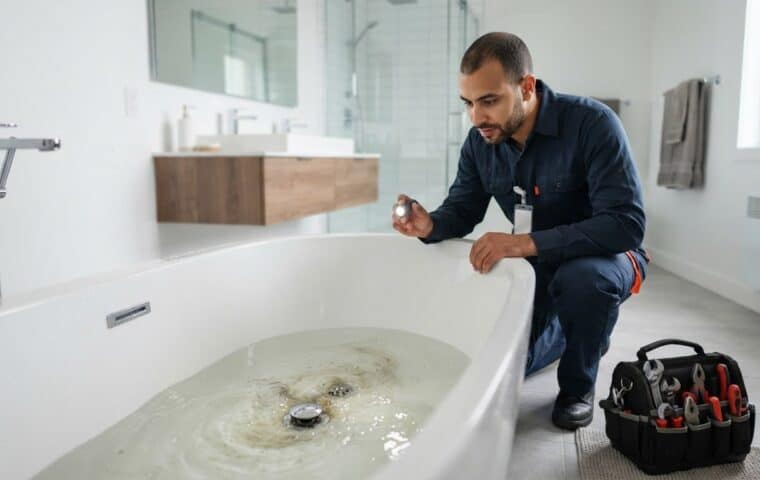
- several fixtures draining slowly;
- unexplained changes in the toilet-bowl water level;
- a shower reacting when another fixture is used;
- water rising through a floor drain;
- gurgling sounds;
- intermittent backups;
- a blockage returning after an earlier service.
These signs suggest that the drainage system should be evaluated, but they do not prove that roots are present. Buildup, a foreign object, a displaced joint, a sagging section or a venting problem can cause similar reactions.
Our article about a gurgling drain explains which observations may help distinguish a localized restriction from a problem affecting a shared drain.
How Can Returning Roots Be Confirmed?
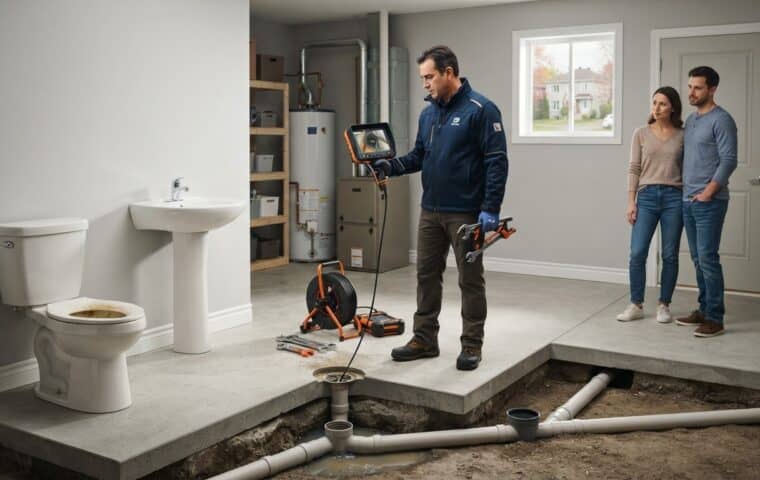
A camera may reveal roots growing inside an accessible section of the sewer line. It can also help identify the joint, crack or damaged area where the intrusion appears.
The inspection is often more informative after the line has been cleared. In a completely obstructed pipe or one filled with cloudy water, the camera may reach the blockage without showing what lies beyond it.
A drain camera inspection may help document:
- the approximate location of the intrusion;
- the amount of root material still visible;
- the number of observed entry points;
- the apparent condition of the joints;
- visible deformation or breakage;
- the distance travelled;
- sections that could not be inspected.
The camera only shows the inside of the pipe. It cannot directly reveal roots in the surrounding soil, the outside of the sewer line or every condition affecting it.
When a repair must be marked from the surface, confirm whether the service includes a transmitter and locating equipment. The cable-length measurement does not always represent a straight-line distance from the building.
Should the Pipe Be Cleaned, Monitored or Repaired?
Finding roots does not automatically mean that the entire sewer line must be replaced. The next decision depends on the condition of the pipe and how the problem behaves over time.
Cleaning May Provide a Short-Term Solution
Drain cleaning or unclogging may restore flow when roots restrict the passage but the pipe remains usable.
Cleaning may be part of a management strategy when:
- the intrusion is limited;
- no collapse is visible;
- the owner understands that the entry point remains;
- recurrence is being documented;
- reasonable monitoring can be arranged.
Cleaning should not be presented as a permanent structural repair.
Monitoring May Be Appropriate
A small, localized intrusion does not carry the same implications as roots entering through several joints or a heavily deformed section.
If the line functions normally after cleaning, the footage and service history can establish a baseline. Another inspection can then be scheduled if symptoms return or according to an interval based on the actual findings.
A Localized Repair May Correct One Weak Point
When a single joint or short section is responsible for repeated intrusion, a targeted repair may be considered.
The appropriate method depends on the location, diameter, material, accessibility and condition of the surrounding pipe. A localized repair only makes sense when the rest of the sewer line can reasonably continue performing its intended function.
More Extensive Work May Become Necessary
Sewer-line repair or excavation may be appropriate when the images and symptoms reveal:
- several failing sections;
- a collapsed pipe;
- severe deformation;
- displaced joints in several locations;
- repeated root intrusion despite cleaning;
- a pipe that is too deteriorated for a localized correction.
The presence of one root does not justify replacing the entire line. That decision should be based on the pipe’s overall condition, the extent of its defects and whether other options are technically suitable.
Mechanical Cutting or High-Pressure Cleaning?
No single cleaning method is automatically suitable for every root intrusion.
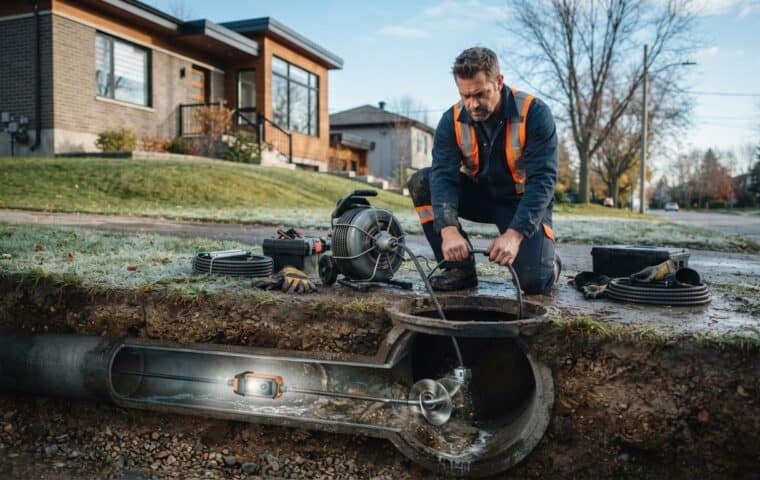
A mechanical tool equipped with an appropriate cutting head can remove woody roots and restore an opening. High-pressure water equipment may remove some deposits and smaller fibres after the pipe has been opened.
The selection depends on:
- the pipe’s material and condition;
- its diameter;
- the quantity and thickness of the roots;
- the blockage location;
- known or suspected defects;
- the available access point.
A fragile or already damaged pipe requires a cautious approach. The objective is not to apply the greatest possible force, but to use equipment compatible with the condition of the line.
A particular safety risk must also be considered when clearing a sewer lateral outside the building. The CMMTQ explains that contractors must complete appropriate checks to rule out the possibility of a gas line crossing through the sewer before using mechanical or high-pressure equipment.
Why Do Household Remedies Fail to Correct the Cause?
Salt, bleach, crystals, herbicides and corrosive drain cleaners are sometimes promoted as simple ways to kill sewer roots. Even if a product damages part of the plant growth, it does not seal the joint or crack.
Using these products may also:
- expose occupants to a hazardous substance;
- create risks for the technician;
- damage certain piping materials;
- cause a dangerous reaction when mixed with another product;
- introduce an inappropriate substance into the sewer system;
- temporarily mask symptoms without documenting the defect.
Health Canada warns that drain cleaners and other household chemicals can cause burns, poisoning, fires or explosions when used improperly. Its guidance recommends reading the label and never mixing household chemicals.
If a chemical product has already been poured into the drain, inform the plumber before work begins. That information may affect the protective measures required.
Does the Tree Need to Be Removed?
Not automatically. Removing the tree does not repair the crack or joint that allowed roots to enter. Roots already present in the soil may also remain for some time.
Before changing the landscaping, determine:
- whether the visible roots can be linked to a particular tree;
- whether the tree is on your property;
- whether its removal is permitted;
- whether the pipe must be repaired regardless;
- how removal could affect the property and nearby infrastructure.
The Government of Quebec advises against cutting roots belonging to a neighbour’s tree without the owner’s permission. Its guidance concerning trees and branches also recommends consulting the municipality when local regulations may apply.
An arborist’s opinion can be useful before cutting major roots or removing a tree. Improper root cutting can affect the tree’s stability without solving the sewer problem.
How Can the Long-Term Risk Be Reduced?
Prevention does not depend on one action. It involves maintaining reliable information about the sewer line and avoiding new risks.
Document Every Intervention
Keep:
- drain-cleaning dates;
- camera-inspection videos;
- recorded distances;
- locations marked on the property;
- invoices;
- written recommendations;
- repair records.
This history helps determine whether roots are returning at the same location and how quickly the recurrence is developing.
It may also be useful during a real estate transaction. Our guide explains when a sewer inspection may be appropriate before buying a home.
Avoid Feeding the Blockage
Roots become more obstructive when they catch materials travelling through the pipe. Avoid flushing or pouring:
- wipes, including products labelled flushable;
- personal-hygiene products;
- cooking grease;
- solid waste;
- excessive amounts of toilet paper.
These precautions do not close the root entry point, but they can reduce the amount of material that becomes trapped in the fibres.
Locate Underground Infrastructure Before Planting
Before planting a new tree, consider its mature size and the infrastructure located beneath the property.
Info-Excavation recommends submitting a locate request before planting to identify underground infrastructure and the required clearances.
The municipality also provides a practical tree-planting guide. Tree placement should not be based on one generic distance for every species and property.
Correct the Defect When Recurrence Justifies It
If cleanings become frequent or the sewer line continues deteriorating, repeatedly cutting roots without evaluating the entry point may only postpone a necessary repair.
A useful comparison should consider:
- the cumulative cost of repeated service;
- the frequency of recurrence;
- the risk of another backup;
- the extent of the defect;
- access to the pipe;
- the expected service life of the proposed options.
Check the Rules Before Digging
A camera may help locate an anomaly, but it does not automatically determine whether the affected section belongs to the property owner or the municipal system.
For a property serviced by Laval, water and sewer connections and certain modifications are regulated by the City. Before excavating or replacing a line, consult the requirements applying to service-connection work.
For properties elsewhere, verify the rules of the appropriate municipality. This step is particularly important before assigning responsibility for the work or accepting an estimate for a major repair.
The Right Solution Begins With the Entry Point
Roots return after cleaning when the opening that gave them access remains in the sewer line. Root cutting may restore drainage, but it should not be confused with a structural repair.
A reasonable decision depends on three factors: the visible condition of the pipe, the frequency of recurrence and the location of the entry points.
A limited intrusion may sometimes be cleaned and monitored. A localized defect may justify a targeted repair. Several damaged sections or a collapsed line may require more extensive work.
The important point is to choose the next step from documented observations instead of assuming that every root requires complete excavation—or that one cleaning will permanently eliminate the problem.
Frequently Asked Questions
Can Roots Enter a PVC Sewer Pipe?
PVC resists corrosion, but no installation is completely protected from an improperly assembled joint, shifting or mechanical damage. Roots primarily exploit an existing opening rather than penetrating an intact pipe wall.
Do Roots Always Return After Cleaning?
They can return when the entry point remains open and living roots surround the pipe. The timing varies considerably. No universal interval can predict the next obstruction.
How Often Should Roots Be Removed From a Sewer Line?
The frequency should be based on the pipe’s actual history, available footage and how quickly symptoms return. A fixed recommendation of 18 months, two years or three years does not suit every property.
Should the Camera Inspection Take Place Before or After Cleaning?
When the pipe remains sufficiently open, an initial inspection may show the type and location of the blockage. Another inspection after cleaning may provide a clearer view of the pipe wall and root entry point. When the line is completely blocked, some clearing may be necessary before a complete inspection is possible.
Is It Necessary to Remove the Tree?
Not necessarily. Removing the tree does not close the defect in the sewer line. The pipe should be evaluated first, the source of the roots should be identified carefully and applicable rules should be checked before disturbing the tree or its root system.
Does High-Pressure Cleaning Prevent Roots From Returning?
No. High-pressure equipment may remove small roots and other buildup when suitable for the pipe, but it does not seal a crack or open joint. Regrowth remains possible while the entry point exists.
Reliable Sources and Resources
- North Carolina Cooperative Extension — Tree Roots and Sewers
- CMMTQ — Safety Measures When Clearing a Sewer Line
- Health Canada — Using Household Chemicals Safely
- Info-Excavation — Planting Trees
- Government of Quebec — Trees and Branches
- Practical Guide to Planting a Tree
- Municipal Requirements for Service-Connection Work