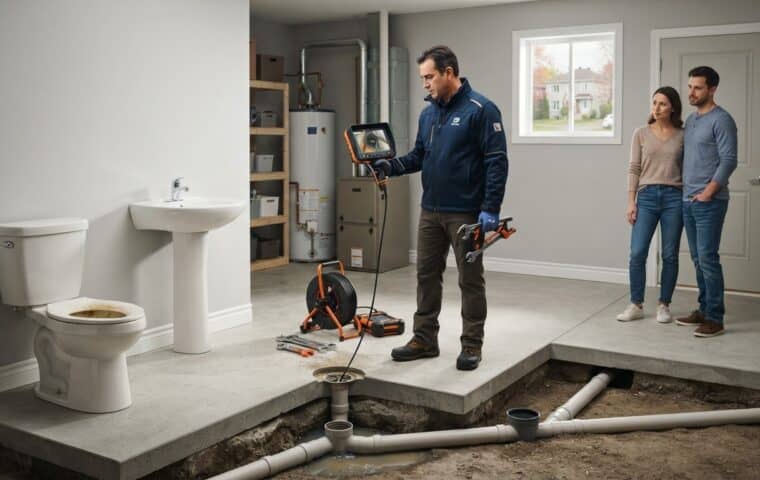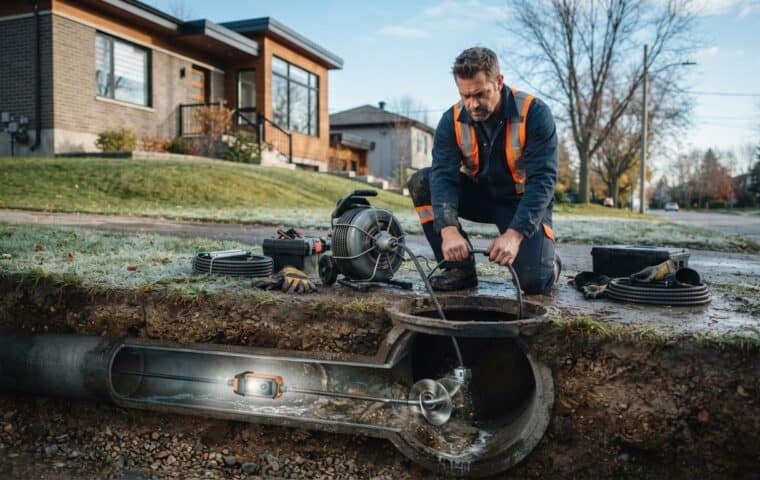
A pre-purchase inspection evaluates the visible components of a property. However, an important part of the drainage system remains buried beneath the concrete slab, yard or street. Its condition cannot always be determined during a conventional building inspection.
Should every buyer arrange a sewer camera inspection? No. This specialized assessment becomes more relevant when there is a specific concern: previous sewer backups, repeated drain cleaning, poorly documented repairs, trees near the likely route of the sewer lateral or a recommendation from the building inspector.
The goal is not to obtain a video “just in case.” It is to answer a question that could influence the transaction or the planning of future repairs.
Quick answer: A sewer camera inspection is not automatically necessary for every home. It becomes useful when the property’s history, available documents or visible signs indicate a particular concern involving a buried drainpipe.
What a Pre-Purchase Inspection Covers — and What It Does Not
A general pre-purchase inspection remains the first step. It covers the building’s visible and accessible components, including the structure, roof, visible plumbing, electrical system, heating equipment and other observable elements.
The OACIQ emphasizes the importance of having a property inspected by a qualified professional or building inspector who meets the applicable requirements. The inspection should also result in a written report.
The inspector can examine plumbing fixtures, visible piping and signs that may suggest a drainage problem. However, a general inspection does not automatically reveal the condition inside a buried sewer lateral.
When a concerning observation falls outside the scope of the visual inspection, the inspector may recommend a specialized assessment. A sewer camera inspection can then provide additional information. It does not replace the general building inspection or the evaluation of other property components.
Start With the Available Documents
Before arranging a specialized inspection, review the documents associated with the property. They may reveal a history that is impossible to identify during a single visit.
The Seller’s Declarations
The Declarations by the seller of the immovable form contains information provided to the best of the seller’s knowledge. The OACIQ explains that the seller’s declarations should disclose known incidents, including water damage, infiltration and the corrective work performed.
Pay particular attention to answers concerning:
- water infiltration or water damage;
- sewer backups;
- odours or drainage problems;
- foundation cracks;
- work performed on buried pipes;
- previous repairs or insurance claims;
- problems affecting the basement.
An affirmative answer does not necessarily mean that the problem still exists. It means the buyer should understand what happened, when it occurred and how the situation was corrected.
Previous Invoices and Reports
When available, ask for:
- drain-cleaning or unclogging invoices;
- previous camera-inspection reports;
- videos or photographs of the pipes;
- repair or replacement invoices;
- excavation records;
- applicable warranties;
- plans showing the route of the sewer lateral.
An invoice stating only that a drain was unclogged may not identify the cause of the blockage. By contrast, a detailed report may show that a defect was repaired and the pipe was inspected afterward.
The date matters as well. Footage recorded several years ago does not necessarily represent the pipe’s current condition.
Seven Signs That May Justify a Sewer Inspection
No single sign proves that a sewer line is defective. These observations help determine whether additional investigation would be reasonable.
1. The Property Has a History of Sewer Backups
A previous backup deserves a clear explanation. Was it caused by a foreign object, accumulated waste, roots, a damaged pipe or a problem in the municipal sewer?
Ask when the incident occurred, which parts of the building were affected and what corrective work was completed. If the cause remains unknown or several backups have occurred, a specialized inspection may reduce uncertainty.
2. The Drains Have Been Cleared Repeatedly
One drain-cleaning visit is not necessarily alarming. Repeated service at the same location may indicate an underlying condition that encourages new blockages.
Possible causes include roots, a deformed pipe, a displaced joint or buildup that was not completely removed. Once the pipe has been cleared, a camera may help distinguish a one-time blockage from a recurring condition.
3. Several Fixtures React at the Same Time
When a toilet, shower and floor drain react at the same time, the problem may be inside a shared drain rather than one fixture trap.
A single noise is not enough to locate the cause. Our guide to a gurgling drain explains which observations can help distinguish a localized restriction from a problem farther along the drainage system.
4. Trees Are Located Near the Probable Pipe Route
The presence of trees does not prove that roots have entered the sewer. Roots usually take advantage of an existing opening, deteriorated joint or damaged section.
They become more concerning when combined with recurring blockages, an older inspection report or a sewer route that passes near mature trees.
5. Exterior Work Has Not Been Clearly Explained
A repaired strip of asphalt, a newer section of concrete or an area that appears to have been excavated can have several explanations.
Ask what was repaired and request the related invoices. Evidence of previous work does not prove that a sewer problem still exists, but substantial repairs without documentation deserve clarification.
6. The Pipe’s Age or Material Is Unknown
The age of the house does not determine the condition of its sewer lateral. Older pipes may still function properly, while a newer installation may have shifted or been poorly repaired.
Uncertainty increases when the material, route or history of the pipe is unknown. A camera can document some accessible sections, although the material cannot always be identified conclusively from the image alone.
7. The Building Inspector Recommends Further Evaluation
Slow drainage, evidence of a previous backup, unusual materials or contradictory information may lead the building inspector to recommend an assessment by a plumber.
That recommendation deserves attention, particularly when the inspection period in the promise to purchase still allows enough time to obtain the necessary information.
What a Camera Can Clarify Before the Purchase
A camera inserted into an accessible drainpipe may reveal:
- an obstruction or substantial buildup;
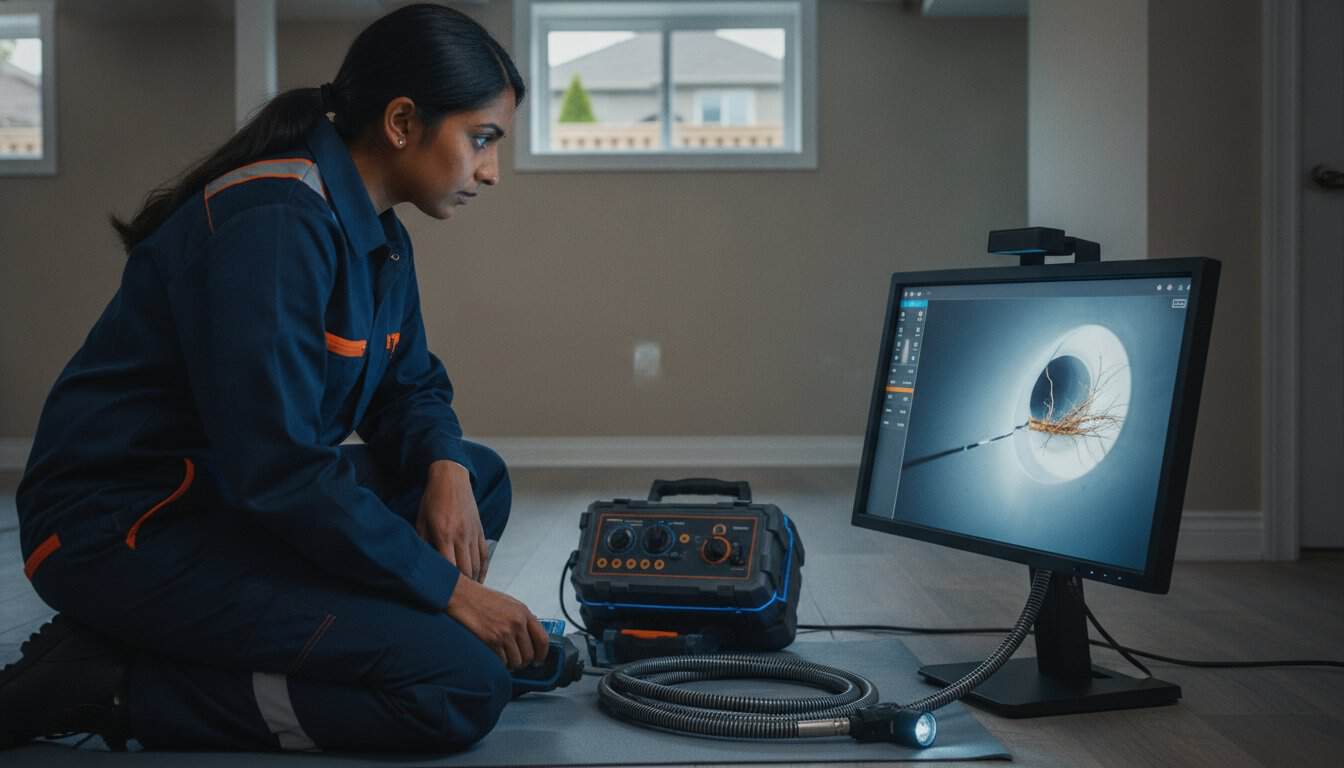
- roots inside the pipe;
- a separated or displaced joint;
- a visible crack or perforation;
- a deformed or collapsed section;
- corrosion or heavy deposits;
- water remaining in one area;
- a transition between different pipes;
- the point where the camera can no longer move forward.
When the camera head contains a transmitter, compatible locating equipment may help estimate the position of an observation from the surface. Confirm whether this service is included in the inspection.
The CMMTQ presents cameras as tools for inspecting and locating piping problems. Their usefulness still depends on access, visibility and the interpretation of the footage.
What the Inspection Does Not Guarantee
A sewer camera inspection has limitations that a buyer should understand before relying on the results.
It does not guarantee:
- that every drainpipe on the property was inspected;
- that the camera reached the municipal sewer;
- that the outside of the pipe is intact;
- that the surrounding soil is stable;
- that every leak is visible;
- that the pipe’s slope was measured precisely;
- that no problem will develop after the transaction;
- that the foundation drain was also inspected.
Cloudy water, buildup, a blockage or a sharp bend may interrupt the inspection. The report should clearly identify the access point, distance travelled and any section that could not be observed.
Footage showing no major defect can be reassuring for the section inspected. It is not a general warranty covering the entire plumbing system.
Do Not Confuse the Sanitary Sewer With the Foundation Drain
This distinction is especially important during a real estate transaction.
The sanitary sewer carries wastewater from toilets, sinks, showers and other fixtures. The foundation drain, commonly called a French drain in Quebec, collects water around the building’s footings.
A camera inserted into the sanitary sewer does not automatically inspect the French drain. The foundation drain requires its own accessible entry points and suitable inspection equipment.
Basement moisture may result from:
- a foundation crack;
- poor grading around the building;
- gutters or downspouts;
- infiltration around an opening;
- a foundation-drain problem;
- a water-supply line;
- a backup or drainage problem.
A sanitary-sewer inspection should never be presented as a complete foundation assessment.
How to Define the Inspection Mandate
Before the appointment, the buyer should know exactly what will be inspected and what documentation will be provided.
Ask the plumber to specify:
- which pipe will be inspected;
- which access point will be used;
- how far the camera is expected to travel;
- which obstacles could limit the inspection;
- whether the drain may need to be cleared first;
- whether surface locating is included;
- whether the video will be provided;
- whether photographs or a written report are included;
- whether the findings will be explained;
- what will happen if the camera cannot complete the intended route.
Removing a toilet or opening another access point may also involve additional work. This should be clarified before the technician arrives.
If the pipe is obstructed, drain cleaning or unclogging may be required before useful footage can be obtained. Drain cleaning and camera inspection remain separate operations.
How to Interpret the Results During a Transaction
Finding an irregularity does not automatically establish the severity of the problem or determine what the buyer should do.
Roots Are Visible
Determine where the roots are entering, how much of the pipe opening they occupy and whether they have already caused recurring blockages. A small amount of root intrusion does not automatically justify replacing the entire sewer lateral.
A Joint Is Displaced
The important question is whether the displaced joint interferes with drainage, catches waste or compromises the pipe’s integrity. Its distance and location should be documented.
Water Remains Inside the Pipe
Standing water may suggest a sagging section, but footage alone cannot always establish the exact slope or depth. The observation must be considered alongside the route of the pipe and the reported symptoms.
Buildup Restricts the Passage
Determine whether the buildup can be removed using an appropriate cleaning method and whether the condition of the pipe wall can be properly evaluated afterward.
The Camera Cannot Move Forward
This limitation should appear in the report. A blockage, bend, diameter change or damaged section may stop the camera. The pipe beyond that point has not been inspected.
No Major Defect Is Visible
This result may reduce uncertainty about the section that was examined. It does not confirm the condition of uninspected branches, the foundation drain or the outside of the sewer pipe.
Before amending a promise to purchase or negotiating repairs, obtain a clear explanation of the finding and, when appropriate, a separate estimate for the possible corrective work.
Consider the Inspection Deadline
Specialized inspections must be arranged within the time allowed by the transaction. Buyers should not wait until the final day to request an appointment, report or repair estimate.
The OACIQ notes that buyers should have enough time to review the building-inspection report, ask questions and obtain clarification from an appropriately qualified person when needed.
The real estate broker can explain the applicable deadlines and transaction documents. The plumber can describe the visible condition of the pipe and possible interventions. These roles are complementary but different.
Check Municipal Rules Before Estimating the Work
A camera may help estimate where an anomaly is located. It does not, by itself, determine whether a repair is the responsibility of the property owner or the municipality.
For a property located in Laval, the City regulates water and sewer service connections as well as certain connection modifications. Before estimating the cost of excavation or replacement, review the municipal requirements for service-connection work.
This body-copy reference provides a useful local signal without turning the article into another location-based service page. For properties elsewhere, the rules of the appropriate municipality should be consulted.
Any plumbing work following the diagnosis must also comply with Quebec plumbing regulations and be entrusted to a contractor with the appropriate qualifications when required.
Four Questions That Help You Decide
Before ordering a sewer camera inspection, consider four questions.
Is There a Specific Concern?
A previous backup, repeated service, a recommendation from the building inspector or incomplete documentation gives the inspection a clear purpose.
Is the Pipe Accessible?
Without a cleanout or another suitable access point, additional work may be required. Some pipes may remain partly or completely inaccessible.
Could the Result Affect Your Decision?
A specialized inspection is most useful when its findings could change your understanding of the property, anticipated repair budget or conditions of the transaction.
Is There Enough Time to Review the Results?
Allow time for the appointment, delivery of the documentation, interpretation of the findings and, if necessary, an estimate for corrective work.
When these elements are present, the inspection has a practical objective. Otherwise, the better first step may be to clarify the property’s history and discuss the building inspector’s observations.
A Targeted Assessment, Not an Automatic Formality
Inspecting the sewer before buying a home is neither mandatory in every transaction nor unnecessary by definition. Its value depends on the warning signs and missing information.
A properly targeted inspection can document the inside of a pipe that cannot be evaluated visually. It may help distinguish removable buildup from an anomaly requiring further assessment.
It does not replace the pre-purchase inspection, the seller’s declarations, supporting documents or advice from the professionals involved in the transaction.
When the property’s history or the building inspection raises a specific concern, a drain camera inspection can provide useful information before the purchase is completed.
Frequently Asked Questions
Is a Sewer Camera Inspection Mandatory Before Buying a Home?
No. It is a specialized inspection that may be recommended based on the property’s history, the building inspector’s observations or a specific concern raised by the buyer.
Does the Building Inspector Examine the Inside of the Pipes?
A pre-purchase inspection primarily concerns visible and accessible components. Inserting a camera into a buried pipe is generally a separate specialized service.
Can a Sewer Camera Inspect the Foundation Drain?
Not automatically. The sanitary sewer and foundation drain are separate systems. The foundation drain requires appropriate access points and a separate inspection.
Who Pays for the Specialized Inspection?
There is no single rule for every transaction. Responsibility for the cost depends on the agreement between the parties and the conditions of the transaction. The buyer should discuss this with their real estate broker before arranging the service.
Is an Older Camera Report Sufficient?
That depends on its date, the section inspected, the quality of the images and any work completed afterward. An older report may provide useful history, but it does not necessarily represent the pipe’s current condition.
Which Documents Should the Buyer Request?
At minimum, request an explanation of the findings and the limits of the inspection. If documentation is important to the transaction, confirm in advance whether the service includes the video, photographs, recorded distances and a written report.