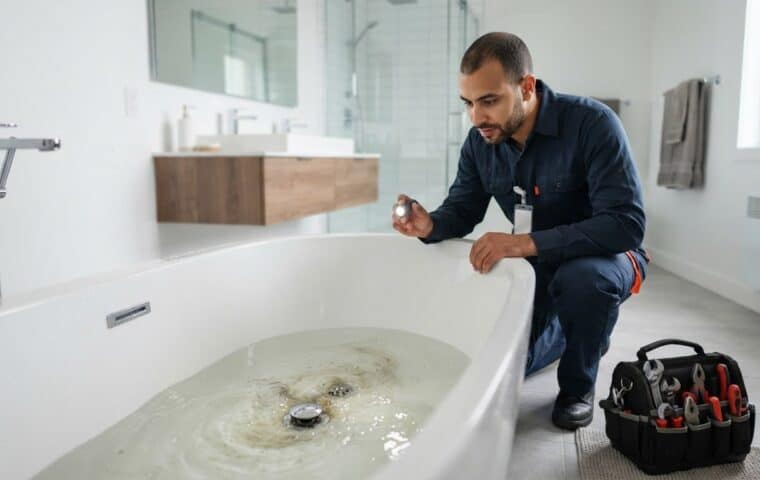
Water appearing in a shower, sink or floor drain when another fixture empties is more than an isolated slow drain. This cross-drain reaction usually indicates that wastewater can no longer move freely through a section of pipe shared by two or more fixtures.
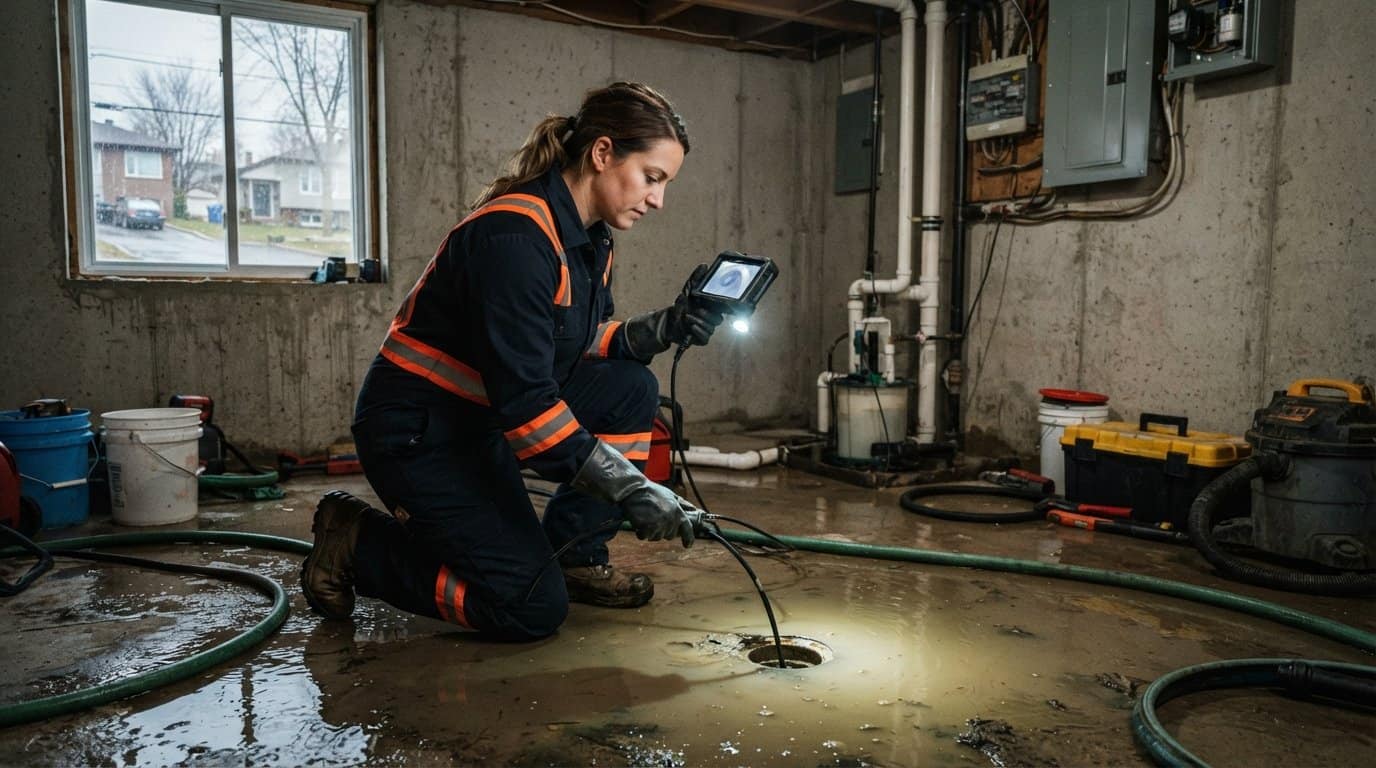
A typical example occurs when a washing machine begins its drain cycle and water suddenly rises in a nearby shower or basement floor drain. Because a washing machine releases a large volume of water quickly, it can expose a restriction that remains less noticeable during ordinary use.
If this happens, stop running water and avoid repeating the test. Each additional discharge may send more wastewater toward the lowest available opening.
The short answer: a shared drainage route is probably restricted
Plumbing fixtures do not necessarily have separate pipes all the way to the municipal sewer. Several fixture branches may join a common building drain before wastewater leaves the property.
When a restriction reduces that pipe’s capacity, water follows the easiest available path. If it cannot continue downstream quickly enough, it may rise through a lower fixture or floor drain.
This reaction helps narrow down the possible location of the problem:
- If only one fixture drains slowly, the obstruction may be close to that fixture.
- If one fixture causes water to appear in another, the restriction may be beyond the point where their branches connect.
- If several low-level drains react, the problem may involve a larger portion of the building drain or sewer service line.
- If water rises when no one is using water indoors, exterior surcharge or a municipal sewer condition may also need to be considered.
The visible backup is therefore not always located directly above the blockage.
Why a washing machine often reveals the problem first
A washing machine pump can discharge many litres of water over a short period. A partially restricted pipe may still accept the modest flow from a faucet but fail when the washer empties.
The same principle can apply when:
- a bathtub is drained;
- a toilet is flushed;
- a dishwasher discharges;
- several fixtures are used simultaneously;
- rainwater enters a drainage system connected to vulnerable piping.
This does not mean the washing machine caused the obstruction. Its rapid discharge may simply have revealed a loss of capacity elsewhere in the system.
Four patterns that help locate the affected area
1. Water backs up in the same fixture
If water rises only in the fixture being used, the problem may be located in its trap or individual branch. Hair, soap residue, food waste and accumulated grease are common causes, depending on the fixture.
A localized problem becomes less likely if other fixtures begin reacting as well.
2. One fixture triggers a nearby drain
When draining a sink, bathtub or washing machine makes water appear in another fixture, the two fixtures probably share part of the same drainage route.
The restriction is often downstream from the junction between their branches. Treating only the drain where the water appeared may therefore fail to address the actual obstruction.
3. Several low fixtures react
If a basement shower, floor drain and toilet all react when water is used upstairs, the affected section may be farther along the main building drain or sewer service line.
Stop using water until the situation is assessed. Continued use can turn a warning sign into a larger wastewater backup.
4. Water rises without indoor water use
A backup that occurs during heavy rain or while no plumbing fixture is being used may involve conditions outside the immediate fixture network.
Possible factors include:
- surcharge in the public sewer;
- stormwater entering an inappropriate connection;
- groundwater infiltration;
- a blocked or damaged private sewer line;
- a backwater valve that cannot close properly;
- water entering through a foundation opening or another route.
The City of Laval provides French-language information on distinguishing water accumulation, infiltration and sewer backups. The timing, appearance and origin of the water are important because not every wet basement is caused by the same mechanism.
For additional context, see our guide to water in the basement after heavy rain.
Clear water does not prove the backup is harmless
Water emerging from a floor drain or shower may initially look clear. However, its appearance does not confirm that it is clean.
Once water has entered a drainage pipe shared with toilets, sinks or other wastewater sources, it should be treated cautiously. Contamination may not be visible or accompanied by a strong odour.
Keep children and pets away from the affected area. Avoid direct skin contact and do not handle contaminated materials without appropriate protection.
The Government of Quebec explains precautions for cleaning a home after flooding or a sewer backup, including measures related to contaminated water and porous materials.
Gurgling may appear before water rises
A gurgling drain often means that air and water are no longer moving normally through the drainage system. It can accompany:
- a partial obstruction;
- poor venting;
- pressure changes in a shared branch;
- water displacing trapped air near a restriction.
Gurgling alone does not identify the precise cause. However, gurgling combined with slow drainage, changing toilet-bowl levels or cross-fixture reactions deserves prompt attention.
Our guide to a gurgling drain explains how the timing and location of the noise can help distinguish a local restriction from a broader drainage issue.
Why counting affected fixtures has limitations
The number of reacting fixtures provides useful clues, but it does not diagnose the system by itself.
A single visible backup can still result from a restriction in a shared pipe. Conversely, several slow fixtures do not automatically prove that the main sewer line is completely blocked.
Drainage behaviour depends on:
- how the branches are connected;
- the elevation of each fixture;
- the volume and speed of the discharge;
- the location and severity of the restriction;
- the condition and slope of the piping;
- whether a backwater valve or pumping system is involved.
The lowest opening often shows the symptom first, even if the obstruction is several metres away.
What to do immediately
Stop adding water
Do not flush toilets, run faucets, start another laundry cycle or drain a bathtub. If the affected line serves the entire building, reduce all water use until the cause is understood.
Keep people and pets away
Treat water from an unidentified drain backup as potentially contaminated. Limit access to the area and avoid tracking the water into unaffected rooms.
Consider electrical hazards
Water near receptacles, appliances, extension cords, electrical panels or powered equipment can create a serious hazard.
Do not step into standing water to reach a breaker or unplug an appliance. Hydro-Québec provides guidance on electrical safety during flooding or water damage. If access is unsafe, remain outside the affected area and obtain qualified assistance.
Do not mix drain chemicals
Chemical drain openers may remain trapped behind an obstruction. They can damage some materials, create hazardous splashes and expose the person who later opens or cleans the pipe.
Never combine different drain products, bleach, acids or other household chemicals.
Do not open a pressurized cleanout
A cleanout cap located upstream of a blockage may be holding back wastewater. Removing it without knowing the condition of the pipe can release sewage suddenly.
Leave the cap in place if there are signs of pressure, leakage or a significant backup.
Record these observations before the water disappears
A few precise details can make the investigation more efficient:
- Which fixture was being used when the backup began?
- Where did the water first appear?
- Did more than one fixture react?
- Was the discharge rapid, as with a washing machine or bathtub?
- Was there gurgling before or during the event?
- Did the toilet-bowl level change?
- Did the water contain debris, foam, grease or an odour?
- Was it raining heavily?
- Did the water rise when no one was using plumbing indoors?
- Has the same pattern happened before?
Photographs and a short video may also help document the water level and sequence of events. Do not recreate the backup merely to obtain better footage.
Is the problem inside the building or farther downstream?
The pattern can suggest where to begin, but confirmation usually requires an on-site assessment.
A restriction is more likely to be within the private drainage system when:
- the backup consistently follows indoor water use;
- certain fixtures trigger the same low drain;
- neighbours are not reporting similar problems;
- the issue occurs in dry weather;
- the property has a history of roots, grease accumulation or pipe damage.
An exterior or municipal surcharge becomes more plausible when:
- the backup coincides with intense rainfall;
- water rises without indoor plumbing use;
- several nearby properties are affected;
- the public sewer is known to be surcharged;
- the water enters through a low drain despite minimal household discharge.
These are indicators, not proof. More than one factor can exist at the same time.
A backwater valve does not unclog a pipe
A backwater valve is designed to limit reverse flow under specific conditions. It does not remove grease, roots, wipes, sediment or another obstruction from the private sewer line.
A closed valve can also temporarily prevent wastewater from leaving the building. For that reason, occupants should avoid using plumbing while the valve is closed.
The protection provided depends on the valve’s location, the fixtures connected upstream and downstream, its accessibility and its condition. Read our explanation of which fixtures a backwater valve actually protects.
The Régie du bâtiment du Québec also publishes French-language technical guidance on backwater valves.
How the affected section is identified
A useful diagnosis begins with the drainage pattern rather than an assumption that the lowest visible drain is blocked.
The process may include:
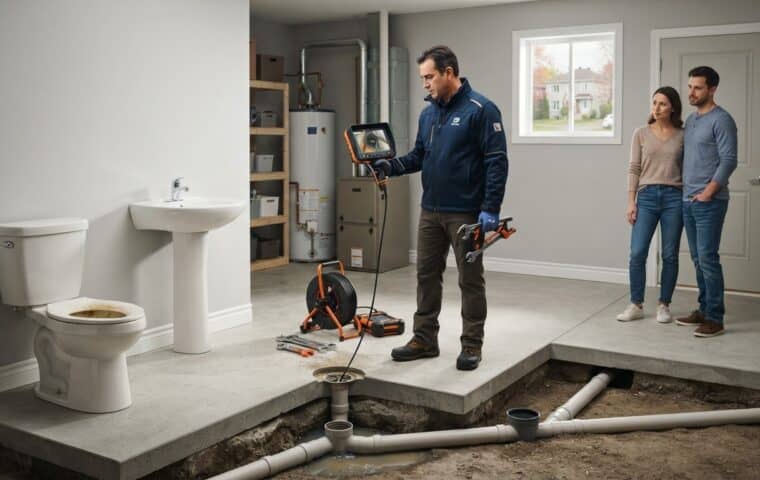
Mapping the affected fixtures
The first objective is to determine which fixtures share the symptom and which continue to drain normally. This helps identify the probable branch or common pipe involved.
Checking accessible components
Traps, cleanouts, pumping equipment and backwater valves may be checked when they can be accessed safely. The objective is to identify evidence of restricted flow without releasing wastewater unnecessarily.
Restoring flow
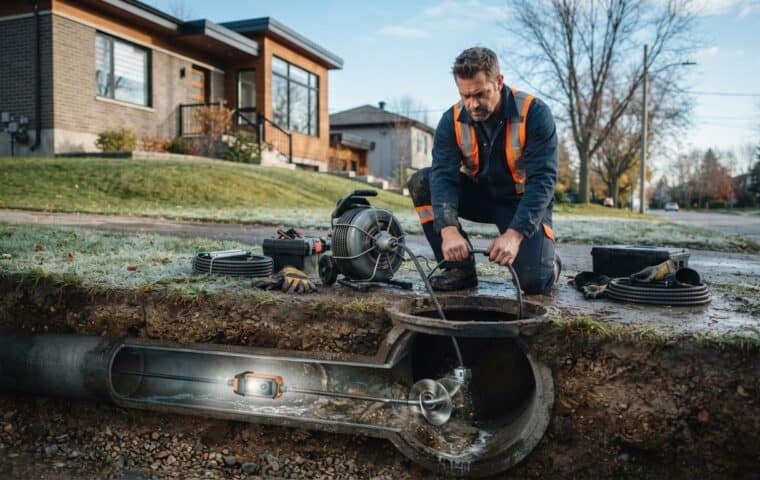
The cleaning method should match the probable obstruction and pipe configuration. A small fixture branch and a larger sewer service line do not necessarily require the same equipment.
Inspecting the pipe when useful
A camera inspection may help after sufficient flow has been restored. It can document roots, displaced joints, fractures, deformation, deposits or another recurring defect.
A camera does not see effectively through opaque standing water or a dense obstruction. In many cases, clearing the line comes before obtaining useful images.
If roots are found, the important question is not merely how to remove them but how they entered the pipe. Our article on why tree roots return after sewer cleaning explains the relationship between root growth and existing pipe defects.
How to reduce the chance of another cross-drain backup
Not every obstruction can be prevented, particularly when piping is damaged or affected by roots. However, several habits reduce avoidable stress on the drainage system:
- keep wipes, hygiene products, paper towels and grease out of drains and toilets;
- use strainers to capture hair and food particles;
- avoid pouring fats and cooking oils into sinks;
- respond to recurring gurgling or slow drainage before water begins to rise;
- keep accessible cleanouts unobstructed;
- have recurring problems investigated instead of repeatedly treating the nearest fixture;
- maintain pumping and backwater-protection equipment according to its design and condition.
A repeated cross-fixture reaction is evidence that the underlying problem has not been resolved, even if the water eventually drains away.
Frequently asked questions
Why does the shower fill when the washing machine drains?
The washer releases water quickly. If the shared downstream pipe cannot accept that flow, water may rise through the shower because it is a lower opening on the connected drainage route.
Does water in a floor drain always mean the main sewer is blocked?
No. The restriction may be in a branch serving only part of the building. Heavy rain, exterior surcharge, a closed backwater valve or another drainage issue can also produce similar symptoms.
Can I continue using the upstairs plumbing?
It is safer to stop. Water used upstairs may travel toward the affected section and increase the backup at a lower fixture.
Can plunging the floor drain solve the problem?
Not necessarily. If another fixture causes the backup, the restriction may be beyond a shared junction. Working only at the visible drain may not reach the affected area.
Should I pour a chemical drain opener into the drain?
No. The product may remain trapped, damage piping or seals, create hazardous fumes and expose the person who later services the line.
Why did the water disappear on its own?
A partial obstruction may allow water to drain slowly after fixture use stops. A temporary reduction in sewer pressure can also lower the water level. Neither situation proves that the cause has been corrected.
Is a camera inspection always the first step?
No. If the pipe is full of standing water or completely obstructed, the camera may not provide a useful view. Restoring enough flow to inspect the pipe is often necessary first.
When is the situation urgent?
Prompt assistance is appropriate when wastewater is actively rising, several fixtures are affected, toilets cannot be used, water is near electrical equipment, sewage has entered occupied space or the backup continues without indoor water use.
The key clue is the connection between fixtures
When one plumbing fixture causes water to rise in another, the most useful clue is not simply where the water appeared. It is the relationship between the two fixtures and the pipe they share.
Stop adding water, protect occupants from possible contamination and record the sequence of events. A diagnosis based on the full drainage pattern can identify the affected section more accurately than repeatedly treating the lowest visible drain.
If water is actively backing up or several fixtures are reacting, request professional drain cleaning and unclogging before additional wastewater enters the affected line.