A sewer line that retains water has not necessarily collapsed. It may have developed a low spot, commonly called a belly, where water and solid waste collect. The line could also have an improper slope, a displaced joint or an obstruction farther downstream. These defects can produce similar symptoms, but they do not all require the same repair.
The most useful warning sign is therefore not a sound, smell or slow drain considered on its own. It is the combination of several symptoms, how often they return and what can be seen inside the pipe after it has been cleaned.
Here are seven signs that may justify a closer inspection, along with the limits of what each sign can actually prove.
What is a sagging sewer line?
A drainage system operates primarily by gravity. Its route must allow wastewater and solids to travel toward the public sewer without remaining trapped in a low section.
A sag develops when part of the pipe settles below its intended profile. Water must fill this depression before it can continue downstream. Some water may remain in the pipe even when no plumbing fixtures are being used.
Two conditions are frequently confused:
- A localized belly creates a low area over a limited portion of the line.
- A reverse slope describes a longer section that slopes in the wrong direction.
A pipe can also be cracked, offset or partially crushed without having either of these defects. The term “sagging sewer line” should not be treated as a confirmed diagnosis until the line has been inspected.
Sign 1: blockages keep returning in the same area
A blockage caused by an object, paper, grease or tree roots can return if its cause was not completely removed. Recurrence does not automatically prove that the pipe has sagged.
It becomes more significant when:
- the flow is properly restored but slows again soon afterward;
- deposits return at approximately the same distance from the access point;
- the same portion of the line has required repeated cleaning;
- the pipe fills again even though no new object appears to be lodged inside it.
In a low spot, transported solids lose speed and settle more easily. Cleaning may remove the accumulation, but it does not raise the pipe. The passage becomes temporarily clear, and then new deposits begin forming.
The frequency of the blockages, the distance at which the cleaning equipment encounters resistance and the condition of the pipe after cleaning are therefore more useful than the simple fact that a blockage has occurred before.
Sign 2: several fixtures react at the same time
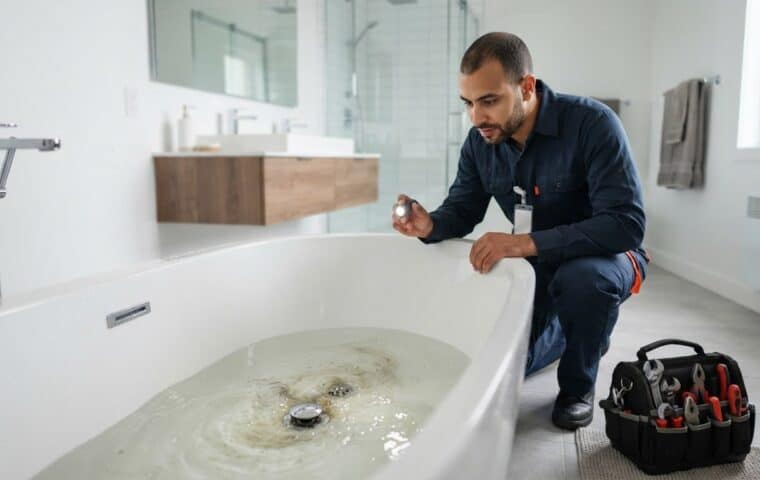
A slow sink may be obstructed in its trap or immediate branch. When a toilet, shower, floor drain and laundry tub react together, the restriction may be located in a shared part of the drainage system.
The lowest fixtures are often the first to show a problem. For example:
- the toilet water rises when the washing machine drains;
- the shower gurgles while a bathtub is emptying;
- water enters the floor drain when another fixture is used;
- several fixtures begin draining slowly at the same time.
These reactions can also result from a main-line obstruction, a ventilation problem or an overloaded system. They mainly indicate that the problem probably extends beyond the branch serving a single fixture.
Our guide explaining why water backs up into another drain shows how the triggering fixture and the affected fixture can help narrow down the area that should be investigated.
Sign 3: the problem returns during high-flow events
A slightly deformed section may appear to function when the flow is low. The water level can rise, however, when several fixtures are used or a large volume is discharged quickly.
The problem may become noticeable after:
- a load of laundry;
- filling and draining a bathtub;
- several showers taken close together;
- the simultaneous use of multiple fixtures;
- a period of heavier occupancy in the building.
This behaviour does not confirm a sag. A partial blockage often produces the same result. It does indicate that the available capacity inside the line is reduced and that a test performed with a slowly running faucet may not reveal the problem.
If a high-flow event causes wastewater to back up, stop the test. Adding more water to see whether it eventually drains can force sewage out through the building’s lowest fixture.
Sign 4: gurgling accompanies widespread slow drainage
Gurgling occurs when water and air no longer move normally through the drainage system. By itself, the sound cannot distinguish between an obstruction, inadequate ventilation and a pipe that remains partly filled with water.
It deserves more attention when it accompanies:
- slower drainage from several fixtures;
- changes in the water level inside a toilet;
- a sound triggered by the use of another fixture;
- a history of recurring blockages;
- water backing up at basement level.
A gurgling drain can therefore be an early warning sign, but the sound alone does not establish that the sewer line has sagged.
Sign 5: the camera passes through standing water
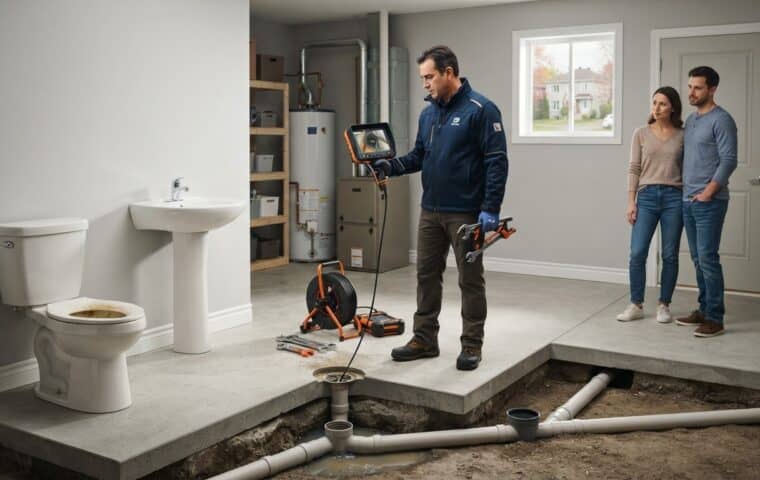
After the line has been cleaned, a camera may show the lens entering the water, remaining submerged for a certain distance and emerging again when the pipe rises.
This can be consistent with a low section. It must still be interpreted carefully because water may also remain in the pipe when there is:
- an obstruction farther downstream;
- debris that was not completely removed;
- a displaced joint that locally restricts flow;
- water entering the pipe during the inspection;
- an access position that prevents the camera from remaining centred.
A conventional camera displays the interior condition of the pipe, but it does not necessarily measure the exact grade. The CMMTQ discusses cameras as tools for inspecting and locating piping problems in its French-language industry resource on pipe cameras. For the recording to be useful, it should be continuous, clearly identified and accompanied by the distance travelled from a known access point.
When water completely blocks the view, the inspection should ideally be repeated after the line has been cleaned and the retained water has had an opportunity to drain. An opaque image does not provide a reliable view of the pipe walls, joints or material beneath the surface.
Sign 6: deposits reform in the same section
A low spot does not always completely block the pipe. It may simply retain enough water to encourage paper, organic material, grease or sediment to collect.
A camera inspection may then reveal:
- a deposit line along the bottom of the pipe;
- material concentrated in one section;
- a relatively clean pipe before and after that section;
- an accumulation that returns in the same location after cleaning.
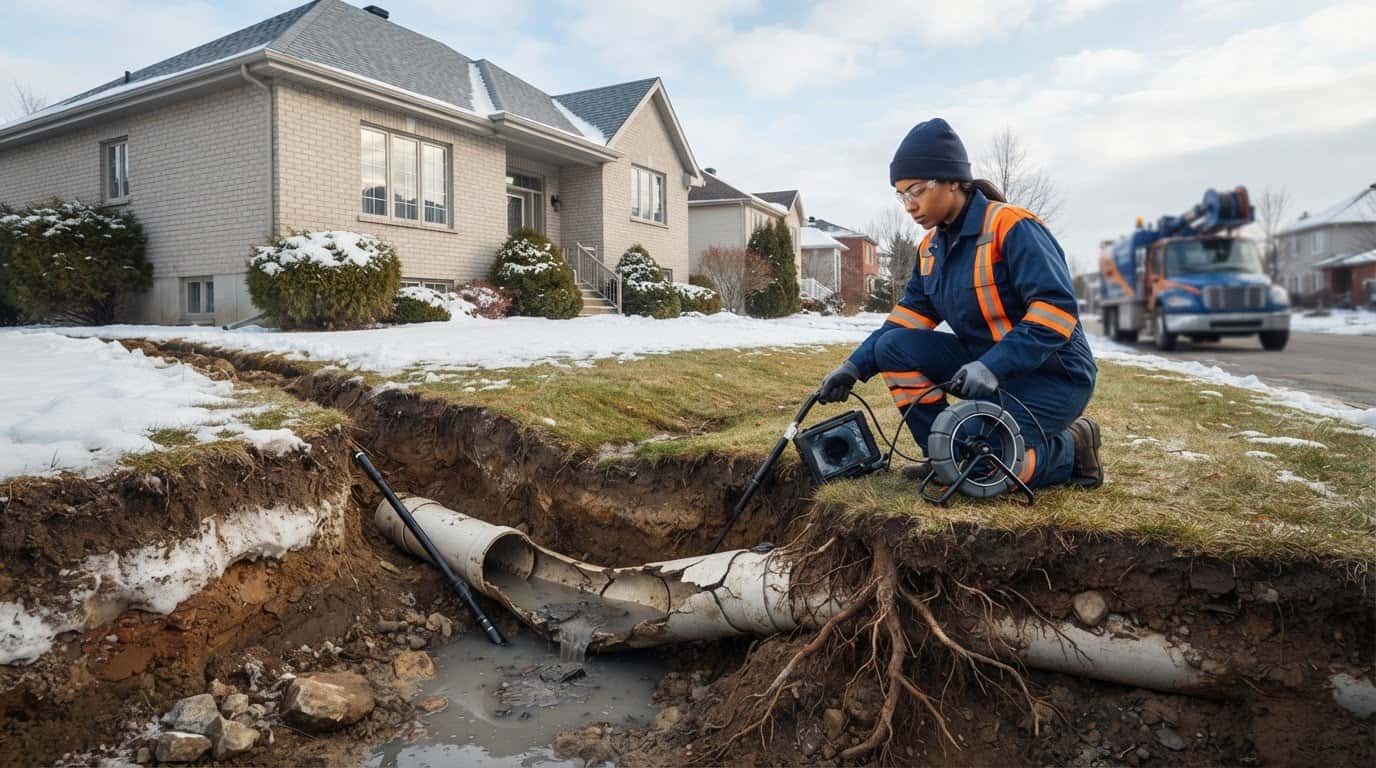
The type of deposit matters. Tree roots, for example, first point to a joint or crack through which they entered. They can slow the flow and trap solids without a sag necessarily being present. Our article on why tree roots return to sewer lines after cleaning explains this distinction.
The report should describe what is actually visible: retained water, roots, a crack, an offset joint, deformation or deposits. The general term “sagging pipe” should not replace that description.
Sign 7: the ground changes above the suspected route
A surface depression, sinking pavers or an area that remains unusually wet can draw attention to the soil surrounding a buried pipe. These clues become more relevant when they correspond with the location of a defect documented by the camera.
They must not be overinterpreted.
A watertight belly can retain water inside the pipe without making the ground wet. Conversely, saturated soil can result from surface drainage, a water service line, foundation drainage or another source.
Greener grass does not prove that the sewer is leaking. The exterior condition must first be compared with the sewer’s actual route and the observations made inside the pipe.
Why can none of these signs confirm the problem alone?
Most symptoms associated with a sagging sewer line can also be caused by:
- a partial obstruction;
- tree roots;
- a displaced joint;
- a crushed or cracked pipe;
- inadequate venting;
- an overloaded sewer;
- an incorrectly configured connection.
Even water seen during a camera inspection must be considered in context. Was the pipe cleaned first? Was water running elsewhere in the building? Was the camera submerged for a few centimetres or several metres? Did a second camera pass show the same condition?
A careful diagnosis compares the symptoms, the building’s history, the cleaning performed, the video and the defect’s location. This is what helps distinguish an ordinary blockage from a structural problem.
How should the condition be documented?
A drain camera inspection becomes more useful when the following information is preserved with the recording:
- the exact access point used for the camera;
- the displayed distance at which the anomaly begins;
- the approximate length of the affected section;
- the condition of the line before the camera enters the water;
- any visible joints, cracks, roots or deformation;
- the flow conditions during the inspection;
- the surface location of the defect when the equipment allows it to be traced.
A camera head equipped with a transmitter can help locate the probe from the surface. This identifies the probe’s position, but it does not replace the location of other buried utilities. It also does not determine whether the defective section is privately or municipally owned.
Before approving excavation, ask to see the complete recording and have each important image explained.
Can cleaning correct the defect?
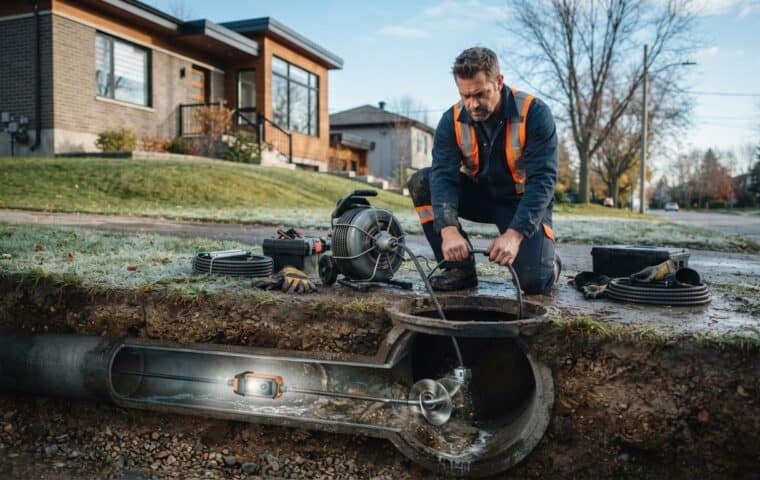
Mechanical or high-pressure cleaning can remove accumulated material and make the pipe easier to inspect. It may also temporarily restore enough open space for wastewater to pass.
It cannot:
- raise a settled pipe;
- rebuild its supporting base;
- correct a reverse slope;
- realign an offset joint;
- repair a crushed section.
Chemical drain cleaners should also be avoided when the line is draining poorly. The chemical can remain concentrated in the water-filled section and create a hazard for anyone who works on the pipe later. Always tell the technician if a chemical product has already been poured into the drain.
Does a sagging pipe always require immediate repair?
The decision depends on the extent of the defect and its consequences.
A small, stable amount of retained water without recurring blockages or backups may not lead to the same decision as a long submerged section that repeatedly becomes obstructed. Factors to compare include:
- how much of the pipe remains filled with water;
- the length of the affected section;
- the frequency of the blockages;
- the condition of the joints and pipe walls;
- the material and approximate age of the line;
- the surfaces located above it;
- the risk of sewage backing up into the building.
It is also important to understand that an interior liner generally follows the existing shape of the pipe. Lining may address certain wall defects, but it does not automatically restore a lost slope. No trenchless method should be presented as a universal solution for a sewer-line sag.
When a structural defect is confirmed, the page on sewer-line excavation and repair explains the factors used to compare a targeted repair with a longer replacement.
What should you do if several fixtures begin backing up?
If wastewater rises through a fixture or floor drain:
- stop using toilets, washing machines, dishwashers and showers;
- keep occupants and animals away from the contaminated water;
- do not handle electrical equipment located in a wet area;
- do not remove a pressurized cleanout cap;
- disclose any chemical cleaner that was previously used;
- have the line evaluated promptly.
An active backup is no longer simply a warning sign to monitor. Water use should be limited immediately while the affected private line, shared connection or exterior sewer is identified.
What must be checked before digging?
A repair should not begin until the defect has been located and the affected portion of the line has been clarified. Our guide covering the seven essential checks before excavating a sewer line addresses the video, surface location, permits, scope of work and property restoration.
For work in Laval, the City’s English permit finder directs property owners to the current municipal requirements. The procedure can depend on the nature and location of the work. A property line should not be treated as a universal dividing point for responsibility without verifying the applicable municipal rules and the precise location of the service connection.
Before opening the ground, an Info-Excavation locate request helps identify underground networks belonging to participating members. Other privately owned infrastructure may still have to be located separately.
A trench is never a safe place for a property owner to enter and examine the pipe. The CNESST explains the collapse hazards and protective requirements associated with trenches and excavations.
Questions to ask before authorizing a repair
An inspection report or quotation should provide clear answers to the following questions:
- Where does the water-retaining section begin and end?
- Was the sewer line cleaned before the inspection?
- Was a downstream obstruction ruled out?
- Does the recording show a belly, offset joint, crack or crushed section?
- Was the defect located from the surface?
- Does the condition of the remaining line allow for a localized repair?
- Which portion is the property owner responsible for?
- Which permits, inspections and restoration work are included?
This information reduces the risk of opening the ground in the wrong place or selecting a repair that does not address the documented defect.
Frequently asked questions
Do recurring blockages prove that the sewer line has sagged?
No. They can also be caused by roots, a lodged object, an offset joint, accumulated deposits or another damaged section. Recurring blockages at the same location do justify an inspection after the pipe has been cleaned.
Can a camera measure the sewer line’s slope?
A camera can show the inside of the pipe and reveal an area of standing water. A conventional camera does not necessarily measure the exact grade. The images must be considered with the measured distance, the route of the pipe, the flow conditions and any additional measurements that may be required.
Can high-pressure cleaning repair a sewer-line belly?
No. Cleaning can remove deposits and temporarily restore flow, but it does not correct the pipe’s support or geometry.
Can trenchless lining correct a reverse slope?
Not automatically. An interior liner generally follows the existing pipe profile. The method must be evaluated according to the actual defect and should not be promised as a solution for a lost slope.
Does a sewer odour indicate a sagging pipe?
Not by itself. An odour may result from a dry trap, a failed seal, inadequate ventilation or another drainage problem. It becomes more concerning when accompanied by slow drains, gurgling or wastewater backups.
When does the situation become urgent?
Limit water use immediately when several fixtures are backing up, sewage is entering the basement or every additional discharge makes the situation worse. An isolated slow drain can usually be evaluated without deliberately sending large volumes of water into the line.
Recognize the pattern without jumping to a conclusion
A sagging sewer line cannot be identified from a single sound or slow drain. The most useful clues are recurring problems at the same location, several fixtures reacting together, standing water seen after cleaning and deposits that repeatedly form in the same section.
A camera can document the anomaly, but its interpretation must account for flow, prior cleaning, distance and the overall condition of the line. This approach allows the next step to be based on an observed defect instead of excavating on an assumption.