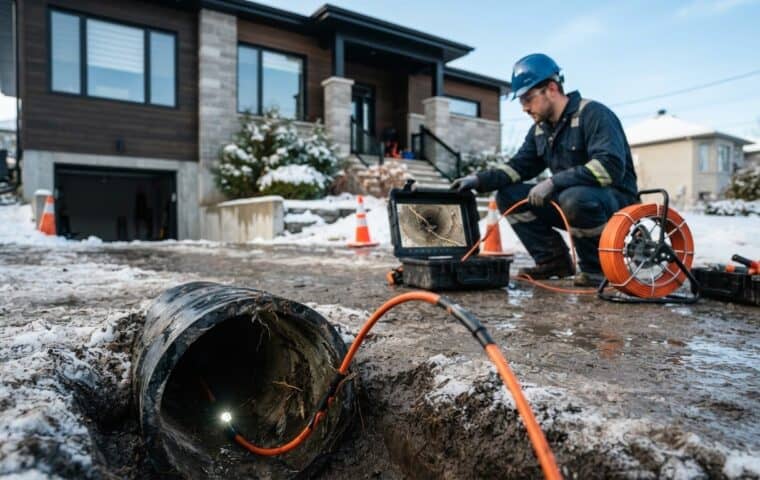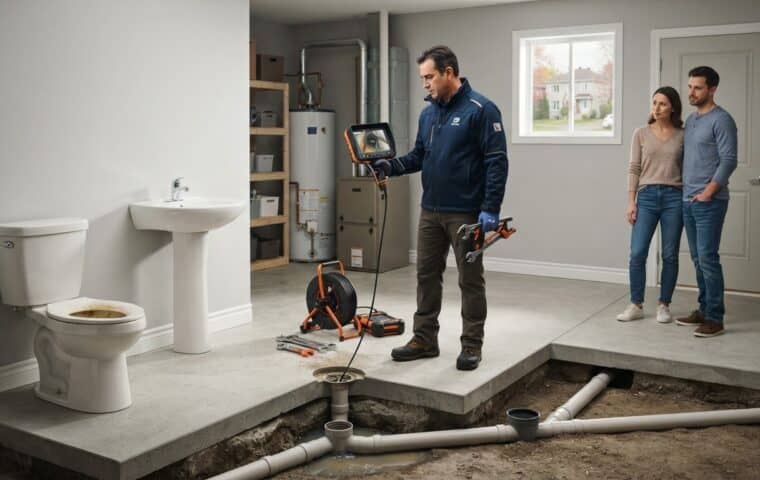
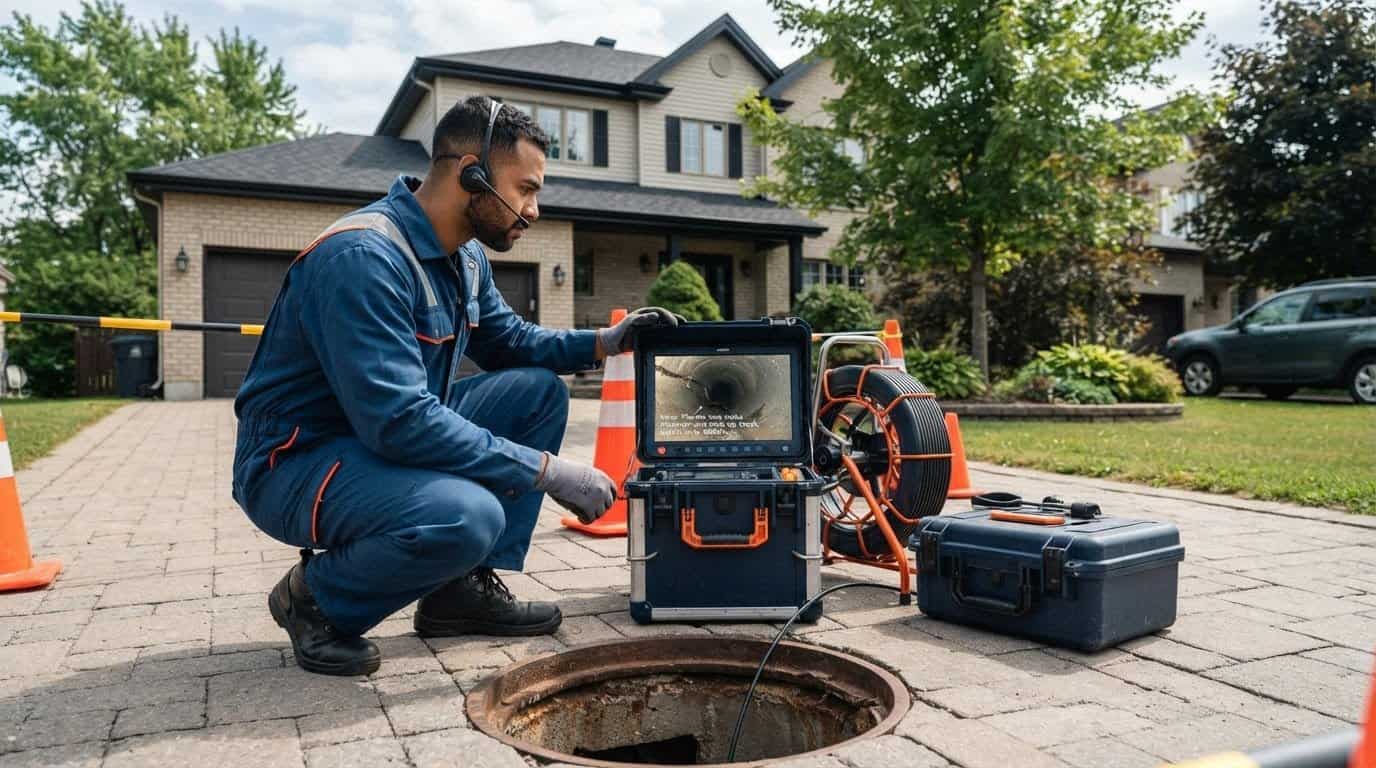
A drain camera that cannot advance does not, by itself, prove that the pipe has collapsed. The stopping point first establishes a limit to the run completed: distinguish what prevented progress, what remains visible and which section is still unknown. The next step should address that particular limitation rather than automatically repeat the same attempt.
This question can arise after an inspection connected with a property purchase, recurring symptoms or a check of a buried pipe. Here is how to discuss an incomplete result with the professional without turning a stopped camera into a diagnosis or attempting to free the equipment yourself.
Key takeaways
- A camera that cannot advance, an unreadable image and an unusable access point are different limitations.
- The completed portion can provide useful observations even when the assignment could not be finished.
- An unseen section should remain identified as unexamined; its condition cannot be inferred from earlier images.
- Before another attempt, ask what will change and which question the new attempt should resolve.
- Major repairs need supporting findings, rather than only the fact that the camera could not continue.
Identify the inspection’s exact limitation
Start by requesting a description of what happened. “The camera will not pass” may summarize several situations that call for different follow-up. The owner does not need to choose the tool: they need to understand which information is missing and why it could not be obtained during the visit.
The camera cannot move farther
The head stopped during the run. The useful question is whether the image shows what lies in front of it. Resistance felt while advancing the cable and an obstacle clearly documented on video are different kinds of evidence. Ask for precise wording: an observed obstruction, a change in direction that was difficult to negotiate, or an undetermined reason for stopping.
Do not replace cautious wording with a stronger conclusion when describing the visit to someone else. If the technician says “the reason for stopping remains to be confirmed,” passing that on as “the sewer has collapsed” changes the entire case. Keep the original explanation together with the corresponding video sequence so that another professional can assess the same information.
The camera advances, but the walls are difficult to see
A camera can move through a pipe without providing enough visibility for a useful examination. An obscured view does not become interpretable simply because the distance counter shows a long run. Ask which parts of the section could actually be examined and whether the limitation affected the whole image or only a particular area.
Quebec’s CERIU guide to sewer video inspections (French) discusses conditions that allow or prevent a conclusive analysis in its network inspection context. That specialized framework does not turn a residential visit into a standardized municipal inspection. It does reinforce the need to distinguish travelling through a pipe from obtaining useful observations of it.
The limitation concerns the access point
The intended pipe may not be reachable through the planned access. In that situation, the result is not an observation of the entire pipe interior. Ask whether no run was possible or whether another section was examined instead. A different access point can change the scope of the assignment, rather than merely where the equipment is placed on the property.
What the stopping point confirms and what it does not establish
A stop documents what the system and operator could accomplish under the conditions present. To explain its significance, the professional needs to connect that limitation with the images and observations collected. Inability to advance does not automatically establish the nature of a problem, its length or the appropriate correction for the pipe.
A defect may also be visible before the stopping point. That finding does not disappear because the rest of the route is missing. However, keep two explanations separate: “this is the observation at this location” and “this is what could not be examined beyond it.” The first does not describe the condition of the entire second section.
Ask what supports each conclusion. If an obstruction is mentioned, which sequence shows it? If deformation is suspected, which features are visible and which remain uncertain? If the cause is unknown, what check would help distinguish the possibilities? These questions clarify the evidence without requiring you to interpret the footage yourself or decide which technical explanation is correct.
Water that can still drain does not fill the gaps in the images. Conversely, an interrupted inspection does not automatically mean that water cannot circulate through the pipe. Describe fixture behaviour separately from the inspection result. Avoid deliberately running more water to show that “everything works,” especially if water has already backed up somewhere in the building.
Separate observed, partly visible and unexamined sections
To organize the discussion, request a simple breakdown of the run. Three categories help avoid presenting the entire pipe as inspected or, at the other extreme, assuming that the visit provided no useful information at all. The distinction concerns what was actually examined, rather than whether the appointment is labelled complete or incomplete.
- Observed section: the portion where images support the findings described, subject to the stated limitations.
- Partly visible section: a portion reached by the camera where some walls or features remained obscured.
- Unexamined section: the pipe beyond the stopping point or a branch that the camera did not enter.
Connect that breakdown to an access point and direction of travel. “The first half is fine” is insufficient when the total length and endpoint have not been established. Prefer references that the company can explain and connect to the files, rather than an approximate description that another reader may interpret differently.
If locating from the surface is proposed, clarify its purpose. Is the intention to find where the camera stopped, trace part of the route or confirm another reference? The manufacturer separately describes line locating with a SeeSnake inspection system. Locating addresses a position question; it does not make the pipe walls beyond a stopping point visible.
For general network terminology, an overview of sewer systems provides background. For your own file, the professional’s identification of the pipe remains essential: sanitary connection, an interior line or another clearly designated section. The word “sewer” alone does not establish which route was inspected or which parts of the building’s drainage system were excluded.
Why pushing harder is not evidence of competence
An owner may feel that a successful inspection is one where the camera reaches the end at any cost. Protecting equipment and avoiding an aggravated situation are nevertheless part of the limits that must be respected. Ask why the operator chose to stop instead of simply asking them to apply more force until the camera moves again.
SeeSnake’s manufacturer recommendations include not using the camera to clear obstructions. The distinction matters: observing a pipe and treating something that restricts passage are different operations. It does not, however, allow a cleaning method to be selected remotely for your installation simply because the camera stopped during an examination.
Do not try to push the cable, retrieve a trapped head or open an access point to help. An open chamber, operating equipment and a pipe that may contain wastewater call for professional precautions. Your useful contribution is to report symptoms and any products already poured into the drain, then let the person on site explain the proposed next step.
If retrieval becomes difficult or another complication occurs, request an explanation of the actual situation and proposed measures. This guide does not provide a camera recovery procedure. Instructions must depend on the equipment, access and conditions observed on site. Another owner’s account of how equipment was recovered elsewhere is not enough to choose a procedure for your pipe.
What should change before another attempt?
A second visit is easier to understand when the proposal explains what will be different. The change might concern access, viewing conditions, pipe preparation or the method used. It should correspond to the limitation encountered, without an automatic promise that every part of the intended route will then be examined.
A different access point or route
Ask which additional section could become visible from the proposed access. If the camera approaches from another direction, the company should explain how the two runs will be related. Two videos do not necessarily amount to one continuous inspection: an interval can remain unexamined between their stopping points even though both attempts provided useful observations.
Also clarify practical conditions: authorized access, an occupant’s presence, a cleared work area or an earlier intervention. Do not dismantle equipment or remove a cover to prepare for the visit without instructions suited to the installation. Knowing where the company wants to work is different from being asked to open that access yourself.
Preparation before observation
If cleaning is proposed, ask what it aims to remove and how its result will be checked. The objective may be to make an area visible or permit another camera run. However, the word “cleaning” alone does not guarantee that a complete inspection will subsequently be possible or that the original uncertainty will be resolved.
Clarify the sequence of operations and when another decision will be needed. It helps to know whether the company will stop and inform you if a new limitation appears. That discussion avoids discovering afterwards that a narrowly defined initial service expanded into several different interventions without a clear explanation of their individual purposes.
A method better suited to the question
Ask which additional capability is being sought rather than focusing on a product name. A useful proposal explains how the suggested method addresses the earlier stopping point and what it still will not establish. The owner is not expected to order a particular camera size or design a technical equipment arrangement for the company.
If nothing will change, ask why repeating the attempt is nevertheless relevant. There may be a valid reason, but it should be explained. Repeating the same attempt without that explanation does not necessarily reduce uncertainty. The question is what information the new work is expected to add to the file, rather than simply whether another visit can be booked.
Compare proposals after an interrupted inspection
Give each company the same problem to resolve: an unexamined section, an uncertain reason for stopping or a finding that needs confirmation. A cleaning proposal and an additional inspection proposal may answer different questions. Compare their objectives before comparing only their service names, and check whether each company has received the original video and explanation.
For each proposal, clarify the expected outcome, necessary conditions, documents provided and limitations that may remain. Also ask what will happen if the new camera run stops. An honest response may include another assessment stage rather than a guaranteed result. Clear limits make it easier to understand what has been accomplished if the second visit also remains incomplete.
A proposed repair should be separated from information gathering. If opening the ground is recommended, our guide to checks before excavating a sewer line addresses that decision and its preparation. This article concerns the incomplete inspection result that sometimes comes first; it does not repeat a plan for organizing an excavation project.
Keep written explanations with the initial files. If an opinion changes after another observation, retain the change and its reason. A file becomes clearer when readers can distinguish what was suspected at the first visit from what was later confirmed. Updating the conclusion should not remove the earlier evidence that explains how the assessment developed.
An example of follow-up after an unexplained stop
In a fictional example, a camera stops during a run from an interior access point. Images show part of the route, but the reason for stopping cannot be identified. The owner initially receives a verbal explanation that another access point might help. That statement proposes a way to investigate; it is not yet a finding about the hidden section.
A precise request would be: “Which section did we see, which point could not be passed and which additional portion do you hope to examine from the other access? Will the two sequences be connected, and what will remain unknown if they do not meet?” The answer should help define the purpose of the second attempt before it begins.
This request does not dismiss the possibility of a defect. It simply prevents a hypothesis from being treated as proof. After the second attempt, follow-up should explain what changed in the knowledge available, even if a limitation remains. The value of that follow-up lies in identifying what was added, rather than only saying that the camera was used again.
Prepare the decision when the inspection concerns a purchase
If the visit takes place before buying a home, promptly share the incomplete result with the professionals assisting you. Do not present an unseen section as an approved sewer line, and do not turn uncertainty into a certain repair either. Keep the actual observations and outstanding questions together when explaining the situation.
Our guide to sewer inspection before buying a home explains when this specialized check may complement a building inspection. The question here is which information remains missing after an attempt and how to obtain it. Effects on transaction conditions or deadlines should be discussed with the appropriate professionals handling your particular file, rather than inferred from a general plumbing article.
For another drain camera inspection, send Plomberie Laval the files received and the exact limitation reported. The company can discuss the assignment according to the available access and on-site conditions. Keep a copy of the first video: starting another observation should not erase the history of what was attempted and found previously.
Frequently asked questions
Does a camera stopping prove that the pipe is broken?
No. Explain the stop using the images and conditions of the run. A defect may be visible, but resistance without an interpretable view is not enough to determine its nature. Ask which information is observed and which part remains a hypothesis requiring confirmation.
Is the portion already recorded still useful?
Yes, when it is identifiable and sufficiently visible for the findings stated. An incomplete inspection can provide information about a particular section. It does not establish the condition of sections that were not examined or remained obscured, even when the earlier images appear reassuring.
Is cleaning always necessary before recording again?
Not simply because the camera stopped. Preparation should correspond to the limitation encountered and the pipe’s condition. Ask what the proposed cleaning aims to make possible and how the company will assess its result before another stage. That explanation connects the preparation with the missing information.
Can two access points always cover the whole pipe?
No. Ask how the two routes will be connected in the observations. Even with two runs, a section may remain unseen. Distances and endpoints need to be understood in context, without assuming that the videos meet simply because the camera entered from two different locations.
Can drainage performance replace the missing images?
Observed flow and examination of the pipe walls provide different information. Water that can drain does not automatically describe the condition of an unexamined portion. Report normal fixture behaviour without deliberately creating tests that could cause an overflow, especially when a backup has already been observed.
What should I send before requesting another inspection?
The original video, written account, access used, reported reason for stopping and outstanding question. Add current symptoms and previous interventions. The aim is to prepare a different or more targeted check rather than start again without knowing what happened during the first attempt or which limitation still needs to be addressed.