A sewer smell in the basement can be alarming. So can a gurgling floor drain. Neither sign, on its own, proves that sewage is backing up. The clearest observation is water rising through an opening in the drainage system—a floor drain, shower or toilet—when it should be leaving the building.
Even when you see water come up, the cause remains uncertain. Wastewater generated inside the building may be unable to get past a restriction, or flow may be returning from farther downstream. A puddle near a drain could even have another source. This guide helps you weigh the evidence, describe what actually happened and avoid choosing a repair before the cause has been checked.
Key takeaways
- Seeing water emerge from a plumbing fixture is stronger evidence than an odour, a damp patch or a noise on its own.
- Clear-looking water is not proof of its source or safety if it has emerged from a drainpipe.
- Where water first appeared is often more useful than the size or position of the puddle found later.
- Rain, the number of affected fixtures and previous incidents provide context. None alone establishes whether the problem is private or municipal.
- During an active backup, stop adding water to the drainage system, avoid contact and keep people and pets out of the area.
- Drain clearing, a backwater valve and pipe repair address different causes. The right choice follows the findings.
Table of contents
- What actually counts as a sewer backup?
- Which signs carry the most weight?
- Which clues can be misleading?
- What types of causes should be considered?
- How can you record the facts without causing another overflow?
- What should you do during and after a backup?
- How can the cause be confirmed?
- Frequently asked questions
- Start with the observation, then choose the repair
What actually counts as a sewer backup?
A building’s drainpipes collect wastewater from toilets, sinks, showers and other fixtures. Normally, that water moves away from the property. If it cannot continue along its usual path, or if flow reverses, water may rise through an opening connected to the drainage system. A basement shower, toilet or floor drain can be the first place where the problem becomes visible.
People often use “sewer backup” to describe any dirty water that returns indoors. It helps to separate what you have seen from why it happened. A visible backup does not yet show whether a pipe is clogged, damaged or affected by conditions farther downstream. Nor does it establish that an existing backwater valve has failed. Those are different possibilities requiring different checks.
Not every wet basement involves the sewer. Water may come through a window well or foundation opening, spill from a sump pit or leak from a supply pipe. Our guide to water in the basement after heavy rain examines those entry points in detail. The question here is narrower: how strong is the evidence that water has come back through the building’s wastewater drainage system?
That question matters because the first visible symptom may not reveal where the underlying problem lies. Water can travel across a sloped floor after it appears. A lower fixture may overflow even when a restriction is elsewhere. Describing the observation precisely is therefore more valuable than naming a component you have not inspected.
Which signs carry the most weight?
You actually see water emerge from a drain or fixture
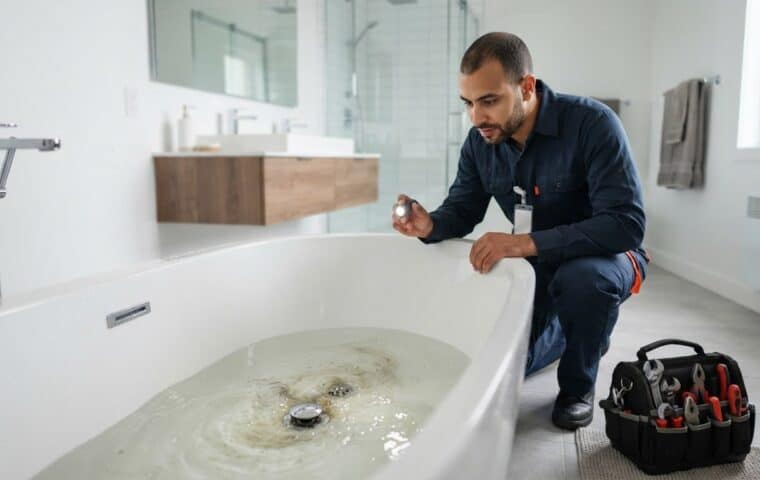
This is the most direct sign. Water rises inside a shower although its faucet is off, comes through a floor-drain grate or enters a toilet bowl without that toilet being flushed. Tell the plumber what you saw, where you stood and which fixture reacted first. You do not need to identify the water’s origin by smell or touch.
The word first matters. Minutes later, water may have spread across the floor and pooled around several fixtures. A photo taken after the event documents damage, but it may not identify the original entry point. If you did not see water emerge from the drain, say so: “I found water around the floor drain, but I didn’t see it come out.” That distinction prevents a puddle’s location from being mistaken for a confirmed source.
If the water is still rising, gathering more evidence is not the priority. Stay clear of the affected area and stop using fixtures that may discharge into the line. Do not deliberately run water to obtain a better video or reproduce what you saw once.
Debris or residue appears inside a fixture
Visible waste, debris or residue left inside a shower or floor drain can strengthen the suspicion that water has returned through the drainage system. Their absence does not rule it out. Water rising through a drain may look fairly clear, especially if some of the volume originated at another fixture before entering the shared drainage system.
Colour, odour and debris describe the incident; they are not a reliable safety test. Water that has passed through a wastewater pipe should be treated cautiously even without a strong smell. Keep children and pets away. Do not lean over the opening to smell the water, collect a sample or test it with your hands.
You know the sequence of events
“It happens sometimes” gives less information than a short timeline. Was water already rising when you discovered it? Had anyone recently used the plumbing? Did the level stop increasing after everyone stopped using the fixtures? Did the water continue to appear? Write down what you remember rather than creating another event to answer a missing question.
In a duplex or apartment building, the person in the basement may not know a fixture was operating on another floor. Other occupants can help complete the timeline, provided nobody tests the system during an active overflow. If the main observation is that using one fixture makes water rise in another, the separate guide Why Is Water Backing Up Into Another Drain? explains that pattern. This article focuses on the strength and limits of the evidence before anyone assigns a cause to the backup.
The same direct sign recurs
A previous incident becomes useful when it is described accurately. “The basement was wet twice” is less specific than “I saw water rise through the floor drain on both occasions.” Keep the date, photographs and any service notes. A repeated pattern may justify further investigation, but it does not prove that the pipe is broken or that the same cause produced both incidents. Conditions inside or outside the building can change between events.
Which clues can be misleading?
A sewer odour with no visible water
An odour can accompany a drainage issue, but it does not establish that wastewater has risen into the room. It can occur without water on the floor or a blocked main sewer line. Note where it seems strongest, when it began and whether it persists. “The smell appeared near the basement bathroom yesterday” is more useful than “the street sewer must be blocked.”
If you also see a water level rise or material come out of a fixture, the visible backup becomes the main fact to report. Without that evidence, several other explanations for the odour remain possible. Its intensity alone does not locate a defect or predict that a backup will occur.
Gurgling or a slow drain
Changes in drainage or noise can indicate that water and air are not moving normally. They may precede a more serious blockage, but a single noise does not identify the affected pipe. One slow fixture does not necessarily implicate the building sewer. Our guide to a gurgling drain looks at the sound and its possible causes when there is no active backup.
Here, ask a different question: was the noise followed by water actually rising from a fixture? If so, note the order. If not, describe the noise as a symptom to investigate, not proof that a sewer backup has already occurred. Avoid combining separate observations into a diagnosis that neither one establishes.
Water found near a floor drain
A puddle surrounding a floor-drain grate may have come from the drain. It may also have run across the floor from a wall, window, appliance or sump. Water collects at low spots, and floor drains are usually installed at or near one. The place where water settles is not necessarily its point of entry.
From a dry, safe location, look for a visible trail from another source and note whether the water level inside a fixture has changed. Do not remove a drain grate, cleanout cap or valve cover to seek confirmation. If the water has disappeared before you notice the marks, retain that uncertainty in your account. A professional can then examine the competing possibilities without being led by an assumed source.
Heavy rain or a neighbour’s report
Heavy rain is useful context, especially if water appeared without known indoor plumbing use. It does not prove that the municipal sewer caused the problem. Likewise, a neighbour reporting a wet basement is worth mentioning, but their water may have entered through a different route. A private restriction and exterior conditions can also exist at the same time.
The City of Laval distinguishes water accumulation, infiltration and sewer backup in its official English guidance. That distinction matters before requesting a particular repair or assigning responsibility to the property owner or the City. Elsewhere on the North Shore or in Montreal, follow the guidance of the municipality responsible for that address.
What types of causes should be considered?
Flow is restricted on the building side
Accumulated material or an object can narrow a fixture branch or another part of the private drainage route. Depending on the pipe layout, wastewater may rise through an opening lower than the fixture that produced it. A single backup cannot tell you what formed a clog, exactly how far away it lies or which clearing method will be appropriate.
If water drains normally after a blockage is cleared, the immediate passage has been restored. That result does not always establish why the restriction formed. The question becomes more important if a similar backup returns. A one-time obstruction and a pipe condition that repeatedly traps material may require different follow-up.
It is also possible for more than one restriction to exist. A partial buildup near a fixture and a separate issue farther along can influence what appears at the lowest opening. Symptoms alone should not be used to promise that clearing one visible drain will settle the entire matter.
Pipe condition encourages recurring obstructions
Roots, an offset joint, a low spot or a damaged section can retain material and contribute to repeated incidents. None can be identified from the colour of water on the floor. A single backup does not justify assuming that the line must be excavated or replaced from end to end.
A useful question is, “What defect was actually seen, where is it, and does it explain this pattern?” The guide Does Your Sewer Line Need Replacing? examines that later decision when backups recur after clearing. This article does not replace a documented assessment of the pipe’s condition.
Flow is attempting to return from farther downstream
Reverse flow can involve a part of the drainage system beyond the building. A backup during substantial rainfall, no known indoor water use and simultaneous reports from nearby properties may guide the investigation. They do not, by themselves, locate where flow changed direction. A private pipe may also be restricted while the exterior network is carrying an unusually large volume of water.
A backwater valve addresses a specific risk: water attempting to return through the branch it protects. It does not remove a blockage on the building side or stop water entering through a foundation crack. For the Quebec technical framework, the Régie du bâtiment du Québec explains sewer-backup protection and backwater valves in French. To understand a device already in your building, read which fixtures a backwater valve actually protects.
The water did not come through the sewer
A wet basement may involve foundation drainage, a sump pump, an opening in the building envelope or a pressurized water-supply leak. Clearing the sanitary sewer would not correct those entry routes. Confirming where water entered therefore comes before choosing an intervention. Finding one source does not automatically exclude a second problem, particularly after extensive rainfall or when a building already has a drainage concern.
The goal is not to memorize every failure a drainage system could have. It is to keep plausible alternatives open until the observation and the inspection support one explanation. That helps avoid choosing equipment based on a symptom it cannot address.
How can you record the facts without causing another overflow?
A short note written from memory in a dry area is more valuable than a series of plumbing tests. Record:
- First known sign: odour, noise, slow drainage or visible water, with the approximate time.
- First observed entry point: the fixture or part of the floor. Say clearly if you did not see water emerge.
- Affected fixtures: those that actually changed level or overflowed, without operating others to check them.
- What happened next: whether the level continued to rise, stabilized or fell after water use stopped.
- Context: rain, known normal fixture use, other occupants, a power outage or another observed event.
- History: approximate dates of prior incidents, drain clearing, repairs and inspection reports.
This approach separates “I saw it” from “I think it happened.” Both can be shared, but they carry different weight. A photograph of visible marks or accessible covers may help document the loss if it can be taken without approaching wastewater or wet electrical equipment. An old invoice or camera report can be valuable even when you cannot interpret it yourself.
Do not pour water into a drain, flush again or start a washing machine simply to film the reaction. You may add more volume to a pipe that is already struggling to drain. Do not open a cleanout or backwater-valve cover while the line may be full; its contents could be released suddenly. If a chemical drain opener was used before the backup, tell the person who will work on the line.
Keep observations tied to the correct time. A photograph of a dried floor taken the following morning establishes that an area was affected; it may not show how or where the water entered. A neighbour’s account is useful context, but it does not replace an observation from your property. This kind of precision makes the next assessment more useful without requiring you to diagnose the plumbing.
What should you do during and after a backup?
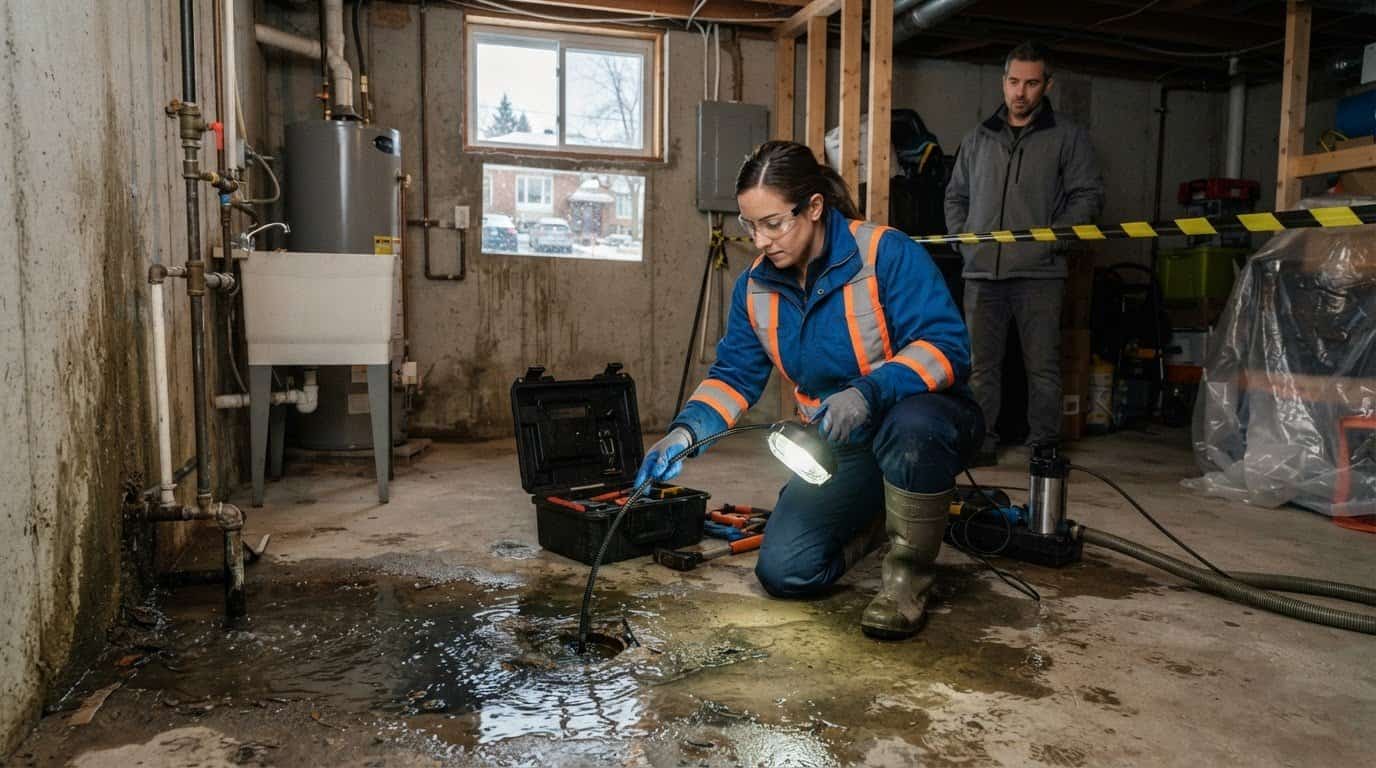
While water is rising, stop using fixtures connected to the drainage system. In a multi-unit building, inform the other occupants so they can also limit discharge. Keep children and pets away. Do not cross standing water to rescue belongings or reach an access cover in the floor. Protecting people takes priority over documenting the exact volume.
Electrical equipment sets a firm boundary. If water may reach an outlet, appliance, cord or panel, stay away. Do not touch a breaker panel if reaching it requires walking through water. Ask for qualified assistance from a safe location. Clear-looking water near electrical equipment is still a hazard.
Once the water has stopped rising, photograph accessible damage from a safe position and contact your insurer if property has been affected. Cleaning and drying require precautions appropriate to possible contamination. The Government of Quebec’s English guidance on cleaning up your house says to check for electrical and structural hazards before entering and to prepare an inventory of damage. A stopped backup does not make a hazardous area safe to clean.
If a street catch basin is overflowing or several properties seem affected, report those observations to the municipality as well. In Laval, use the City’s 311 and online services for local instructions. At an address in another municipality, use its official contact route. Making a report does not, on its own, determine who will perform or pay for work on a particular service connection.
Keep a separate record of what happened after the incident: when the water receded, which fixtures remained unused, whom you contacted and any instructions received. This can help the plumber, municipality and insurer understand the sequence. Do not discard service reports or assume that a temporary return to normal flow proves the underlying cause has been removed.
How can the cause be confirmed?
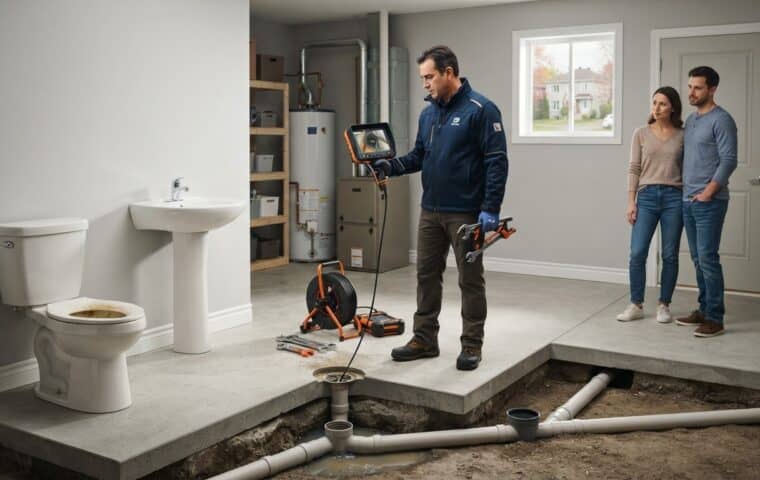
An assessment begins with an accurate account of the event. A plumber can compare the timeline, affected fixtures and visible access points with the building’s drainage layout. The next step may be clearing an obstruction, examining an accessible pipe or investigating another source of water. The method follows the findings, not merely the word “backup” used when the problem was reported.
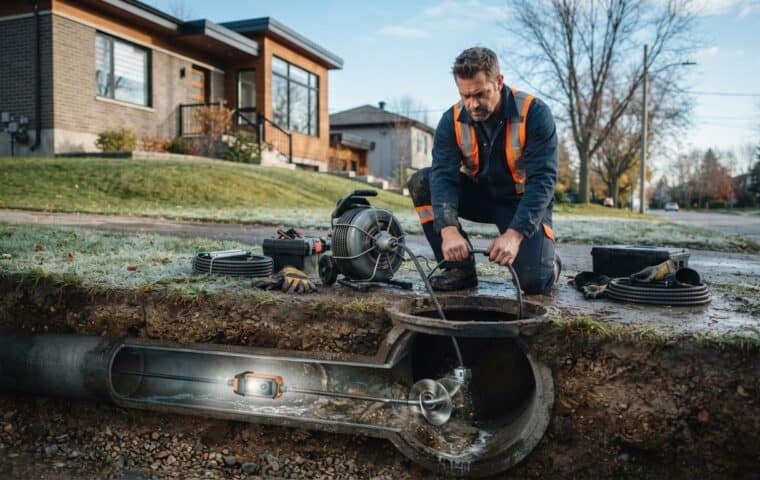
A drain camera inspection can show the inside of the section the camera can travel through. It may document roots, buildup, an offset joint or visible damage, especially when incidents recur. It does not automatically inspect every branch, the outside of the pipe or any section beyond a complete blockage. No defect visible in limited footage is not a guarantee that the entire system is sound.
If work is recommended, ask what section was examined, what was directly observed and what remains an inference. Has flow been restored? Is the reason for recurrence understood? Does the proposed work address the finding or only a suspected possibility? These questions separate stabilizing an immediate overflow from preventing a future one. Clearing a drain, changing backwater-valve protection and repairing a structural defect are different decisions.
The division between a private service connection and public infrastructure depends on the route and location of the problem, along with local rules. Symptoms inside a house do not draw that boundary. Where street infrastructure or several properties may be involved, inform the City while the building is being assessed and keep the resulting records. Conclusions about responsibility follow the relevant findings and municipal procedure.
Frequently asked questions
Does an overflowing toilet mean the main sewer is backing up?
No. A toilet bowl may overflow because of a restriction close to that fixture or a problem farther along the drainage system. Note whether its level rose only after a flush or without that toilet being used. Do not flush it again to compare the possibilities.
Is a persistent sewer smell a reliable early warning?
It is a reason to investigate, but it does not reliably predict a backup. On its own, an odour confirms neither a main-line obstruction nor wastewater rising into the basement. Its location and any other changes provide the context needed to assess it.
Can I rule out a backup if the water has disappeared?
No. Water may recede after an intermittent episode or when fixtures stop discharging. Marks may also have been left by another source. Keep your timeline and photographs taken safely; the absence of water at the time of the visit does not settle its origin.
Can the colour tell me whether water came from the sewer?
Not reliably. Dark water with visible waste raises suspicion, but clearer water may also emerge from a drain after passing through a wastewater pipe. Conversely, an infiltration can pick up dirt while crossing a basement floor. The observed entry point carries more weight than colour alone.
Does heavy rain prove the City must repair the problem?
No. Rain may coincide with several different problems in or around a building. Report signs involving public infrastructure to the municipality while also having the plumbing and water’s entry point assessed. The defect’s location and applicable rules must be established before responsibility is assigned.
Does a backwater valve rule out a backup?
No. You need to know which fixtures connect to the protected branch, where the valve sits and whether it is functioning. A blockage on the building side or water entering through the foundation involves another mechanism. A visible access cover in the floor does not establish that every fixture is protected.
Should excavation be requested right away?
No. Water rising indoors does not establish that an underground pipe is broken or that the yard must be opened. First determine how the water entered, make the area safe and document the likely cause. Major repairs should follow adequate findings about the defect and its extent.
Start with the observation, then choose the repair
To recognize a possible sewer backup, begin with what was directly observed: water emerging from a drain or fixture, where it appeared first and what happened when the plumbing was no longer used. Add less precise clues—odour, noise, rain and previous incidents—without treating them as proof of a particular cause.
If water is rising now, stay out of the affected area, limit wastewater discharge and describe the event to a plumber. Those observations help determine which checks are needed. The cause, the repair and any question of responsibility should be based on the drainage system actually examined and the municipality’s relevant instructions.
SEO overlap: This article assesses how reliable each sign of a suspected backup is. The existing cross-drain guide owns fixture-to-fixture reactions; the basement rain guide owns the broader search for water entry points. The backwater valve and camera inspection pages retain their service intent. Some shared symptom vocabulary is necessary, but the article’s central question and detailed sections remain distinct.